Al-Biltagi Mohammed, El Amrousy Doaa, El Ashry Heba, Maher Sara, Mohammed Mahmoud A, Hasan Samir
Department of Pediatrics, University Medical center, King Abdulla Medical City, Arabian Gulf University, Manama 26671, Bahrain.
Department of Pediatrics, Faculty of Medicine, Tanta University, Tanta 31527, Al Gharbia, Egypt.
World J Clin Pediatr. 2022 Jul 9;11(4):330-340. doi: 10.5409/wjcp.v11.i4.330.
Irritable bowel syndrome (IBS) is a highly prevalent gastrointestinal disorder in children and adults, which increased over the past twenty years. The Mediterranean diet is a well-known diet full of antioxidants and anti-inflammatory ingredients.
To evaluate the safety, tolerability, and effects of adherence to the Mediterranean diet on disease patterns in children and adolescents with IBS.
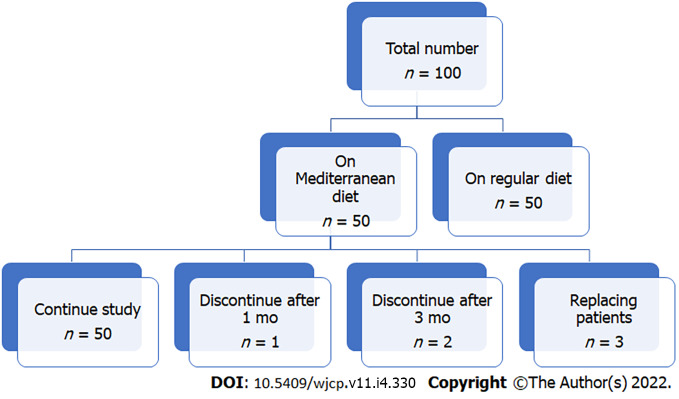
This prospective, cross-sectional case-controlled study included 100 consecutive IBS patients diagnosed according to Rome IV criteria, aged 12-18 years. Patients were subdivided into two groups (50 patients each); Group I received a Mediterranean diet, and Group II on their regular diet for six months. Besides IBS scores (IBS-SSS, IBS-QoL, and total score), different clinical and laboratory parameters were evaluated at the start and end of the study.
The Mediterranean diet was safe and well-tolerated in IBS patients. IBS children and adolescents with good adherence to the Mediterranean diet (KIDMED Score ≥ 8 points); group I showed significant improvement in IBS scores. IBS-SSS in the Mediterranean diet group was 237.2 ± 65 at the beginning of the study and decreased to 163.2 ± 33.8 at the end of the study ( < 0.001). It did not show a significant improvement in the group with a regular diet (248.3 ± 71.1 at the beginning of the study compared to 228.5 ± 54.3 at the study end with < 0.05). The mean IBS-SSS in the Mediterranean diet group significantly improved compared with the group with a regular diet. Mean IBS-QoL in group I improved from 57.3 ± 12.9 at the start of the study to 72.4 ± 11.2 at the study end ( < 0.001) and significantly improved when compared to its level in group II at the study end (59.2 ± 12.7 with < 0.001), while group II showed no significant improvement in IBS-QoL at the study end when compared to the beginning of the study (59.2 ± 11.7 with >0.05). The mean total IBS score in group I became 28.8 ± 11.2 at the end of our study compared to 24.1 ± 10.4 at the start ( < 0.05) and significantly improved when compared to its level in group II at the end of the study (22.1 ± 12.5 with < 0.05), while in group II, non-significant improvement in the total score at the end of our study compared to its mean level at the start of the study (22.8 ± 13.5 with > 0.05).
The Mediterranean diet was safe and associated with significant improvement in IBS scores in children and adolescent patients with IBS.
肠易激综合征(IBS)是一种在儿童和成人中高度流行的胃肠道疾病,在过去二十年中发病率有所上升。地中海饮食是一种众所周知的富含抗氧化剂和抗炎成分的饮食。
评估坚持地中海饮食对IBS儿童和青少年疾病模式的安全性、耐受性和影响。
这项前瞻性横断面病例对照研究纳入了100例根据罗马IV标准诊断的连续IBS患者,年龄在12至18岁之间。患者被分为两组(每组50例);第一组接受地中海饮食,第二组维持常规饮食六个月。除IBS评分(IBS-SSS、IBS-QoL和总分)外,在研究开始和结束时评估不同的临床和实验室参数。
地中海饮食对IBS患者安全且耐受性良好。IBS儿童和青少年中对地中海饮食依从性良好(儿童地中海饮食质量指数评分≥8分);第一组IBS评分有显著改善。地中海饮食组的IBS-SSS在研究开始时为237.2±65,在研究结束时降至163.2±33.8(<0.001)。常规饮食组未显示出显著改善(研究开始时为248.3±71.1,研究结束时为228.5±54.3,P<0.05)。与常规饮食组相比,地中海饮食组的平均IBS-SSS有显著改善。第一组的平均IBS-QoL从研究开始时的57.3±12.9提高到研究结束时的72.4±11.2(<0.001),与研究结束时第二组的水平相比有显著改善(59.2±12.7,P<0.001),而第二组在研究结束时与研究开始时相比,IBS-QoL无显著改善(59.2±11.7,P>0.05)。在我们的研究结束时,第一组的平均IBS总分变为28.8±11.2,而开始时为24.1±10.4(P<0.05),与研究结束时第二组的水平相比有显著改善(22.1±12.5,P<0.05),而在第二组中,研究结束时总分与研究开始时的平均水平相比无显著改善(22.8±13.5,P>0.05)。
地中海饮食对IBS儿童和青少年患者安全,且与IBS评分的显著改善相关。