Department of Psychiatry, University of Maryland School of Medicine, Baltimore, Maryland, USA.
Department of Psychiatry, University of Pennsylvania, Perelman School of Medicine, Philadelphia, Pennsylvania, USA.
Alcohol Clin Exp Res. 2022 Oct;46(10):1900-1912. doi: 10.1111/acer.14932. Epub 2022 Sep 11.
In a previous study, ondansetron, a serotonin 5-HT receptor antagonist, reduced drinking intensity (drinks/drinking day [DPDD]) among European-ancestry (EA) participants with moderate-to-severe alcohol use disorder (AUD) and variants in genes encoding the serotonin transporter (SLC6A4) and 5-HT (HTR3A), and 5-HT (HTR3B) receptors. We tested whether (1) ondansetron reduces DPDD among individuals of either European or African ancestry (AA), and (2) that reductions in DPDD are greatest among ondansetron-treated individuals with population-specific combinations of genotypes at SLC6A4, HTR3A, and HTR3B.
In this 16-week, double-blind, placebo-controlled, parallel-group clinical trial, adults with AUD were randomized to receive low-dose oral ondansetron (0.33 mg twice daily) or placebo stratified by "responsive" versus "nonresponsive" genotype defined using population-specific genotypes at the three genetic loci. Generalized estimating equation regression models and a modified intent-to-treat analysis were used to compare the treatment groups on the primary outcome-DPDD-and two secondary outcomes-heavy drinking days per week [HDD] and drinks per day [DPD] across the 16 weeks of treatment.
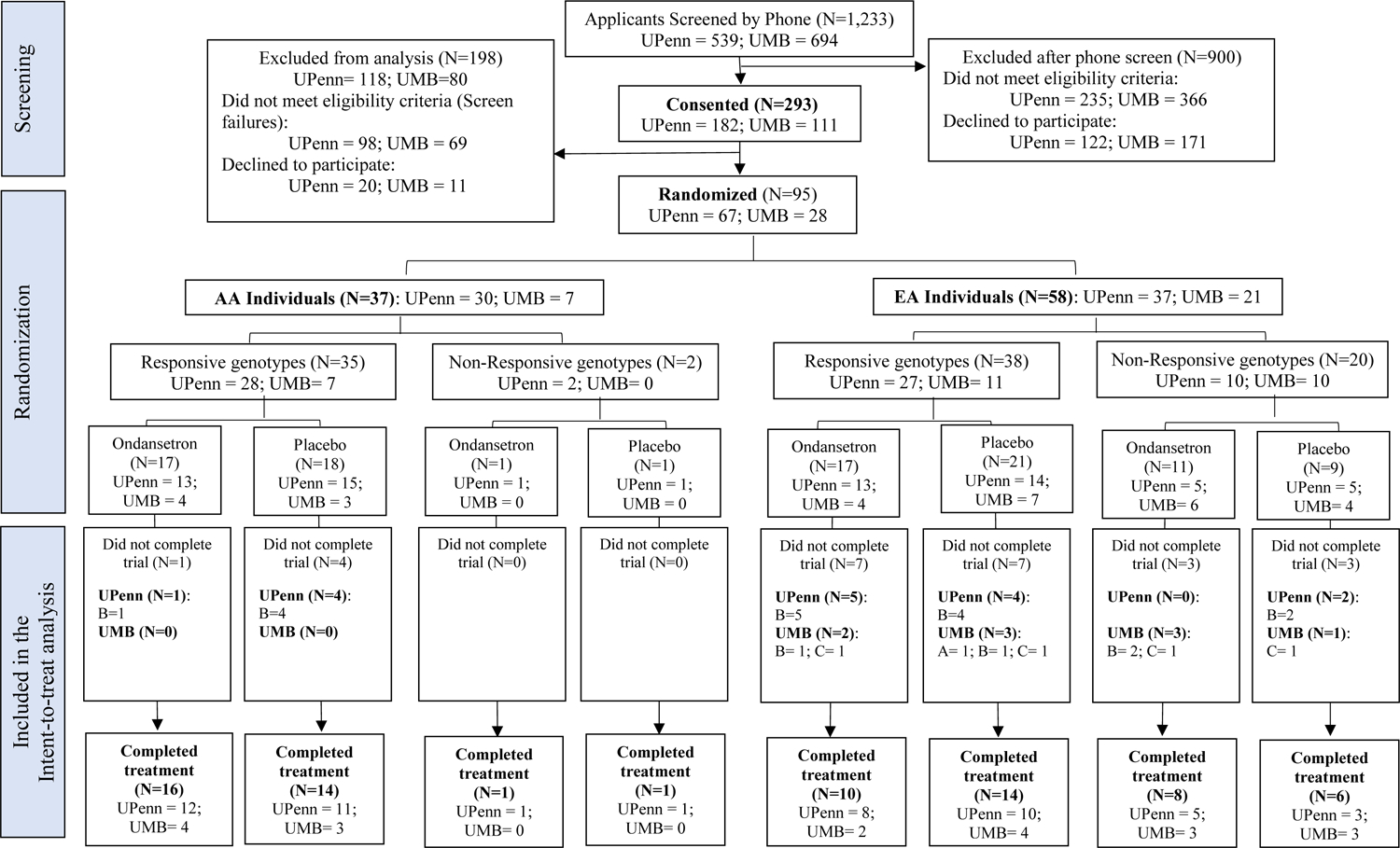
Of 296 prospective participants screened, 95 (58 EA and 37 AA) were randomized and received at least one dose of study medication. In the modified intent-to-treat analysis, the ondansetron group averaged 0.40 more DPDD (p = 0.51), 1.35 times as many HDD (p = 0.16), and 1.06 times as many DPD (p = 0.59) as the placebo group. There were no significant interactions with genotype. There were no study-related serious adverse events (AEs) and similar proportions of participants in the two treatment groups experienced AEs across organ systems.
We found no evidence that low-dose oral ondansetron is beneficial in the treatment of AUD, irrespective of genotype, thus failing to confirm prior study findings. However, the study was underpowered to identify medication by genotype interactions.
在之前的研究中,一种血清素 5-HT 受体拮抗剂昂丹司琼减少了欧洲血统(EA)参与者的饮酒强度(饮酒量/饮酒日[DPDD]),这些参与者有中度至重度酒精使用障碍(AUD)和编码血清素转运体(SLC6A4)和 5-HT(HTR3A)、5-HT(HTR3B)受体的基因的变体。我们测试了(1)昂丹司琼是否减少了 EA 和非裔美国人(AA)个体的 DPDD,以及(2)在 SLC6A4、HTR3A 和 HTR3B 三个遗传位点具有特定人群组合基因型的昂丹司琼治疗个体中,DPDD 的减少程度最大。
在这项为期 16 周、双盲、安慰剂对照、平行组临床试验中,将 AUD 成年人随机分为低剂量口服昂丹司琼(0.33mg,每日两次)或安慰剂组,根据三个遗传位点的特定人群基因型定义“反应性”与“非反应性”基因型进行分层。使用广义估计方程回归模型和修改后的意向治疗分析比较了治疗组在主要结局(DPDD)和两个次要结局(每周重度饮酒天数[HDD]和每日饮酒量[DPD])上的治疗效果。
在 296 名被筛选的预期参与者中,有 95 名(58 名 EA 和 37 名 AA)被随机分配并接受了至少一剂研究药物。在修改后的意向治疗分析中,昂丹司琼组平均 DPDD 增加 0.40(p=0.51),每周 HDD 增加 1.35 倍(p=0.16),每日 DPD 增加 1.06 倍(p=0.59),安慰剂组。基因型与药物无显著交互作用。两组均无与研究相关的严重不良事件(AE),两组参与者在各个器官系统中经历的 AE 比例相似。
我们没有发现低剂量口服昂丹司琼对 AUD 治疗有益的证据,与基因型无关,因此没有证实之前的研究结果。然而,该研究在确定药物与基因型相互作用方面的能力不足。