Kwon H Y, Yoon H G, Park S M, Lee D B, Shi D, Wu Y Z, Choi J W, Won C
Center for Spintronics, Korea Institute of Science and Technology, Seoul, 02792, South Korea.
Department of Physics, Kyung Hee University, Seoul, 02447, South Korea.
Sci Rep. 2022 Sep 2;12(1):15026. doi: 10.1038/s41598-022-19312-3.
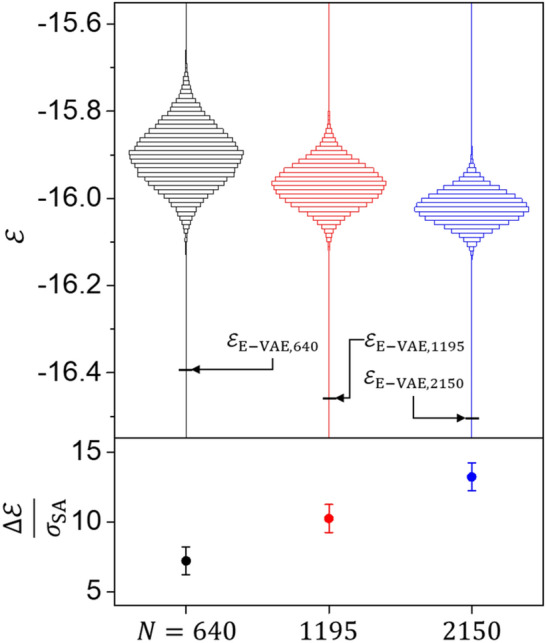
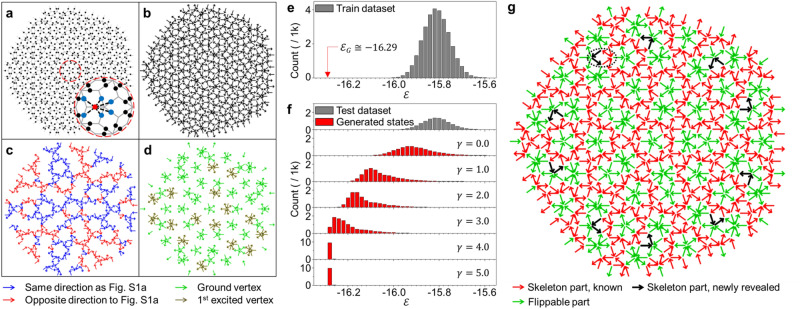
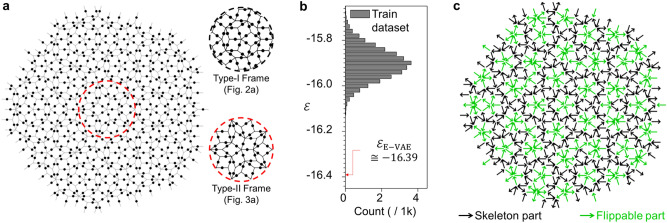
Searching for the ground state of a given system is one of the most fundamental and classical questions in scientific research fields. However, when the system is complex and large, it often becomes an intractable problem; there is essentially no possibility of finding a global energy minimum state with reasonable computational resources. Recently, a novel method based on deep learning techniques was devised as an innovative optimization method to estimate the ground state. We apply this method to one of the most complicated spin-ice systems, aperiodic Penrose P3 patterns. From the results, we discover new configurations of topologically induced emergent frustrated spins, different from those previously known. Additionally, a candidate of the ground state for a still unexplored type of Penrose P3 spin-ice system is first proposed through this study. We anticipate that the capabilities of the deep learning techniques will not only improve our understanding on the physical properties of artificial spin-ice systems, but also bring about significant advances in a wide range of scientific research fields requiring computational approaches for optimization.
寻找给定系统的基态是科学研究领域中最基本和经典的问题之一。然而,当系统复杂且庞大时,这往往会成为一个棘手的问题;使用合理的计算资源基本上不可能找到全局能量最小状态。最近,一种基于深度学习技术的新方法被设计出来,作为一种创新的优化方法来估计基态。我们将此方法应用于最复杂的自旋冰系统之一——非周期性彭罗斯P3图案。从结果中,我们发现了拓扑诱导的涌现受挫自旋的新构型,这与之前已知的不同。此外,通过这项研究首次提出了一种尚未探索的彭罗斯P3自旋冰系统基态的候选者。我们预计,深度学习技术的能力不仅将增进我们对人工自旋冰系统物理性质的理解,还将在广泛需要计算优化方法的科学研究领域带来重大进展。