Department of Physical Therapy, Kennedy Krieger, Baltimore, MD, USA.
Department of Pediatric Cardiology, Taussig Heart Center, Johns Hopkins University School of Medicine, Baltimore, USA.
Orphanet J Rare Dis. 2022 Sep 2;17(1):336. doi: 10.1186/s13023-022-02469-5.
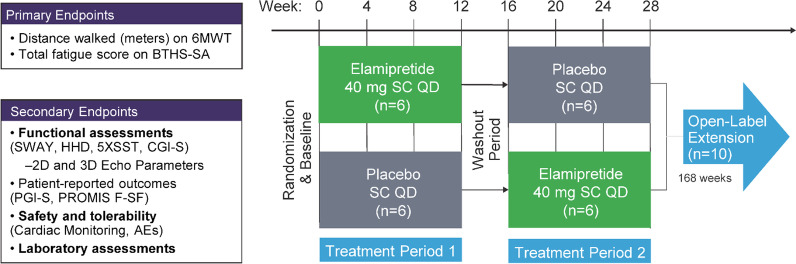
Natural history studies are increasingly recognized as having an important role in drug development for rare diseases. A phase 3, observational, retrospective, and non-interventional study was designed to establish a natural history control (NHC) cohort of patients with Barth syndrome (BTHS) to provide further analysis of the efficacy of elamipretide observed in an open-label extension (OLE) phase of the TAZPOWER trial, a clinical trial that tested the efficacy of 40 mg daily of elamipretide in patients with BTHS.
This was a retrospective, non-interventional study. A propensity score model was used to compare elamipretide-treated patients and NHCs. The analysis included 8 patients from the TAZPOWER OLE and 19 untreated NHCs (including 12 with serial echocardiographic assessments).
For the 6-min walk test (6MWT, primary endpoint), the least squares (LS) mean difference between groups was 79.7 m (P = 0.0004) at week 64 and 91.0 m (P = 0.0005) at week 76 in favor of elamipretide. Significant improvements in muscle strength (secondary endpoint), as assessed by handheld dynamometry (HHD) were also observed with elamipretide, with LS mean differences of 40.8 Newtons at 64 weeks (P = 0.0002) and 56.7 Newtons at 76 weeks (P = 0.0005). Patients continuously treated with elamipretide also experienced statistically significant improvements in other secondary endpoints (i.e., 5 times sit-to-stand [5XSST], multi-domain responder index [MDRI]). The functional improvements were robust to sensitivity analyses. Left ventricular stroke volume increased from baseline in patients with elamipretide but decreased in NHCs.
Overall, the study established a NHC for use in assessing the efficacy of therapeutic interventions in patients with BTHS and the results suggest that elamipretide may improve natural history of BTHS at least in part by attenuating the natural decline in heart function and provide meaningful improvements in heart function and functional capacity in patients with BTHS compared to NHCs.
A matched Natural History Control (NHC) was used to evaluate elamipretide in BTHS Elamipretide may improve natural history of BTHS by attenuating natural decline in heart function Elamipretide was associated with meaningful clinical improvements in skeletal muscle and cardiovascular parameters that were not observed in NHCs The study established a NHC for use in assessing the efficacy of therapeutic interventions in BTHS.
自然史研究在罕见病药物开发中越来越被认为具有重要作用。本研究旨在建立巴德-希利综合征(BTHS)的自然史对照(NHC)队列,以对 TAZPOWER 试验开放标签扩展(OLE)阶段观察到的艾拉米肽疗效进行进一步分析。该临床试验旨在测试 40mg/天艾拉米肽对 BTHS 患者的疗效。
这是一项回顾性、非干预性研究。使用倾向评分模型比较了艾拉米肽治疗患者和 NHC。分析纳入了来自 TAZPOWER OLE 的 8 名患者和 19 名未经治疗的 NHC(包括 12 名接受了连续超声心动图评估的患者)。
在 6 分钟步行测试(6MWT,主要终点)中,治疗组和 NHC 组在第 64 周时的最小二乘均数(LS)差值为 79.7m(P=0.0004),在第 76 周时为 91.0m(P=0.0005),均有利于艾拉米肽。使用手持测力计(HHD)评估肌肉力量(次要终点)也观察到艾拉米肽的显著改善,64 周时 LS 均值差异为 40.8 牛顿(P=0.0002),76 周时为 56.7 牛顿(P=0.0005)。连续接受艾拉米肽治疗的患者在其他次要终点(即 5 次坐站试验[5XSST]、多域应答指数[MDRI])也有统计学意义的改善。功能改善对敏感性分析稳健。接受艾拉米肽治疗的患者左心室射血分数从基线增加,而 NHC 则减少。
总之,本研究建立了一个用于评估 BTHS 患者治疗干预疗效的 NHC,结果表明,艾拉米肽可能至少部分通过减轻心脏功能的自然下降来改善 BTHS 的自然病史,并与 NHC 相比,为 BTHS 患者提供有意义的心脏功能和功能能力改善。
使用匹配的自然史对照(NHC)评估艾拉米肽在 BTHS 中的疗效艾拉米肽可能通过减轻心脏功能的自然下降来改善 BTHS 自然病史艾拉米肽与骨骼肌和心血管参数的有意义的临床改善相关,而 NHC 中未观察到这种改善该研究建立了一个 NHC,用于评估 BTHS 治疗干预的疗效。