Srivastava Devesh Kumar, Tiwari Pradeep Kumar, Srivastava Mayank, Dawadi Babu R
Manipal University Jaipur, Jaipur, India.
Department of ECE, National Institute of Technology, Jamshedpur, Jharkhand, India.
Comput Intell Neurosci. 2022 Aug 25;2022:5324202. doi: 10.1155/2022/5324202. eCollection 2022.
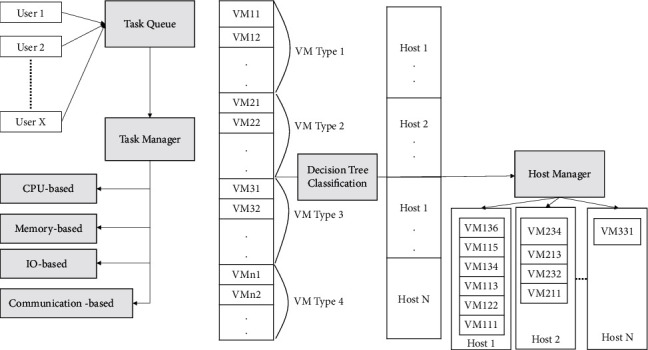
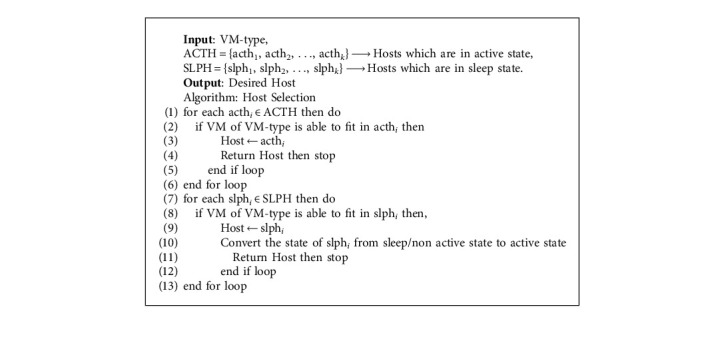
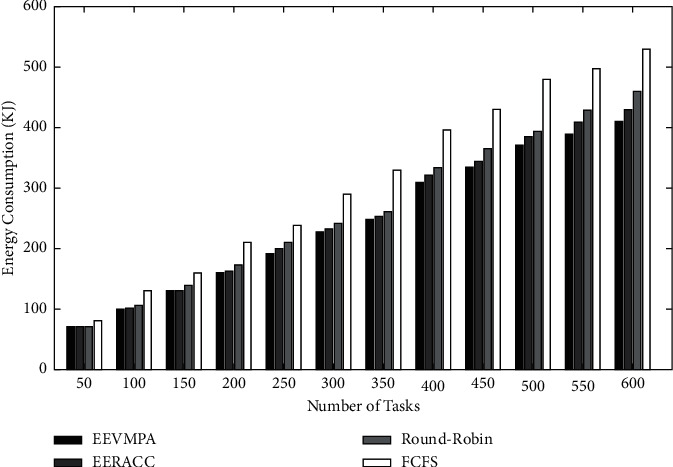
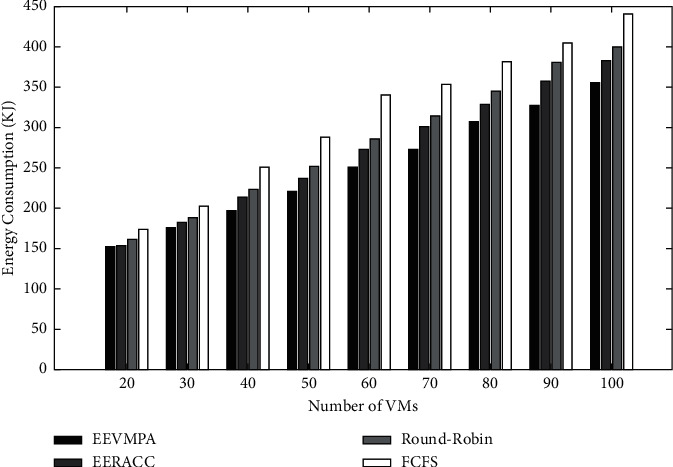
One of the important and challenging tasks in cloud computing is to obtain the usefulness of cloud by implementing several specifications for our needs, to meet the present growing demands, and to minimize energy consumption as much as possible and ensure proper utilization of computing resources. An excellent mapping scheme has been derived which maps virtual machines (VMs) to physical machines (PMs), which is also known as virtual machine (VM) placement, and this needs to be implemented. The tremendous diversity of computing resources, tasks, and virtualization processes in the cloud causes the consolidation method to be more complex, tedious, and problematic. An algorithm for reducing energy use and resource allocation is proposed for implementation in this article. This algorithm was developed with the help of a Cloud System Model, which enables mapping between VMs and PMs and among tasks of VMs. The methodology used in this algorithm also supports lowering the number of PMs that are in an active state and optimizes the total time taken to process a set of tasks (also known as makespan time). Using the CloudSim Simulator tool, we evaluated and assessed the energy consumption and makespan time. The results are compiled and then compared graphically with respect to other existing energy-efficient VM placement algorithms.
云计算中的一项重要且具有挑战性的任务是,通过为我们的需求实施多种规范来获取云的效用,以满足当前不断增长的需求,并尽可能减少能源消耗,确保计算资源的合理利用。已经得出了一种出色的映射方案,即将虚拟机(VM)映射到物理机(PM),这也称为虚拟机(VM)放置,并且需要加以实施。云中计算资源、任务和虚拟化过程的巨大多样性使得整合方法变得更加复杂、繁琐且存在问题。本文提出了一种用于减少能源使用和资源分配的算法以供实施。该算法是在云系统模型的帮助下开发的,该模型能够实现虚拟机与物理机之间以及虚拟机任务之间的映射。此算法中使用的方法还支持减少处于活动状态的物理机数量,并优化处理一组任务所需的总时间(也称为完工时间)。使用CloudSim模拟器工具,我们对能源消耗和完工时间进行了评估和评估。对结果进行了汇总,然后与其他现有的节能虚拟机放置算法进行了图形化比较。