Kim Su-Hyun, Kim Ki Hoon, Hyun Jae-Won, Kim Ji Hyun, Seo Sang-Soo, Kim Ho Jin, Park Sang-Yoon, Lim Myong Cheol
Department of Neurology, Research Institute and Hospital of National Cancer Center, Goyang, South Korea.
Center for Gynecologic Cancer, National Cancer Center, Goyang, South Korea.
Front Oncol. 2022 Aug 17;12:942960. doi: 10.3389/fonc.2022.942960. eCollection 2022.
We aimed to evaluate the potential of serum neurofilament light chain (sNfL) and serum brain-derived neurotrophic factor (sBDNF) as reliable biomarkers for paclitaxel-induced peripheral neuropathy (PIPN).
Forty-eight patients with gynecologic cancer scheduled to undergo six cycles of paclitaxel-based chemotherapy at the National Cancer Center of Korea between September 2020 and January 2022 were prospectively assessed during and after chemotherapy.
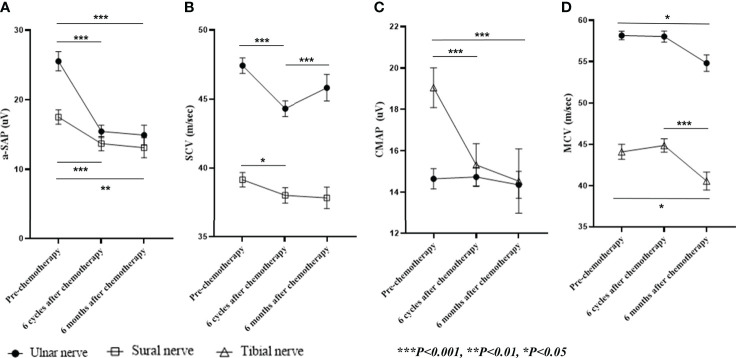
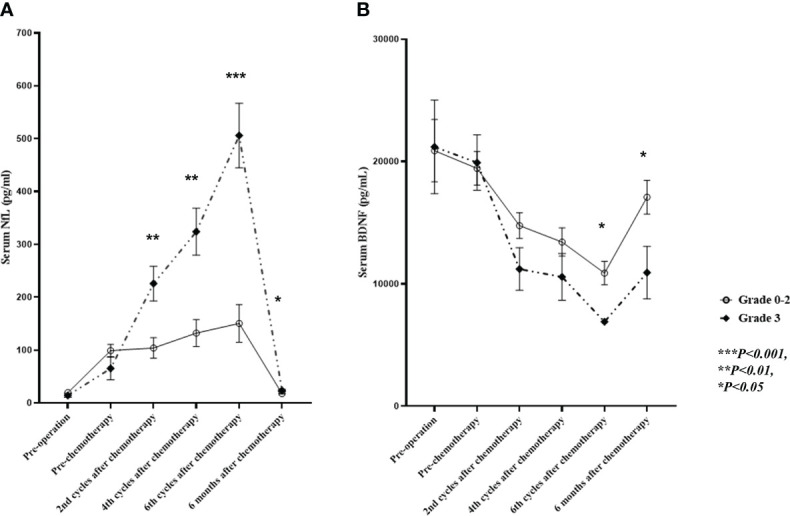
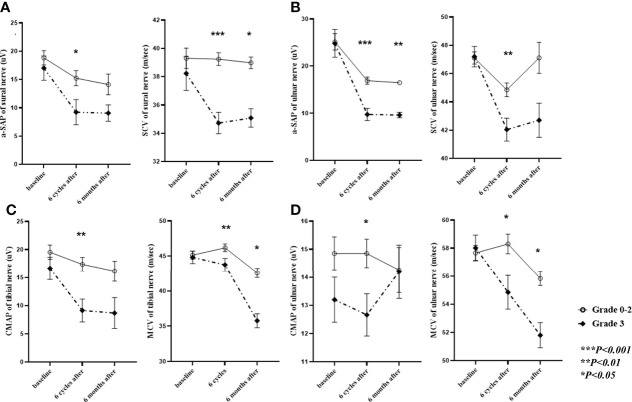
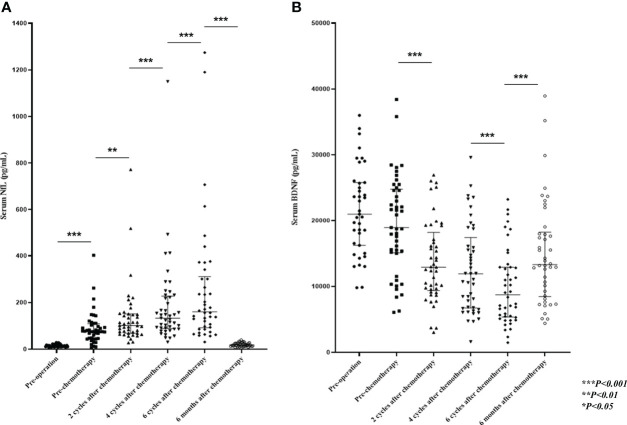
At the end of the chemotherapy, 12 (25%) patients were classified as having grade 3 PIPN according to the National Cancer Institute-Common Toxicity Criteria. The sNfL levels increased during paclitaxel treatment in all patients. After two, four, and six cycles, patients with grade 3 PIPN exhibited higher mean sNfL levels than those in the 0-2 grade range (p = 0.004, p = 001, and p < 0.001, respectively). For sNfL levels ≥ 124 pg/mL, after two cycles of chemotherapy, the sensitivity and specificity for predicting grade 3 PIPN at the end of treatment were 80% and 79%, respectively. Over the course of paclitaxel-based treatment, sBDNF levels continued to decrease regardless of the severity of PIPN. At the end of treatment and six months after chemotherapy, patients with grade 3 PIPN had lower sBDNF levels than those within the 0-2 grade range (p =0.037 and 0.02, respectively), and the patients in the latter group had better clinical symptoms six months after the end of treatment.
The sNfL levels during paclitaxel-based chemotherapy reflect ongoing neuroaxonal injury and serve as reliable biomarkers of PIPN severity. The sNfL levels during early treatment with paclitaxel might be prognostic indicators for PIPN progression. Low sBDNF levels 6 months after chemotherapy might adversely affect PIPN recovery.
我们旨在评估血清神经丝轻链(sNfL)和血清脑源性神经营养因子(sBDNF)作为紫杉醇诱导的周围神经病变(PIPN)可靠生物标志物的潜力。
2020年9月至2022年1月期间,在韩国国立癌症中心计划接受六个周期基于紫杉醇化疗的48例妇科癌症患者在化疗期间及化疗后接受前瞻性评估。
根据美国国立癌症研究所通用毒性标准,化疗结束时,12例(25%)患者被归类为3级PIPN。所有患者在紫杉醇治疗期间sNfL水平均升高。在两个、四个和六个周期后,3级PIPN患者的平均sNfL水平高于0 - 2级范围的患者(分别为p = 0.004、p = 0.01和p < 0.001)。对于sNfL水平≥124 pg/mL,化疗两个周期后,预测治疗结束时3级PIPN的敏感性和特异性分别为80%和79%。在基于紫杉醇的治疗过程中,无论PIPN的严重程度如何,sBDNF水平持续下降。治疗结束时及化疗后六个月,3级PIPN患者的sBDNF水平低于0 - 2级范围的患者(分别为p = 0.037和0.02),且后一组患者在治疗结束六个月后的临床症状更好。
基于紫杉醇的化疗期间sNfL水平反映了正在进行的神经轴突损伤,并作为PIPN严重程度的可靠生物标志物。紫杉醇早期治疗期间的sNfL水平可能是PIPN进展的预后指标。化疗后6个月sBDNF水平低可能对PIPN恢复产生不利影响。