Plüß Marlene, Tampe Désirée, Schwörer Harald, Bremer Sebastian Christopher Benjamin, Tampe Björn
Department of Nephrology and Rheumatology, University Medical Center Göttingen, Göttingen, Germany.
Department of Gastroenterology, Gastrointestinal Oncology and Endocrinology, University Medical Center Göttingen, Göttingen, Germany.
Front Pharmacol. 2022 Aug 17;13:966910. doi: 10.3389/fphar.2022.966910. eCollection 2022.
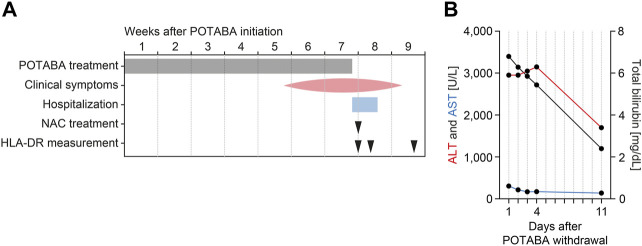
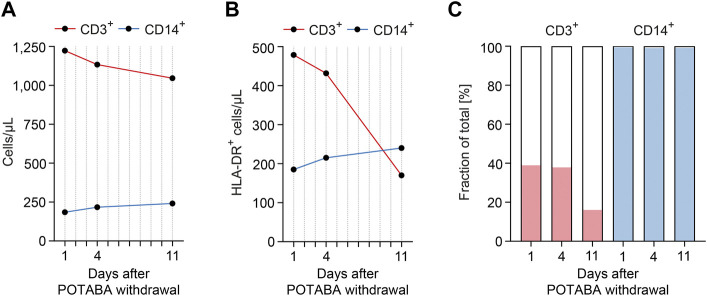
Potassium para-aminobenzoate (POTABA) is used to treat Peyronie's disease by decreasing fibrosis and plaque size progression. Among potential side effects, drug-induced liver injury (DILI) attributed to POTABA administration has been reported in a few cases and inferred to immune hypersensitivity. In the present case, we investigated clinical biochemical, and serological features as well as searched for non-drug-related causes, and applied the updated Roussel Uclaf Causality Assessment Method (RUCAM) confirming a highly probable causality of POTABA-induced liver injury. Moreover, we here observed specific activated CD3 T lymphocytes during the acute phase of liver injury by monitoring of human leukocyte antigen receptor (HLA-DR) expression. Furthermore, improvement of biochemical markers of liver injury after POTABA withdrawal was associated with a rapid decline of CD3 HLA-DR immune cells. In contrast, CD14 monocytes expressing HLA-DR remained stable during recovery from liver injury. These observations implicate a specific involvement of activated T lymphocytes in liver injury mediated by POTABA. Clinicians should be aware of POTABA-induced liver injury, and measurement of activated immune cells by assessment of HLA-DR could provide pathomechanistic insights enabling biomonitoring of recovery from DILI.
对氨基苯甲酸钾(POTABA)通过减少纤维化和斑块大小进展来治疗佩罗尼氏病。在潜在的副作用中,已有少数病例报告了因服用POTABA导致的药物性肝损伤(DILI),并推断为免疫超敏反应。在本病例中,我们调查了临床生化和血清学特征,并寻找非药物相关原因,应用更新后的鲁塞尔·乌克拉夫因果关系评估方法(RUCAM)证实了POTABA所致肝损伤的高度可能性因果关系。此外,我们通过监测人类白细胞抗原受体(HLA-DR)表达,在此观察到肝损伤急性期有特异性活化的CD3 T淋巴细胞。此外,停用POTABA后肝损伤生化标志物的改善与CD3 HLA-DR免疫细胞的快速下降相关。相反,表达HLA-DR的CD14单核细胞在肝损伤恢复过程中保持稳定。这些观察结果表明活化的T淋巴细胞在POTABA介导的肝损伤中具有特异性作用。临床医生应意识到POTABA所致肝损伤,通过评估HLA-DR来测量活化免疫细胞可为理解发病机制提供见解,从而实现对药物性肝损伤恢复情况的生物监测。