Fernando Lourds Michelle, Quesada-Candela Cristina, Murray Makaelah, Ugoaru Caroline, Yanowitz Judith L, Allen Anna K
Department of Biology, Howard University, Washington, DC, United States.
Magee-Womens Research Institute and Department of Obstetrics, Gynecology, and Reproductive Sciences, University of Pittsburgh School of Medicine, Pittsburgh, PA, United States.
Front Cell Dev Biol. 2022 Aug 17;10:901320. doi: 10.3389/fcell.2022.901320. eCollection 2022.
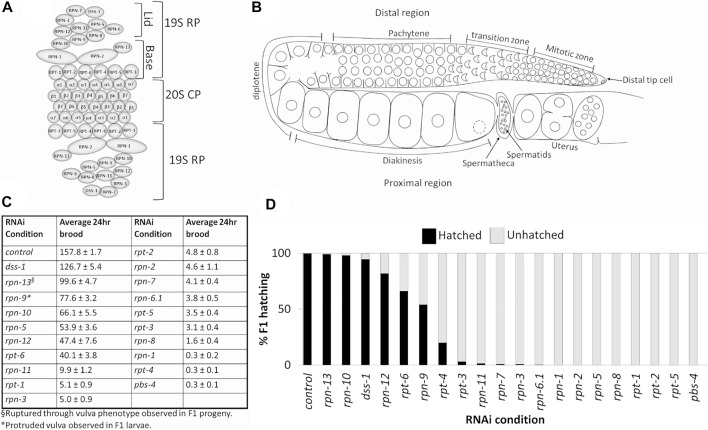
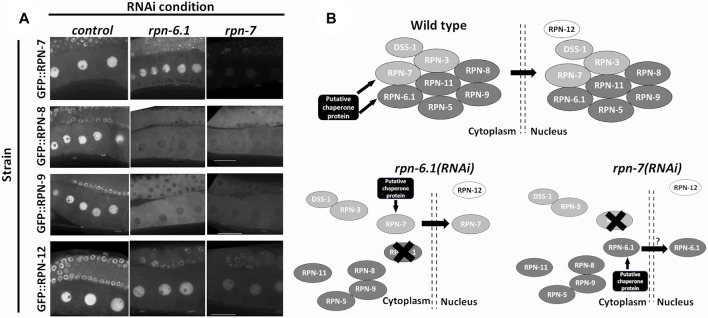
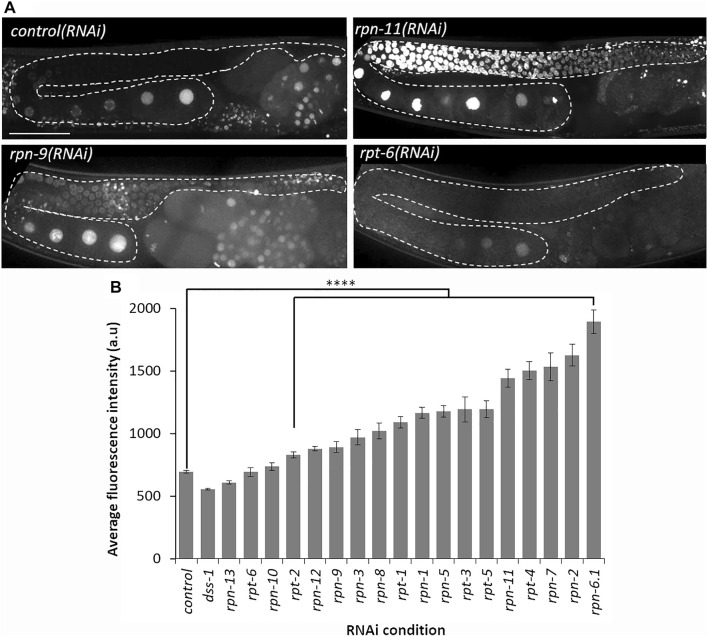
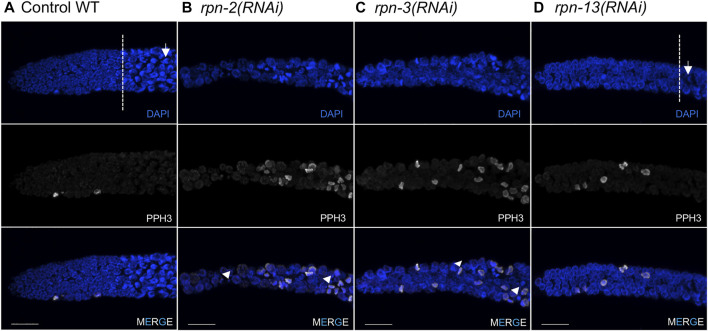
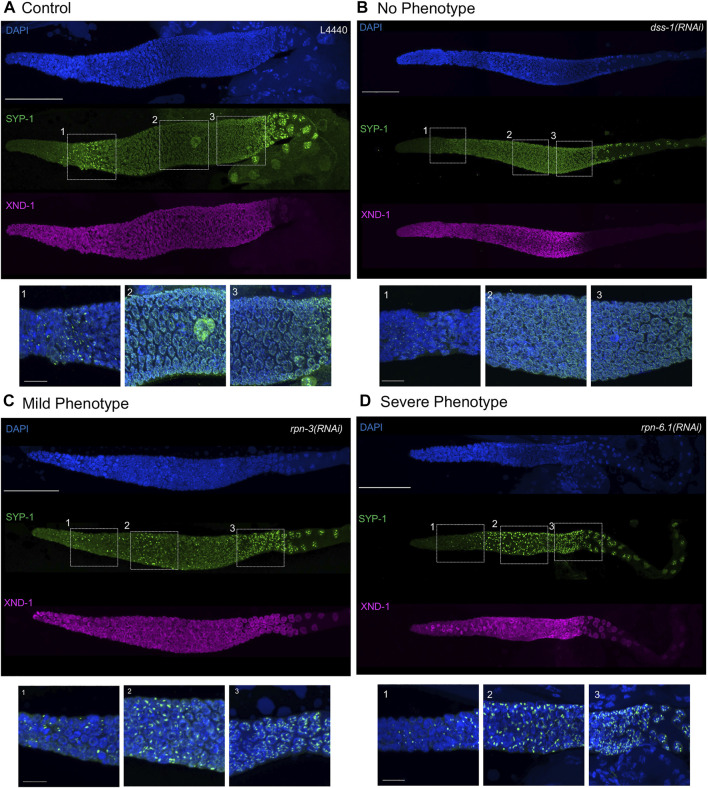
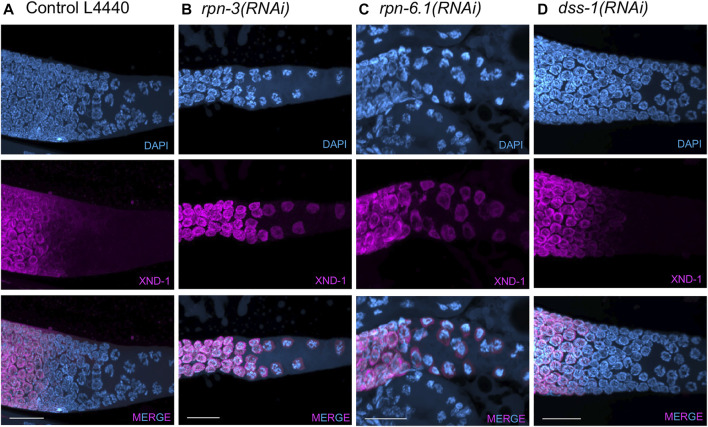
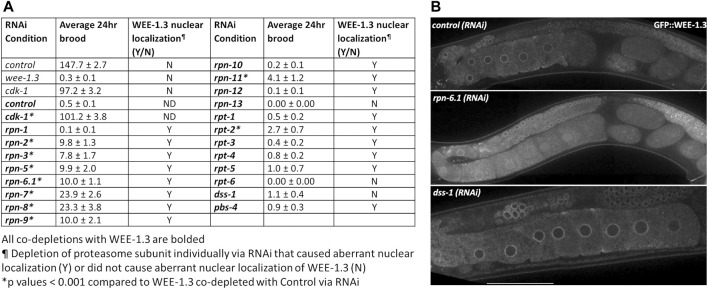
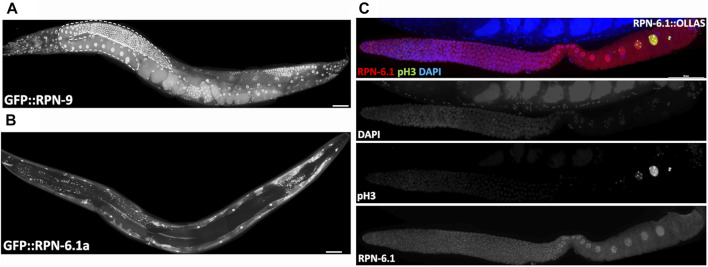
The 26S proteasome is a multi-subunit protein complex that is canonically known for its ability to degrade proteins in cells and maintain protein homeostasis. Non-canonical or non-proteolytic roles of proteasomal subunits exist but remain less well studied. We provide characterization of germline-specific functions of different 19S proteasome regulatory particle (RP) subunits in using RNAi specifically from the L4 stage and through generation of endogenously tagged 19S RP lid subunit strains. We show functions for the 19S RP in regulation of proliferation and maintenance of integrity of mitotic zone nuclei, in polymerization of the synaptonemal complex (SC) onto meiotic chromosomes and in the timing of SC subunit redistribution to the short arm of the bivalent, and in turnover of XND-1 proteins at late pachytene. Furthermore, we report that certain 19S RP subunits are required for proper germ line localization of WEE-1.3, a major meiotic kinase. Additionally, endogenous fluorescent labeling revealed that the two isoforms of the essential 19S RP proteasome subunit RPN-6.1 are expressed in a tissue-specific manner in the hermaphrodite. Also, we demonstrate that the 19S RP subunits RPN-6.1 and RPN-7 are crucial for the nuclear localization of the lid subunits RPN-8 and RPN-9 in oocytes, further supporting the ability to utilize the germ line as a model to study proteasome assembly real-time. Collectively, our data support the premise that certain 19S RP proteasome subunits are playing tissue-specific roles, especially in the germ line. We propose as a versatile multicellular model to study the diverse proteolytic and non-proteolytic roles that proteasome subunits play .
26S蛋白酶体是一种多亚基蛋白质复合物,其以在细胞中降解蛋白质并维持蛋白质稳态的能力而闻名。蛋白酶体亚基存在非经典或非蛋白水解作用,但研究较少。我们通过从L4阶段特异性使用RNA干扰以及通过生成内源性标记的19S RP盖子亚基菌株,对秀丽隐杆线虫中不同19S蛋白酶体调节颗粒(RP)亚基的种系特异性功能进行了表征。我们展示了19S RP在调节增殖和维持有丝分裂区细胞核完整性、将联会复合体(SC)聚合到减数分裂染色体上、SC亚基重新分布到二价体短臂的时间以及在粗线期后期XND-1蛋白的周转方面的功能。此外,我们报告某些19S RP亚基是主要减数分裂激酶WEE-1.3在种系中正确定位所必需的。另外,内源性荧光标记显示,必需的19S RP蛋白酶体亚基RPN-6.1的两种同工型在雌雄同体中以组织特异性方式表达。而且,我们证明19S RP亚基RPN-6.1和RPN-7对于卵母细胞中盖子亚基RPN-8和RPN-9的核定位至关重要,进一步支持了利用种系作为模型实时研究蛋白酶体组装的能力。总体而言,我们的数据支持这样一个前提,即某些19S RP蛋白酶体亚基发挥着组织特异性作用,尤其是在种系中。我们提出秀丽隐杆线虫作为一个通用的多细胞模型来研究蛋白酶体亚基所起的多种蛋白水解和非蛋白水解作用。