Statistical Genetics Lab, QIMR Berghofer Medical Research Institute, 300 Herston Road, Herston, QLD, 4006, Australia.
School of Biomedical Sciences, Faculty of Health, Queensland University of Technology, Brisbane, QLD, Australia.
J Transl Med. 2022 Sep 5;20(1):403. doi: 10.1186/s12967-022-03613-2.
The role of germline genetic factors in determining survival from cutaneous melanoma (CM) is not well understood.
To perform a genome-wide association study (GWAS) meta-analysis of melanoma-specific survival (MSS), and test whether a CM-susceptibility polygenic risk score (PRS) is associated with MSS.
We conducted two Cox proportional-hazard GWAS of MSS using data from the Melanoma Institute Australia, a high ultraviolet (UV) radiation setting (MIA; 5,762 patients with melanoma; 800 melanoma deaths) and UK Biobank (UKB: 5,220 patients with melanoma; 241 melanoma deaths), and combined them in a fixed-effects meta-analysis. Significant (P < 5 × 10⁻⁸) results were investigated in the Leeds Melanoma Cohort (LMC; 1,947 patients with melanoma; 370 melanoma deaths). We also developed a CM-susceptibility PRS using a large independent GWAS meta-analysis (23,913 cases, 342,870 controls). The PRS was tested for an association with MSS in the MIA and UKB cohorts.
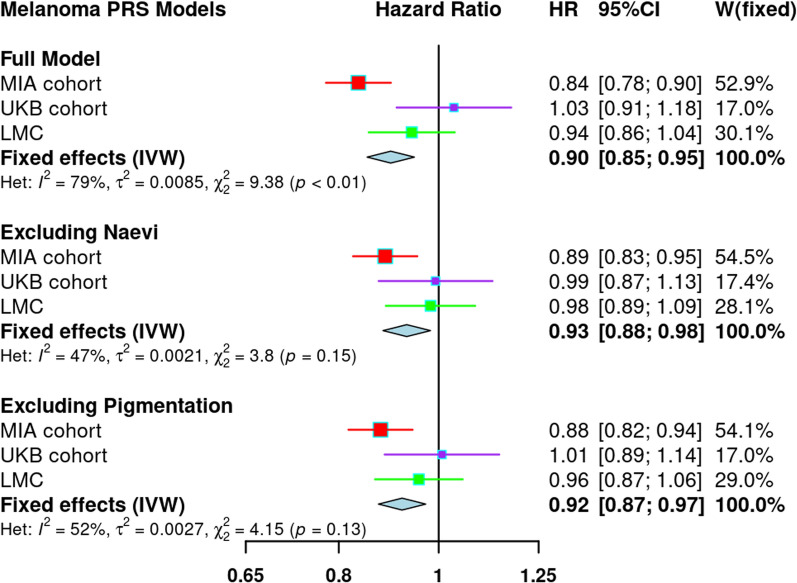
Two loci were significantly associated with MSS in the meta-analysis of MIA and UKB with lead SNPs rs41309643 (G allele frequency 1.6%, HR = 2.09, 95%CI = 1.61-2.71, P = 2.08 × 10⁻⁸) on chromosome 1, and rs75682113 (C allele frequency 1.8%, HR = 2.38, 95%CI = 1.77-3.21, P = 1.07 × 10⁻⁸) on chromosome 7. While neither SNP replicated in the LMC, rs75682113 was significantly associated in the combined discovery and replication sets. After adjusting for age at diagnosis, sex and the first ten principal components, a one standard deviation increase in the CM-susceptibility PRS was associated with improved MSS in the discovery meta-analysis (HR = 0.88, 95% CI = 0.83-0.94, P = 6.93 × 10⁻⁵; I2 = 88%). However, this was only driven by the high UV setting cohort (MIA HR = 0.84, 95% CI = 0.78-0.90).
We found two loci potentially associated with MSS. Increased genetic susceptibility to develop CM is associated with improved MSS in a high UV setting.
胚系遗传因素在确定皮肤黑色素瘤(CM)的生存中起着重要作用,但目前我们对其知之甚少。
进行黑色素瘤特异性生存(MSS)的全基因组关联研究(GWAS)荟萃分析,并检验 CM 易感性多基因风险评分(PRS)是否与 MSS 相关。
我们使用来自澳大利亚黑色素瘤研究所(MIA;5762 例黑色素瘤患者,800 例黑色素瘤死亡)和英国生物库(UKB:5220 例黑色素瘤患者,241 例黑色素瘤死亡)的数据进行了两项基于 Cox 比例风险的 MSS GWAS,并在固定效应荟萃分析中对其进行了合并。在利兹黑色素瘤队列(LMC;1947 例黑色素瘤患者,370 例黑色素瘤死亡)中对有统计学意义的(P < 5 × 10⁻⁸)结果进行了调查。我们还使用一项大型独立的 GWAS 荟萃分析(23913 例病例,342870 例对照)开发了 CM 易感性 PRS。在 MIA 和 UKB 队列中,我们对 PRS 与 MSS 的相关性进行了检验。
在 MIA 和 UKB 的荟萃分析中,有两个位点与 MSS 显著相关,其主要单核苷酸多态性(SNP)为 rs41309643(G 等位基因频率为 1.6%,HR = 2.09,95%CI = 1.61-2.71,P = 2.08 × 10⁻⁸)位于 1 号染色体上,rs75682113(C 等位基因频率为 1.8%,HR = 2.38,95%CI = 1.77-3.21,P = 1.07 × 10⁻⁸)位于 7 号染色体上。尽管这两个 SNP 在 LMC 中均未得到重复,但 rs75682113 在发现和复制集的联合分析中具有显著意义。在调整诊断时的年龄、性别和前十个主要成分后,CM 易感性 PRS 增加一个标准差与发现荟萃分析中的 MSS 改善相关(HR = 0.88,95%CI = 0.83-0.94,P = 6.93 × 10⁻⁵;I2 = 88%)。然而,这仅归因于高 UV 环境队列(MIA HR = 0.84,95%CI = 0.78-0.90)。
我们发现了两个可能与 MSS 相关的位点。CM 发生的遗传易感性增加与高 UV 环境中的 MSS 改善相关。