Lobanov Sergey V, McAllister Branduff, McDade-Kumar Mia, Landwehrmeyer G Bernhard, Orth Michael, Rosser Anne E, Paulsen Jane S, Lee Jong-Min, MacDonald Marcy E, Gusella James F, Long Jeffrey D, Ryten Mina, Williams Nigel M, Holmans Peter, Massey Thomas H, Jones Lesley
Medical Research Council Centre for Neuropsychiatric Genetics and Genomics, Cardiff University, Cardiff, UK.
Department of Neurology, University of Ulm, Ulm, Germany.
NPJ Genom Med. 2022 Sep 5;7(1):53. doi: 10.1038/s41525-022-00317-w.
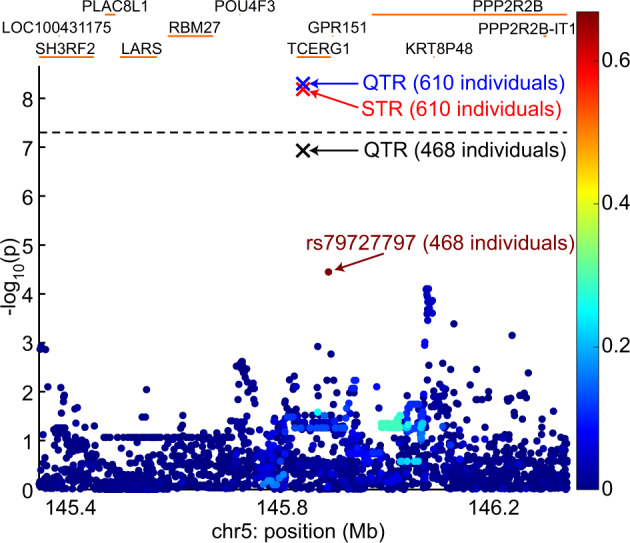
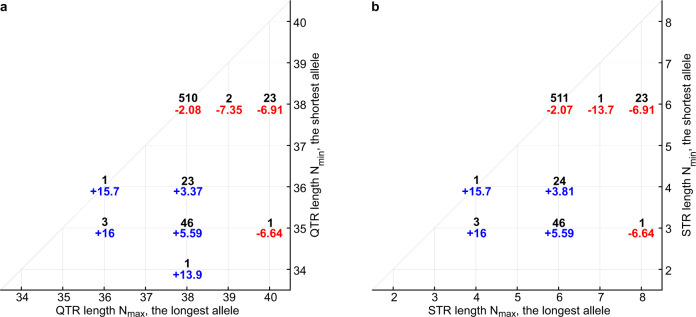
Huntington's disease is caused by an expanded CAG tract in HTT. The length of the CAG tract accounts for over half the variance in age at onset of disease, and is influenced by other genetic factors, mostly implicating the DNA maintenance machinery. We examined a single nucleotide variant, rs79727797, on chromosome 5 in the TCERG1 gene, previously reported to be associated with Huntington's disease and a quasi-tandem repeat (QTR) hexamer in exon 4 of TCERG1 with a central pure repeat. We developed a method for calling perfect and imperfect repeats from exome-sequencing data, and tested association between the QTR in TCERG1 and residual age at motor onset (after correcting for the effects of CAG length in the HTT gene) in 610 individuals with Huntington's disease via regression analysis. We found a significant association between age at onset and the sum of the repeat lengths from both alleles of the QTR (p = 2.1 × 10), with each added repeat hexamer reducing age at onset by one year (95% confidence interval [0.7, 1.4]). This association explained that previously observed with rs79727797. The association with age at onset in the genome-wide association study is due to a QTR hexamer in TCERG1, translated to a glutamine/alanine tract in the protein. We could not distinguish whether this was due to cis-effects of the hexamer repeat on gene expression or of the encoded glutamine/alanine tract in the protein. These results motivate further study of the mechanisms by which TCERG1 modifies onset of HD.
亨廷顿舞蹈症由HTT基因中CAG序列的扩增引起。CAG序列的长度占疾病发病年龄方差的一半以上,并受其他遗传因素影响,这些因素大多与DNA维持机制有关。我们研究了位于5号染色体上TCERG1基因的一个单核苷酸变体rs79727797,该变体先前被报道与亨廷顿舞蹈症相关,同时还研究了TCERG1基因第4外显子中的一个准串联重复(QTR)六聚体,其具有一个中心纯重复序列。我们开发了一种从外显子组测序数据中识别完美和不完美重复序列的方法,并通过回归分析测试了610名亨廷顿舞蹈症患者中TCERG1基因的QTR与运动发病剩余年龄(校正HTT基因中CAG长度的影响后)之间的关联。我们发现发病年龄与QTR两个等位基因重复序列长度之和之间存在显著关联(p = 2.1×10),每增加一个重复六聚体,发病年龄就降低一岁(95%置信区间[0.7, 1.4])。这种关联解释了先前观察到的与rs79727797的关联。全基因组关联研究中与发病年龄的关联是由于TCERG1基因中的一个QTR六聚体,该六聚体在蛋白质中翻译为谷氨酰胺/丙氨酸序列。我们无法区分这是由于六聚体重复序列对基因表达的顺式效应,还是由于蛋白质中编码的谷氨酰胺/丙氨酸序列的顺式效应。这些结果促使人们进一步研究TCERG1修饰亨廷顿舞蹈症发病的机制。