de Freitas Larissa Silva, Queiroz Maria Alice Freitas, Machado Luiz Fernando Almeida, Vallinoto Antonio Carlos Rosário, Ishak Marluísa de Oliveira Guimarães, Santos Fabiana de Almeida Araújo, Goulart Luiz Ricardo, Ishak Ricardo
Laboratory of Virology, Biological Sciences Institute, Federal University of Pará, Belém, Pará, Brazil.
Laboratory of Nanobiotechnology, Genetics and Biochemistry Institute, Federal University of Uberlândia, Uberlândia, Minas Gerais, Brazil.
Infect Drug Resist. 2022 Aug 30;15:4935-4945. doi: 10.2147/IDR.S369339. eCollection 2022.
infection is a major public health problem and the most common sexually transmitted infection in the world. Although highly prevalent, 70% to 80% of cases are asymptomatic and undiagnosed.
To overcome some limitations in terms of rapid diagnosis, phage display technology was used to bioprospect peptide mimetics of immunoreactive and immunogenic antigens to be selected for the production of synthetic peptides.
Initially, IgG from 22 individuals with and 30 negative controls was coupled to G protein magnetic beads. The phage display technique consisted of biopanning, genetic sequencing, bioinformatics analysis and phage ELISA.
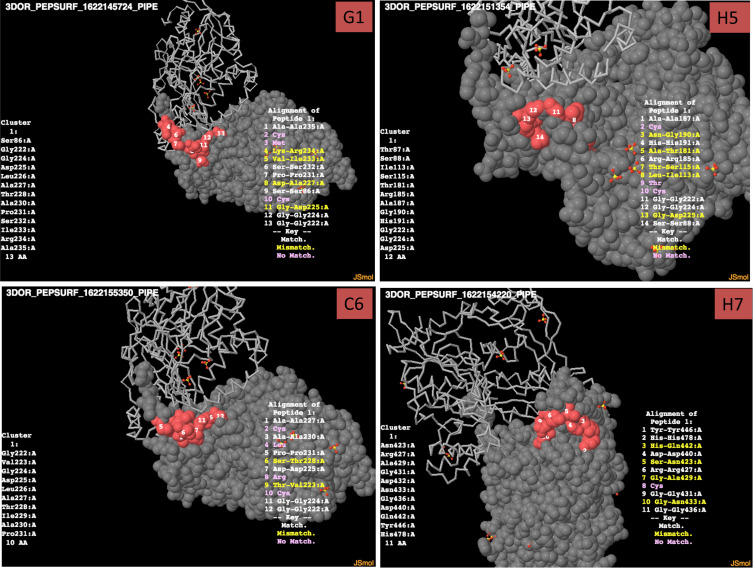
Clones G1, H5, C6 and H7 were selected for testing with individual samples positive and negative for . Reactions were statistically significant (p < 0.05), with a sensitivity of 90.91, a specificity of 54.55, and AUC values >0.8. One-dimensional analysis with components indicated that the G1 clone aligned with cell wall-associated hydrolase domain-containing protein, the H5 clone aligned with glycerol-3-phosphate acyltransferase PlsX protein, the C6 clone aligned with a transposase and inactivated derivatives, and the H7 clone aligned with GTP-binding protein. Molecular modeling and three-dimensional analysis indicated the best fit of the four clones with a protein known as chlamydial protease/proteasome-like activity factor (CPAF), an important virulence factor of the bacterium.
The peptides produced by phage display are related to the metabolic pathways of , indicating that they can be used to understand the pathogenesis of the infection. Because of their high sensitivity and AUC values, the peptides present considerable potential for use in platforms for screening infections.
感染是一个主要的公共卫生问题,也是世界上最常见的性传播感染。尽管感染率很高,但70%至80%的病例无症状且未被诊断出来。
为克服快速诊断方面的一些局限性,采用噬菌体展示技术对免疫反应性和免疫原性抗原的肽模拟物进行生物筛选,以选择用于合成肽生产的抗原。
最初,将22例感染个体和30例阴性对照的IgG与G蛋白磁珠偶联。噬菌体展示技术包括生物淘选、基因测序、生物信息学分析和噬菌体酶联免疫吸附测定。
选择克隆G1、H5、C6和H7对感染阳性和阴性的个体样本进行检测。反应具有统计学意义(p<0.05),敏感性为90.91,特异性为54.55,曲线下面积值>0.8。对成分进行的一维分析表明,G1克隆与含细胞壁相关水解酶结构域的蛋白对齐,H5克隆与甘油-3-磷酸酰基转移酶PlsX蛋白对齐,C6克隆与转座酶及失活衍生物对齐,H7克隆与GTP结合蛋白对齐。分子建模和三维分析表明,这四个克隆与一种名为衣原体蛋白酶/蛋白酶体样活性因子(CPAF)的蛋白最匹配,CPAF是该细菌的一种重要毒力因子。
噬菌体展示产生的肽与感染的代谢途径相关,表明它们可用于了解感染的发病机制。由于其高敏感性和曲线下面积值,这些肽在感染筛查平台中具有相当大的应用潜力。