Jung Lae-Young, Kim Jae-Min, Ryu Sukhyun, Lee Chang-Seop
Department of Internal Medicine, Jeonbuk National University Medical School, 567 Baekje-daero, Deokjin-gu, Jeonju-si, Jeollabuk-do 54907 Republic of Korea.
Biomedical Research Institute of Jeonbuk National University Hospital, Jeonju, Republic of Korea.
Int J Arrhythmia. 2022;23(1):22. doi: 10.1186/s42444-022-00073-z. Epub 2022 Sep 1.
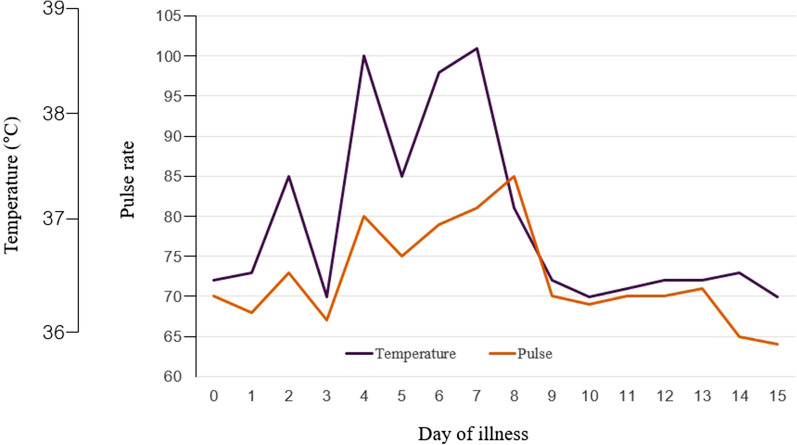
Relative bradycardia(RB) is a relatively low heart rate response to rise in body temperature that occurs in several infectious diseases and can be an important clinical sign. In previous case reports, RB was presented in some patients with Coronavirus disease 2019 (COVID-19) COVID-19.
To investigate the correlation between temperature and heart rate, we retrospectively reviewed 249 febrile patients with documented COVID-19 patients. RB was defined as a rise in the heart rate from a basal heart rate of less than 10 beats/minute/°C rise in temperature.
In this study, the prevalence of RB in patients with COVID-19 was 60.6%. When the HR at peak temperatures for patients with COVID-19 were compared with reference valve (general temperature-heart rate response in infectious disease), our findings demonstrate a relatively lower heart rate at all peak temperatures recorded. Despite differences in heart rate response, there were not significant differences in clinical outcomes (pulmonary manifestation, intensive care unit admission, Death).
Most patients with COVID-19 are associated with relative bradycardia, not related to clinical outcomes. RB in COVID-19 can be considered as the clinical features for differential diagnosis from other febrile conditions.
相对心动过缓(RB)是指在几种传染病中,体温升高时心率相对较低的反应,可能是一项重要的临床体征。在之前的病例报告中,一些2019冠状病毒病(COVID-19)患者出现了RB。
为了研究体温与心率之间的相关性,我们回顾性分析了249例有记录的COVID-19发热患者。RB定义为体温每升高1℃,心率较基础心率升高小于10次/分钟。
在本研究中,COVID-19患者中RB的患病率为60.6%。当将COVID-19患者体温峰值时的心率与参考值(传染病中一般的体温-心率反应)进行比较时,我们的研究结果表明,在所有记录的体温峰值时,心率相对较低。尽管心率反应存在差异,但临床结局(肺部表现、入住重症监护病房、死亡)并无显著差异。
大多数COVID-19患者伴有相对心动过缓,且与临床结局无关。COVID-19中的RB可被视为与其他发热性疾病进行鉴别诊断的临床特征。