Temasek Life Sciences Laboratory, National University of Singapore, Singapore.
Department of Biological Sciences, National University of Singapore, Singapore.
Proc Natl Acad Sci U S A. 2022 Sep 13;119(37):e2204179119. doi: 10.1073/pnas.2204179119. Epub 2022 Sep 6.
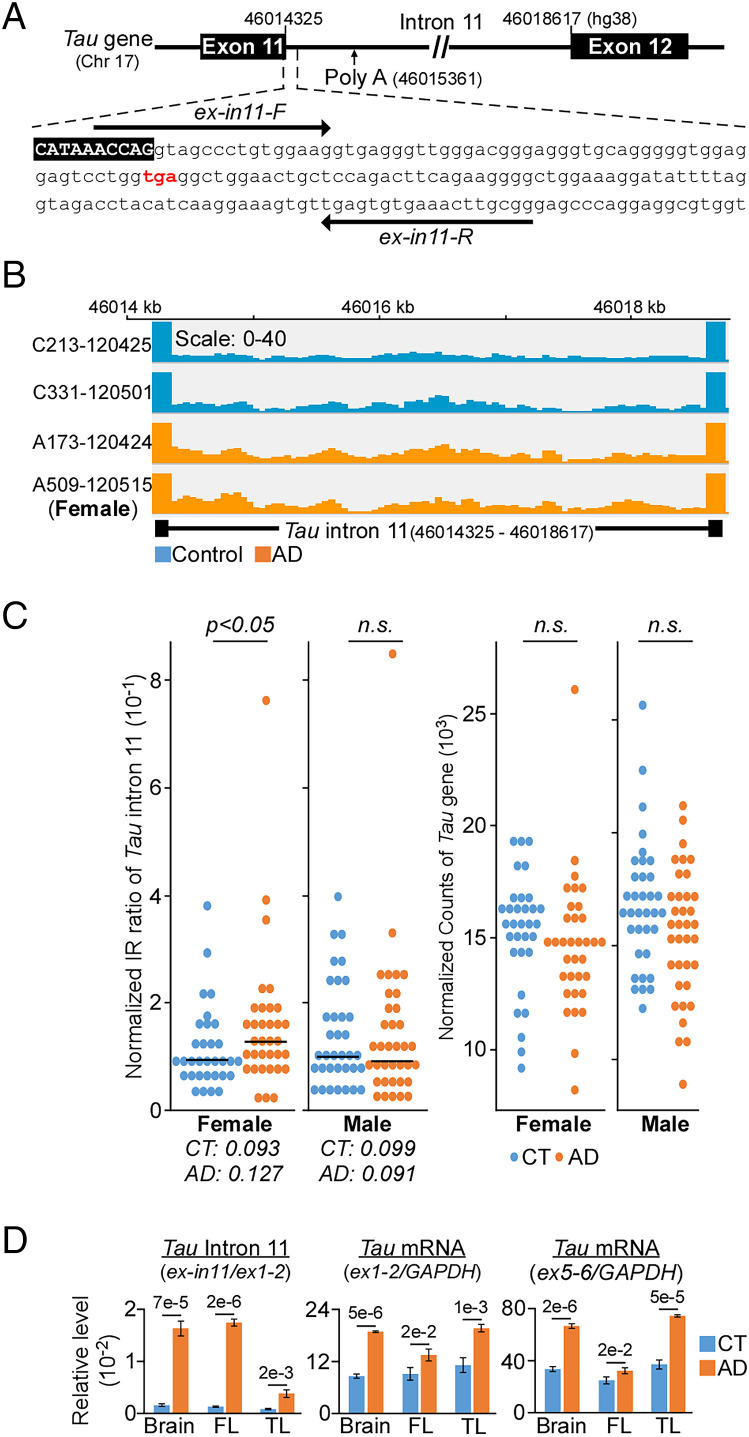
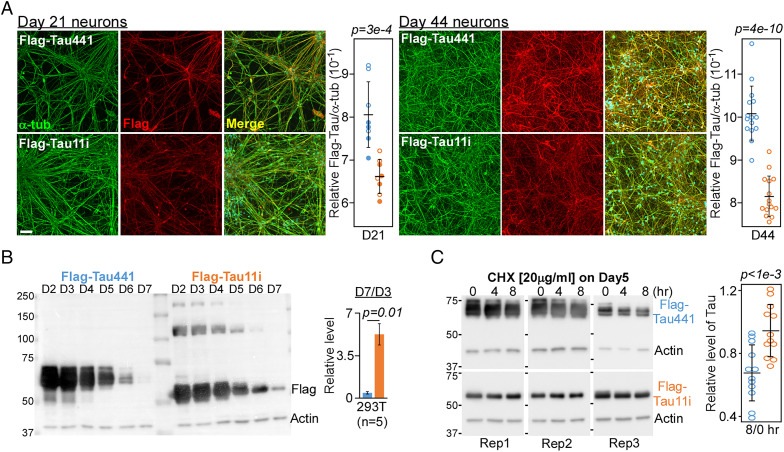
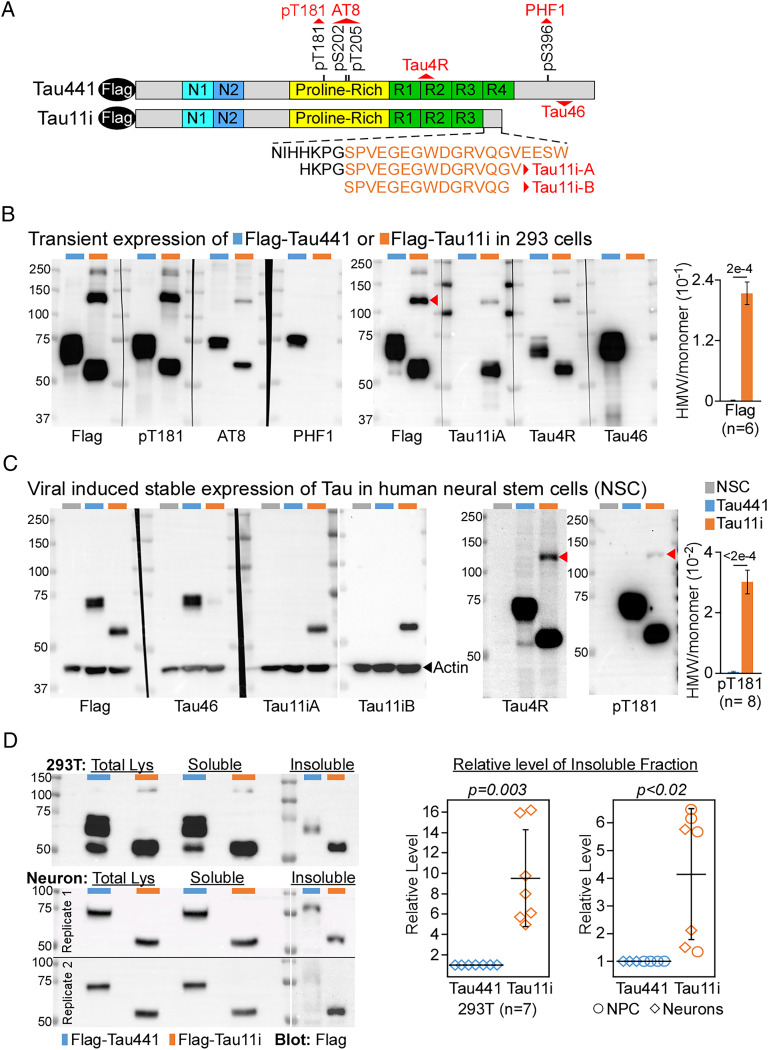
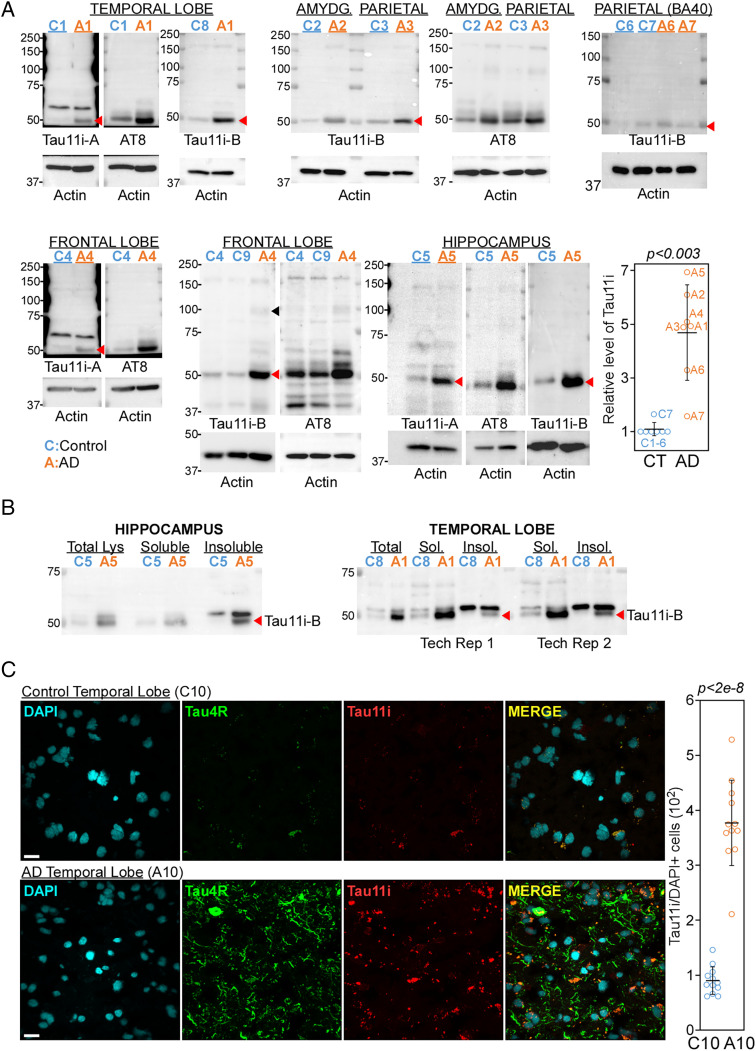
Alzheimer's disease (AD) is characterized by the accumulation of amyloid-β plaques and Tau tangles in brain tissues. Recent studies indicate that aberrant splicing and increased level of intron retention is linked to AD pathogenesis. Bioinformatic analysis revealed increased retention of intron 11 at the gene in AD female dorsal lateral prefrontal cortex as compared to healthy controls, an observation validated by quantitative polymerase chain reaction using different brain tissues. Retention of intron 11 introduces a premature stop codon, resulting in the production of truncated Tau11i protein. Probing with customized antibodies designed against amino acids encoded by intron 11 showed that Tau11i protein is more enriched in AD hippocampus, amygdala, parietal, temporal, and frontal lobe than in healthy controls. This indicates that messenger RNA with the retained intron is translated in vivo instead of being subjected to nonsense-mediated decay. Compared to full-length Tau441 isoform, ectopically expressed Tau11i forms higher molecular weight species, is enriched in Sarkosyl-insoluble fraction, and exhibits greater protein stability in cycloheximide assay. Stably expressed Tau11i also shows weaker colocalization with α-tubulin of microtubule network in human mature cortical neurons as compared to Tau441. Endogenous Tau11i is enriched in Sarkosyl-insoluble fraction in AD hippocampus and forms aggregates that colocalize weakly with Tau4R fibril-like structure in AD temporal lobe. The elevated level of Tau11i protein in AD brain tissues tested, coupled with biochemical properties resembling pathological Tau species suggest that retention of intron 11 of Tau gene might be an early biomarker of AD pathology.
阿尔茨海默病(AD)的特征是脑组织中淀粉样β斑块和 Tau 缠结的积累。最近的研究表明,异常剪接和内含子保留水平的增加与 AD 的发病机制有关。生物信息学分析显示,与健康对照组相比,AD 女性背外侧前额叶皮质中的 基因第 11 号内含子的保留增加,使用不同脑组织的定量聚合酶链反应验证了这一观察结果。第 11 号内含子的保留引入了一个过早的终止密码子,导致截短的 Tau11i 蛋白的产生。用针对第 11 号内含子编码的氨基酸定制的抗体进行探测表明,Tau11i 蛋白在 AD 海马体、杏仁核、顶叶、颞叶和额叶中的丰度高于健康对照组。这表明带有保留内含子的信使 RNA 在体内被翻译,而不是被无意义介导的衰变所处理。与全长 Tau441 同工型相比,异位表达的 Tau11i 形成更高分子量的物质,在 Sarkosyl 不溶性部分富集,并在环己酰亚胺测定中表现出更大的蛋白稳定性。稳定表达的 Tau11i 与微管网络中的 α-微管蛋白的共定位也比 Tau441 弱。与 AD 颞叶中的 Tau4R 纤维样结构弱共定位的 Tau11i 聚集物在 AD 海马体中的 Sarkosyl 不溶性部分富集。在 AD 脑组织中测试的 Tau11i 蛋白水平升高,加上类似于病理 Tau 物种的生化特性表明,Tau 基因第 11 号内含子的保留可能是 AD 病理的早期生物标志物。