Key Laboratory of Cellular Physiology at Shanxi Medical University, Ministry of Education, Taiyuan, China.
Department of Physiology, Shanxi Medical University, Taiyuan, China.
BMC Pregnancy Childbirth. 2022 Sep 6;22(1):687. doi: 10.1186/s12884-022-05003-4.
A significant proportion of women with preeclampsia (PE) exhibit persistent postpartum hypertension (PHTN) at 3 months postpartum associated with cardiovascular morbidity. This study aimed to screen patients with PE to identify the high-risk population with persistent PHTN.
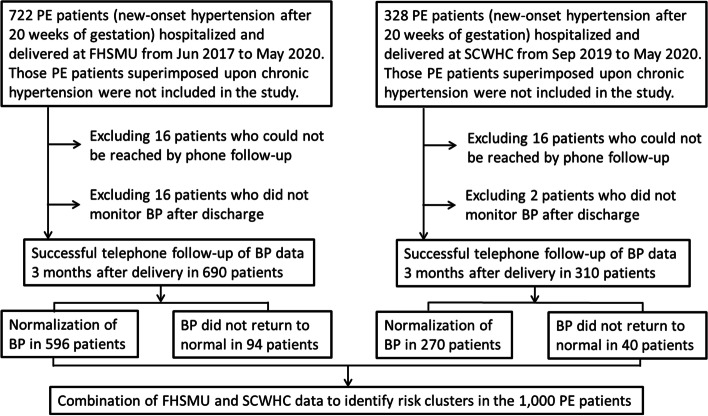
This retrospective cohort study enrolled 1,000 PE patients with complete parturient and postpartum blood pressure (BP) profiles at 3 months postpartum. The enrolled patients exhibited new-onset hypertension after 20 weeks of pregnancy, while those with PE superimposed upon chronic hypertension were excluded. Latent class cluster analysis (LCCA), a method of unsupervised learning in machine learning, was performed to ascertain maternal exposure clusters from eight variables and 35 subordinate risk factors. Logistic regression was applied to calculate odds ratios (OR) indicating the association between clusters and PHTN.
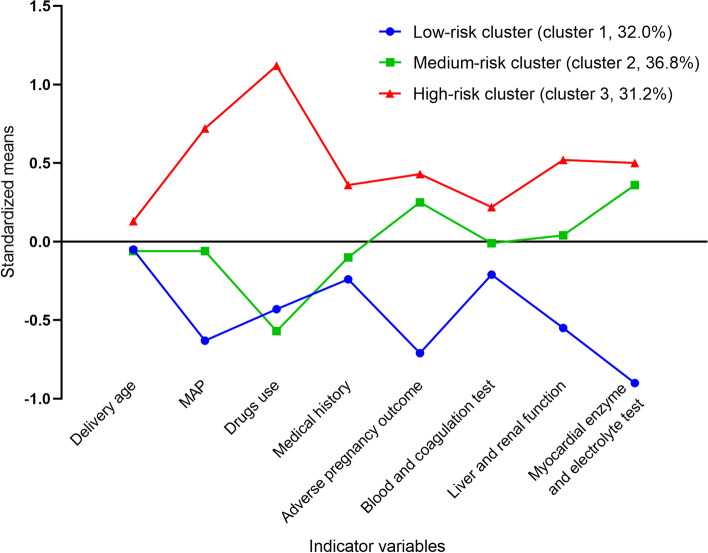
The 1,000 participants were classified into three exposure clusters (subpopulations with similar characteristics) according to persistent PHTN development: high-risk cluster (31.2%), medium-risk cluster (36.8%), and low-risk cluster (32.0%). Among the 1,000 PE patients, a total of 134 (13.4%) were diagnosed with persistent PHTN, while the percentages of persistent PHTN were24.68%, 10.05%, and 6.25% in the high-, medium-, and low-risk clusters, respectively. Persistent PHTN in the high-risk cluster was nearly five times higher (OR, 4.915; 95% confidence interval (CI), 2.92-8.27) and three times (OR, 2.931; 95% CI, 1.91-4.49) than in the low- and medium-risk clusters, respectively. Persistent PHTN did not differ between the medium- and low-risk clusters. Subjects in the high-risk cluster were older and showed higher BP, poorer prenatal organ function, more adverse pregnancy events, and greater medication requirement than the other two groups.
Patients with PE can be classified into high-, medium-, and low-risk clusters according to persistent PHTN severity; each cluster has cognizable clinical features. This study's findings stress the importance of controlling persistent PHTN to prevent future cardiovascular disease.
相当比例的子痫前期(PE)患者在产后 3 个月时表现出持续性产后高血压(PHTN),与心血管发病率有关。本研究旨在筛选出患有 PE 的患者,以确定持续性 PHTN 的高危人群。
本回顾性队列研究纳入了 1000 名产后 3 个月时完整的产妇和产后血压(BP)资料的 PE 患者。这些患者在妊娠 20 周后出现新发高血压,而 PE 合并慢性高血压的患者则被排除在外。采用无监督学习方法中的潜在类别聚类分析(LCCA),从 8 个变量和 35 个亚危险因素中确定母体暴露聚类。应用逻辑回归计算表示聚类与 PHTN 之间关联的优势比(OR)。
根据持续性 PHTN 的发展,1000 名参与者被分为三个暴露聚类(具有相似特征的亚人群):高风险聚类(31.2%)、中风险聚类(36.8%)和低风险聚类(32.0%)。在 1000 名 PE 患者中,共有 134 名(13.4%)被诊断为持续性 PHTN,高、中、低风险聚类中的持续性 PHTN 发生率分别为 24.68%、10.05%和 6.25%。高风险聚类中的持续性 PHTN 发生率近乎是低风险聚类的五倍(OR,4.915;95%置信区间[CI],2.92-8.27)和中风险聚类的三倍(OR,2.931;95% CI,1.91-4.49)。中风险聚类与低风险聚类之间的持续性 PHTN 无差异。高风险聚类中的患者年龄更大,血压更高,产前器官功能更差,不良妊娠事件更多,且需要更大剂量的药物治疗。
根据持续性 PHTN 的严重程度,PE 患者可分为高、中、低风险聚类;每个聚类都有可识别的临床特征。本研究结果强调了控制持续性 PHTN 以预防未来心血管疾病的重要性。