Department of Infectious Diseases, 2nd Faculty of Medicine, Charles University, Budínova 2, 180 81, Prague, Czech Republic.
Department of Infectious Diseases, University Hospital Bulovka, Budínova 2, 180 81, Prague, Czech Republic.
Malar J. 2022 Sep 6;21(1):257. doi: 10.1186/s12936-022-04282-8.
Malaria represents one of the most important imported tropical infectious diseases in European travellers. The objective of the study was to identify changes in the epidemiological features of imported malaria and to analyse the clinical findings and outcomes of imported malaria.
This single-centre descriptive study retrospectively analysed the medical records of all imported malaria cases in travellers treated at the Department of Infectious Diseases of University Hospital Bulovka in Prague from 2006 to 2019.
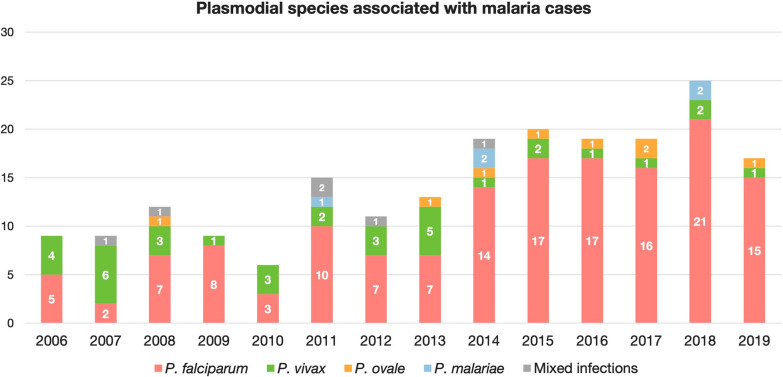
The study included 203 patients with a median age of 37 years (IQR 30-48) and a male to female ratio of 3.72:1. Plasmodium falciparum was the predominant species (149/203), and its proportion significantly increased from 35/60 cases (58.3%) in 2006-2011 to 69/80 (86.3%) in 2016-2019 (p < 0.001). In contrast, the incidence of Plasmodium vivax malaria decreased from 19/60 cases (31.7%) in 2006-2011 to 5/80 (6.3%) in 2016-2019 (p < 0.001). Malaria was imported from sub-Saharan Africa in 161/203 cases (79.3%). The proportion of travellers from Southeast and South Asia decreased from 16/60 (26.7%) and 6/60 (10.0%) in 2006-2011 to 2/80 (2.5%) and no cases (0.0%) in 2016-2019, respectively (p < 0.001 and p = 0.006). Tourism was the most common reason for travel (82/203), however, the proportion of non-tourists significantly increased over time from 29/60 (48.3%) in 2006-2011 to 55/80 (68.8%) in 2016-2019, p = 0.015. Severe malaria developed in 32/203 (15.8%) patients who were significantly older (p = 0.013) and whose treatment was delayed (p < 0.001). Two lethal outcomes were observed during the study period.
This study demonstrated a significant increase in P. falciparum malaria, which frequently resulted in severe disease, especially in older patients and those with delayed treatment initiation. The rising proportion of imported malaria in non-tourists, including business travellers and those visiting friends and relatives, is another characteristic finding analogous to the trends observed in Western European and North American centres. The described changes in the aetiology and epidemiology of imported malaria may serve to optimize pre-travel consultation practices and improve post-travel diagnostics and medical care.
疟疾是欧洲旅行者中最重要的输入性热带传染病之一。本研究的目的是确定输入性疟疾的流行病学特征变化,并分析输入性疟疾的临床发现和结局。
这是一项单中心描述性研究,回顾性分析了 2006 年至 2019 年期间在布拉格布尔诺大学医院传染病科治疗的旅行者中所有输入性疟疾病例的病历。
该研究纳入了 203 例中位年龄为 37 岁(IQR 30-48)的患者,男女比例为 3.72:1。恶性疟原虫是主要的疟原虫种类(149/203),其比例从 2006-2011 年的 35/60 例(58.3%)显著增加至 2016-2019 年的 69/80 例(86.3%)(p<0.001)。相比之下,间日疟原虫疟的发病率从 2006-2011 年的 19/60 例(31.7%)下降至 2016-2019 年的 5/80 例(6.3%)(p<0.001)。203 例疟疾中有 161 例(79.3%)来自撒哈拉以南非洲。来自东南亚和南亚的旅行者比例从 2006-2011 年的 16/60(26.7%)和 6/60(10.0%)分别降至 2016-2019 年的 2/80(2.5%)和 0/80(0.0%)(p<0.001 和 p=0.006)。旅游是最常见的旅行原因(82/203),但非游客的比例随着时间的推移显著增加,从 2006-2011 年的 29/60(48.3%)增加至 2016-2019 年的 55/80(68.8%)(p=0.015)。32/203(15.8%)例患者发生严重疟疾,这些患者年龄明显较大(p=0.013),治疗时间也延迟(p<0.001)。在研究期间观察到 2 例致死性结局。
本研究表明恶性疟原虫疟的发病率显著增加,尤其是在年龄较大的患者和治疗延迟的患者中,恶性疟原虫疟常导致严重疾病。非游客(包括商务旅行者和探亲访友者)中输入性疟疾比例的上升是另一个特征性发现,类似于西欧和北美中心的趋势。输入性疟疾的病因学和流行病学的变化可能有助于优化旅行前咨询实践,并改善旅行后诊断和医疗服务。