Department of Pharmacology, All India Institute of Medical Sciences, New Delhi, India.
Department of Pharmacology, All India Institute of Medical Sciences, Bhubaneswar, India.
Psychopharmacology (Berl). 2022 Nov;239(11):3525-3535. doi: 10.1007/s00213-022-06225-2. Epub 2022 Sep 7.
Alpha lipoic acid is known to reverse NMDA receptor hypofunction in addition to dopamine receptor blockade activity. It also enhances neurotrophic factors and has antioxidant potential. These properties combined together may be beneficial for treatment-resistant schizophrenia (TRS).
This study evaluates the effect of alpha lipoic acid (ALA) on psychopathological scores (positive, negative, cognitive), neurotrophic factors and oxidative stress in TRS.
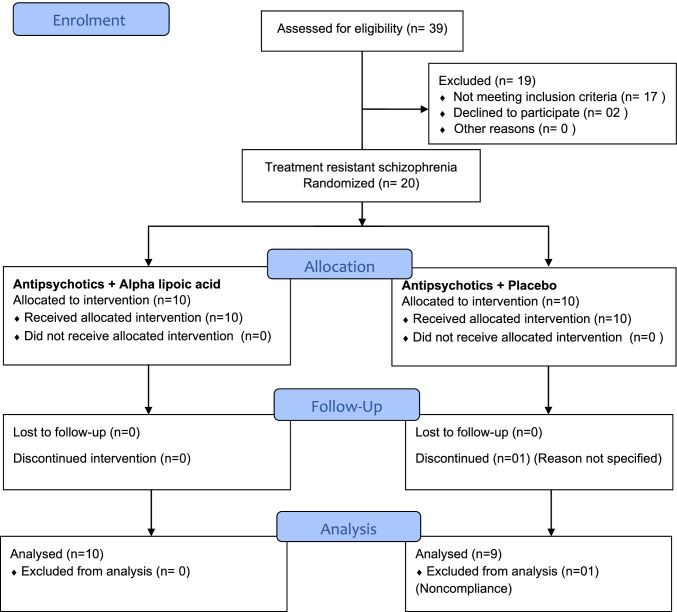
A pilot randomized double-blind placebo-controlled parallel design trial was conducted in 20 patients with TRS. After initial screening, participants were randomized into test (add-on ALA) and control (add-on placebo) groups. After recruitment, clinical evaluations with scale for assessment of positive symptoms and negative symptoms (SAPS and SANS), schizophrenia cognitive rating scale (SCoRS), UKU side effect rating scale were done. Serum levels of BDNF, MDA, and GSH were estimated. Patients were followed up for 8 weeks, and clinical and biochemical evaluations were repeated. Adherence to medication was evaluated at follow-up.
A significantly greater improvement was found in SANS score in the test group when compared to control (Mann-Whitney U = 17.0; p = 0.021), whereas there was no significant improvement in SAPS score (Mann-Whitney U = 41.5; p = 0.780). A significant increase in BDNF levels was observed in the control group when compared to ALA (U = 20.0; p = 0.041). No significant differences were found between the test and control groups in serum MDA (U = 30.0; p = 0.221), serum GSH (U = 40.0; p = 0.683), and medication adherence rating scale (MARS) scores (U = 44.0; p = 0.934).
ALA supplementation improved psychopathology and decreased oxidative stress in patients with TRS. This study thus shows the potential of adjunctive ALA in TRS.
The study was prospectively registered in Clinical Trial Registry of India (CTRI/2020/03/023707 dated 02.03.2020).
α-硫辛酸已知除了多巴胺受体阻断活性外,还能逆转 NMDA 受体功能低下。它还能增强神经营养因子并具有抗氧化潜力。这些特性结合在一起可能对治疗抵抗性精神分裂症(TRS)有益。
本研究评估 α-硫辛酸(ALA)对 TRS 患者的精神病理评分(阳性、阴性、认知)、神经营养因子和氧化应激的影响。
对 20 例 TRS 患者进行了一项前瞻性随机双盲安慰剂对照平行设计试验。初步筛选后,将参与者随机分为试验组(附加 ALA)和对照组(附加安慰剂)。招募后,使用阳性和阴性症状量表(SAPS 和 SANS)、精神分裂症认知评定量表(SCoRS)、UKU 副作用评定量表进行临床评估。检测血清 BDNF、MDA 和 GSH 水平。患者随访 8 周,重复临床和生化评估。在随访时评估药物依从性。
与对照组相比,试验组 SANS 评分有显著改善(Mann-Whitney U = 17.0;p = 0.021),而 SAPS 评分无显著改善(Mann-Whitney U = 41.5;p = 0.780)。与 ALA 相比,对照组 BDNF 水平显著升高(U = 20.0;p = 0.041)。试验组和对照组之间血清 MDA(U = 30.0;p = 0.221)、血清 GSH(U = 40.0;p = 0.683)和药物依从性评定量表(MARS)评分(U = 44.0;p = 0.934)无显著差异。
ALA 补充治疗可改善 TRS 患者的精神病理学和降低氧化应激。因此,本研究表明 ALA 对 TRS 有辅助作用。
该研究前瞻性地在印度临床试验注册处(CTRI/2020/03/023707,注册日期为 2020 年 3 月 2 日)注册。