RAND Corporation, Santa Monica, California, United States of America.
Centre for Mental Health, Melbourne School of Population and Global Health, The University of Melbourne, Melbourne, Australia.
PLoS One. 2022 Sep 7;17(9):e0272870. doi: 10.1371/journal.pone.0272870. eCollection 2022.
People released from prison who experience mental health and substance use problems are at high risk of reincarceration. This study aimed to examine the association between contact with mental health and substance use treatment services, and reincarceration, among adults released from prison.
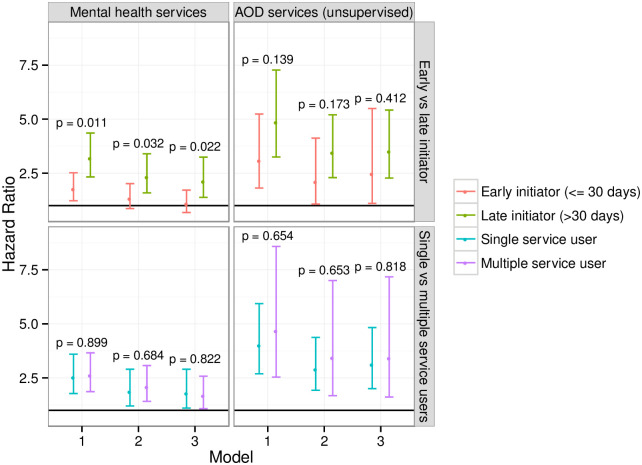
Pre-release survey data from 1,115 adults released from prisons in Queensland, Australia were linked with administrative health and correctional records covering a median of 787 days post-release. We constructed marginal structural Cox proportional hazards models, adjusting for pre-release variables and time-varying indicators of emergent mental health and substance use problems, to examine the association between contact with mental health and substance use treatment services, and reincarceration.
The adjusted hazard ratio (AHR) for reincarceration associated with mental health service contact was 1.76 (95%CI 1.23,2.51). Among those not on parole following release, the AHR for reincarceration associated with substance use treatment service contact was 3.16 (95%CI 2.09,4.77); we found no evidence for an association among those who were released on parole (AHR = 1.07; 95%CI 0.80,1.43).
Although we cannot eliminate the possibility of residual confounding, our findings suggest that infrequent or unsustained contact with community-based mental health and substance use treatment services is not protective against reincarceration, and may even be iatrogenic. Increased investment in high-quality and timely behavioural health services for people released from prison may simultaneously improve health outcomes, and reduce reincarceration.
有心理健康问题和药物使用问题的刑满释放人员再入狱的风险很高。本研究旨在调查澳大利亚昆士兰州监狱释放的成年人与接触心理健康和药物使用治疗服务,以及再入狱之间的关联。
对来自澳大利亚昆士兰州监狱的 1115 名成年人进行了预释放调查数据与医疗保健和矫正记录的链接,涵盖了中位数为 787 天的释放后时间。我们构建了边缘结构 Cox 比例风险模型,根据预释放变量和突发心理健康和药物使用问题的时变指标进行调整,以调查接触心理健康和药物使用治疗服务与再入狱之间的关联。
与心理健康服务接触相关的再入狱调整后危险比(AHR)为 1.76(95%CI 1.23,2.51)。在释放后未假释的人群中,与药物使用治疗服务接触相关的再入狱 AHR 为 3.16(95%CI 2.09,4.77);我们没有发现假释释放者之间存在关联的证据(AHR=1.07;95%CI 0.80,1.43)。
尽管我们不能排除残留混杂的可能性,但我们的研究结果表明,与社区为基础的心理健康和药物使用治疗服务接触频率低或不持续并不能防止再入狱,甚至可能会产生医源性问题。为从监狱获释的人增加高质量和及时的行为健康服务投资,可能同时改善健康结果,并减少再入狱。