Ji Ning-Ning, Xia Ming
Department of Anesthesiology, Shanghai Ninth People's Hospital, Shanghai Jiao Tong University School of Medicine, Shanghai, China.
Jiangsu Province Key Laboratory of Anesthesiology, Xuzhou Medical University, Xuzhou, China.
Transl Pediatr. 2022 Aug;11(8):1398-1407. doi: 10.21037/tp-22-410.
Neonatal maternal separation (NMS), a major kind of early life stress, increases the risk of visceral pain, anxiety- and depression-like behaviors in adulthood. An enriched environment (EE) has been shown to successfully rescue the brain from various early life psychological stressors. Therefore, this study aimed to investigate whether NMS induces visceral pain, anxiety- and depression-like behaviors in adolescents and to evaluate the impact of EE in infancy on these symptoms.
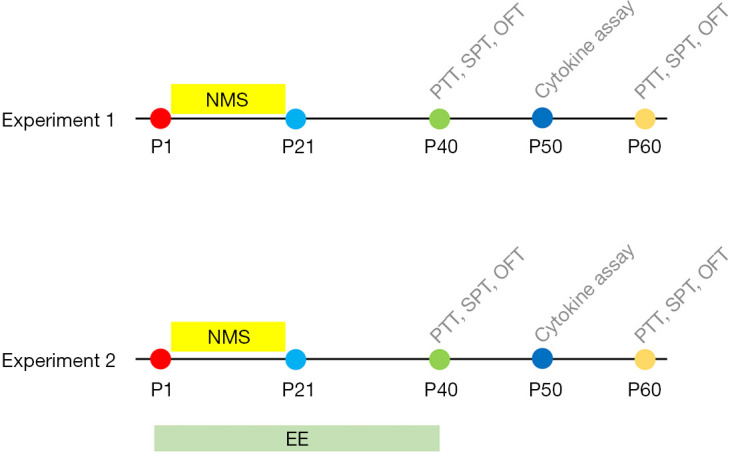
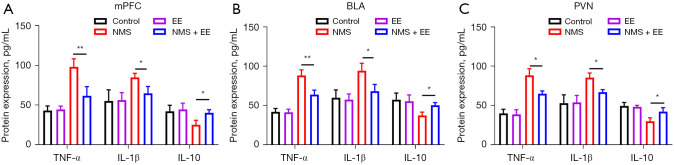
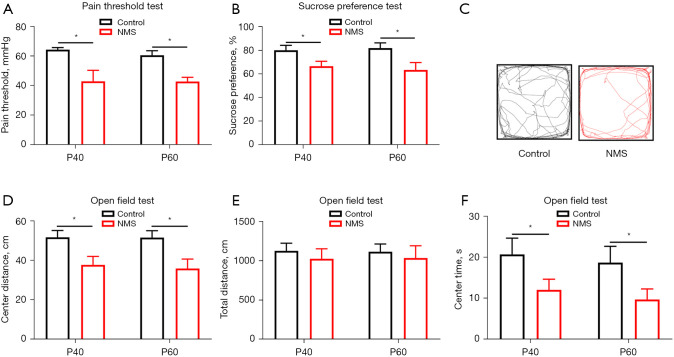
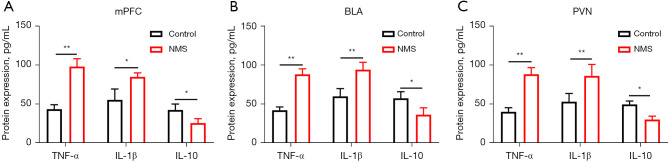
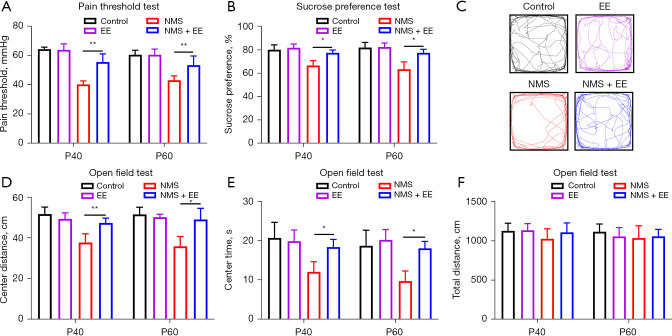
Male C57BL/6 J mice that had been subjected to NMS were used in this study. The visceral pain threshold test (PTT), open field test (OFT), and sucrose preference test (SPT) were conducted to evaluate visceral pain, anxiety- and depression-like behaviors in mice, respectively. An enzyme linked immunosorbent assay (ELISA) for tumor necrosis factor-α (TNF-α), interleukin-1β, (IL-1β), and interleukin-10 (IL-10) was performed to assess neuroinflammatory responses. Then, the effects of EE (free-turning running wheels, pipes, stairs, and various colored ocean balls, etc.) on NMS-induced behaviors and neuroinflammatory factors were examined.
The impacts of NMS included adolescent visceral pain, anxiety- and depression-like behaviors. The medial prefrontal cortex (mPFC), basolateral amygdala (BLA), and paraventricular nucleus (PVN) were biased towards pro-inflammatory features. Further, EE alleviated adolescent visceral pain, anxiety- and depression-like behaviors. The application of EE up-regulated the expression of IL-10, and down-regulated the expression of IL-1β and TNF-α in mPFC, BLA, and PVN.
The effects of NMS include adolescent visceral pain, anxiety- and depression-like behaviors, accompanied by an imbalance of neuroinflammation. Intervention with EE in pediatric mice relieved these symptoms by reducing neuroinflammation in the central nervous system.
新生鼠母婴分离(NMS)是早期生活应激的主要类型之一,会增加成年后患内脏疼痛、焦虑和抑郁样行为的风险。研究表明,丰富环境(EE)能成功使大脑免受各种早期生活心理应激源的影响。因此,本研究旨在调查新生鼠母婴分离是否会导致青少年出现内脏疼痛、焦虑和抑郁样行为,并评估婴儿期丰富环境对这些症状的影响。
本研究使用经历过新生鼠母婴分离的雄性C57BL/6 J小鼠。分别进行内脏疼痛阈值测试(PTT)、旷场试验(OFT)和蔗糖偏好试验(SPT),以评估小鼠的内脏疼痛、焦虑和抑郁样行为。进行肿瘤坏死因子-α(TNF-α)、白细胞介素-1β(IL-1β)和白细胞介素-10(IL-10)的酶联免疫吸附测定(ELISA),以评估神经炎症反应。然后,研究丰富环境(自由转动的跑轮、管道、楼梯和各种彩色海洋球等)对新生鼠母婴分离诱导的行为和神经炎症因子的影响。
新生鼠母婴分离的影响包括青少年内脏疼痛、焦虑和抑郁样行为。内侧前额叶皮质(mPFC)、基底外侧杏仁核(BLA)和室旁核(PVN)呈现促炎特征倾向。此外,丰富环境减轻了青少年的内脏疼痛、焦虑和抑郁样行为。丰富环境的应用上调了mPFC、BLA和PVN中IL-10的表达,并下调了IL-1β和TNF-α的表达。
新生鼠母婴分离的影响包括青少年内脏疼痛、焦虑和抑郁样行为,并伴有神经炎症失衡。对幼鼠进行丰富环境干预通过减少中枢神经系统的神经炎症缓解了这些症状。