
改良有机溶剂型透明化方法对 AAV 转导荧光的长期保持。
Long Preservation of AAV-Transduced Fluorescence by a Modified Organic Solvent-Based Clearing Method.
机构信息
Department of Physiology, Keio University School of Medicine, 35 Shinanomachi, Shinjuku-ku, Tokyo 160-8582, Japan.
Department of Orthopaedic Surgery, Keio University School of Medicine, 35 Shinanomachi, Shinjuku-ku, Tokyo 160-8582, Japan.
出版信息
Int J Mol Sci. 2022 Aug 25;23(17):9637. doi: 10.3390/ijms23179637.
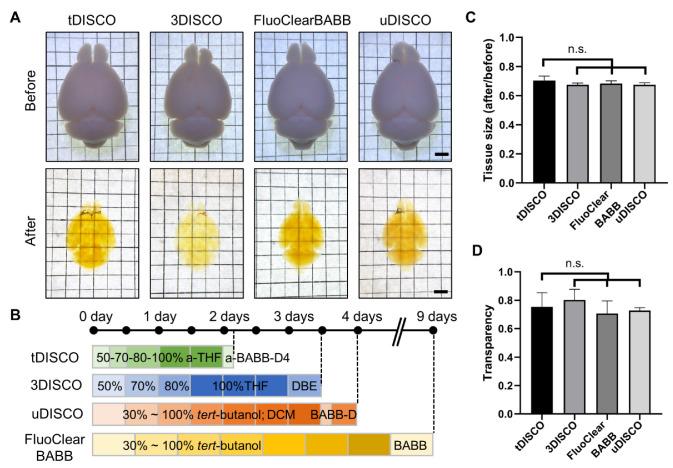
The development of tissue clearing technologies allows 3D imaging of whole tissues and organs, especially in studies of the central nervous system innervated throughout the body. Although the three-dimensional imaging of solvent-cleared organs (3DISCO) method provides a powerful clearing capacity and high transparency, the rapid quenching of endogenous fluorescence and peroxide removal process decreases its practicability. This study provides a modified method named tDISCO to solve these limitations. The tDISCO protocol can preserve AAV-transduced endogenous EGFP fluorescence for months and achieve high transparency in a fast and simple clearing process. In addition to the brain, tDISCO was applied to other organs and even hard bone tissue. tDISCO also enabled us to visualize the long projection neurons and axons with high resolution. This method provides a fast and simple clearing protocol for 3D visualization of the AAV- transduced long projection neurons throughout the brain and spinal cord.
组织透明化技术的发展使得对整个组织和器官进行 3D 成像成为可能,尤其是在研究全身神经系统支配的中枢神经系统方面。虽然溶剂清除器官 3D 成像(3DISCO)方法提供了强大的清除能力和高透明度,但内源性荧光的快速淬灭和过氧化物去除过程降低了其实用性。本研究提供了一种改良的方法,称为 tDISCO,以解决这些限制。tDISCO 方案可以在快速简单的清除过程中保持数月内 AAV 转导的内源性 EGFP 荧光的稳定性,并实现高透明度。除了大脑,tDISCO 还应用于其他器官,甚至硬骨组织。tDISCO 还使我们能够以高分辨率可视化长投射神经元和轴突。该方法为通过 AAV 转导整个大脑和脊髓中的长投射神经元进行 3D 可视化提供了一种快速简单的清除方案。




 Zotero 插件