Genome Integrity and Instability Group, Institut de Biotecnologia i Biomedicina, Universitat Autònoma de Barcelona, 08193 Cerdanyola del Vallès, Spain.
Cytology and Histology Unit, Department of Cell Biology, Physiology and Immunology, Universitat Autònoma de Barcelona, 08193 Cerdanyola del Vallès, Spain.
Int J Mol Sci. 2022 Aug 29;23(17):9818. doi: 10.3390/ijms23179818.
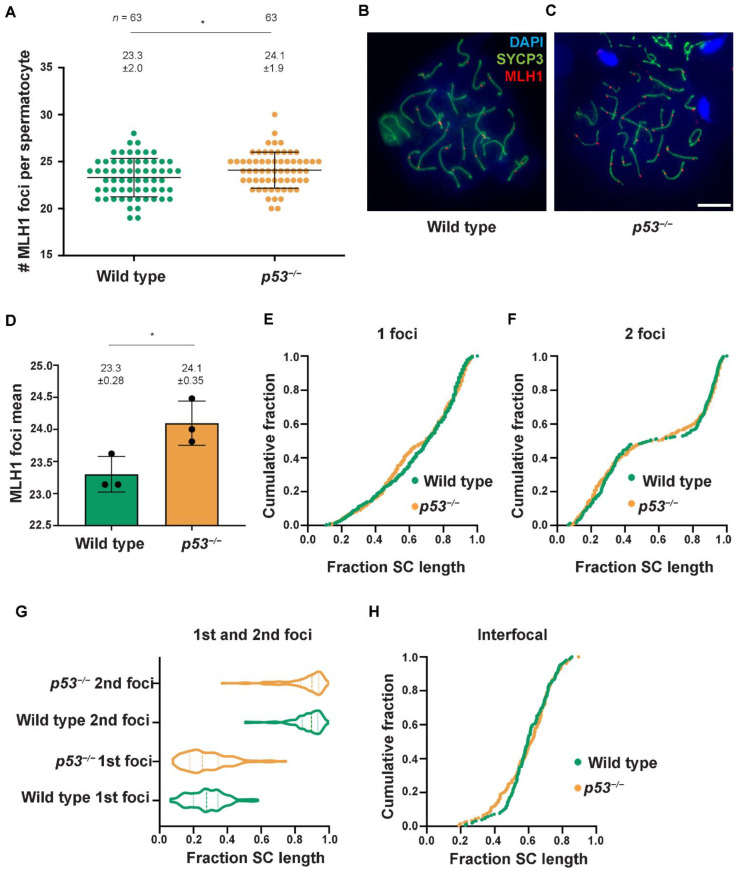
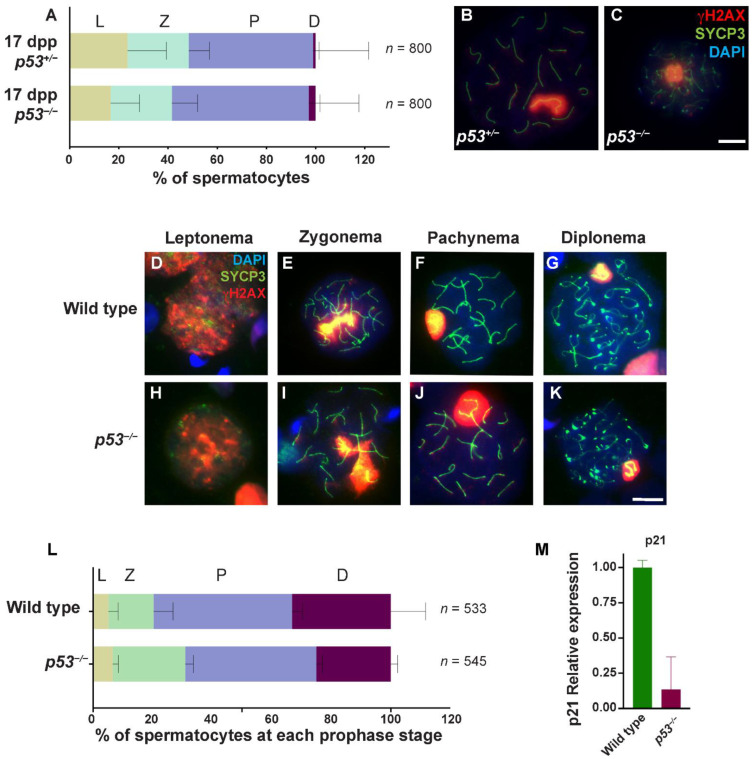
Meiosis initiates with the formation of double strand breaks (DSBs) throughout the genome. To avoid genomic instability, these DSBs need to be correctly repaired by homologous recombination. Surveillance mechanisms involving the DNA damage response (DDR) pathway ATM-CHK2-p53 can detect the persistence of unrepaired DBSs and activate the recombination-dependent arrest at the pachytene stage. However, a complete understanding of p53 functions under normal physiological conditions remains lacking. Here, we report a detailed analysis of the p53 role during meiotic prophase in mice spermatocytes. We show that the absence of p53 regulates prophase progression by slowing down the pachytene stage when the recombination-dependent arrest occurs. Furthermore, our results show that p53 is necessary for proper crossover (CO) formation and localization. Our study contributes to a deeper understanding of p53 roles during the meiotic prophase.
减数分裂首先在整个基因组中形成双链断裂(DSBs)。为了避免基因组不稳定,这些 DSB 需要通过同源重组正确修复。涉及 DNA 损伤反应(DDR)途径 ATM-CHK2-p53 的监控机制可以检测到未修复的 DSB 的持续存在,并激活在粗线期的重组依赖性停滞。然而,对于 p53 在正常生理条件下的功能的全面理解仍然缺乏。在这里,我们报告了在小鼠精母细胞减数分裂前期 p53 作用的详细分析。我们表明,p53 的缺失通过减缓重组依赖性停滞发生时的粗线期来调节前期进程。此外,我们的结果表明 p53 对于正确的交叉(CO)形成和定位是必要的。我们的研究有助于更深入地了解 p53 在减数分裂前期的作用。