Thrombosis Research Center, Medical Technology School, Department of Clinical Biochemistry and Immunohaematology, Faculty of Health Sciences, Universidad de Talca, Talca 3480094, Chile.
Int J Mol Sci. 2022 Aug 31;23(17):9882. doi: 10.3390/ijms23179882.
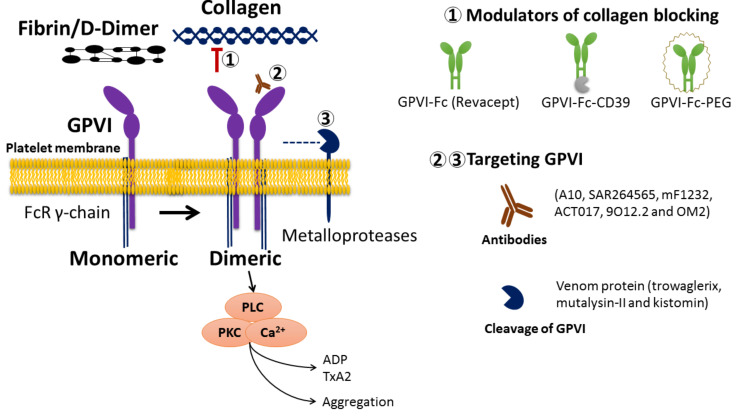
Antiplatelet therapy aims to reduce the risk of thrombotic events while maintaining hemostasis. A promising current approach is the inhibition of platelet glycoprotein GPVI-mediated adhesion pathways; pathways that do not involve coagulation. GPVI is a signaling receptor integral for collagen-induced platelet activation and participates in the thrombus consolidation process, being a suitable target for thrombosis prevention. Considering this, the blocking or antibody-mediated depletion of GPVI is a promising antiplatelet therapy for the effective and safe treatment of thrombotic diseases without a significant risk of bleeding and impaired hemostatic plug formation. This review describes the current knowledge concerning pharmaceutical approaches to platelet GPVI modulation and its downstream signaling pathways in this context.
抗血小板治疗旨在降低血栓事件的风险,同时保持止血功能。目前一种很有前途的方法是抑制血小板糖蛋白 GPVI 介导的黏附途径;这些途径不涉及凝血。GPVI 是一种信号受体,对胶原诱导的血小板激活至关重要,并参与血栓形成过程,是预防血栓形成的合适靶点。考虑到这一点,阻断或抗体介导的 GPVI 耗竭是一种有前途的抗血小板治疗方法,可有效和安全地治疗血栓性疾病,而不会显著增加出血风险和影响止血栓形成。本综述描述了目前在这方面对血小板 GPVI 调节及其下游信号通路的药物干预方法的认识。