Departments of Ophthalmology, School of Medicine, Sapporo Medical University, Sapporo 060-8556, Japan.
Departments of Cardiovascular, Renal and Metabolic Medicine, Sapporo Medical University, Sapporo 060-8556, Japan.
Int J Mol Sci. 2022 Aug 31;23(17):9912. doi: 10.3390/ijms23179912.
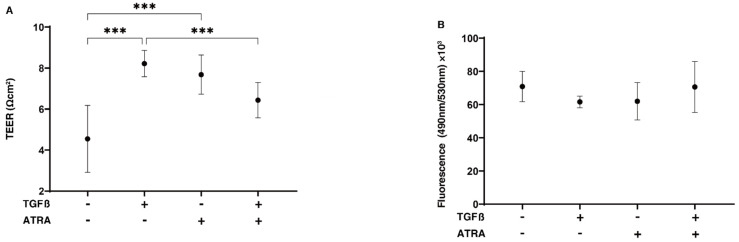
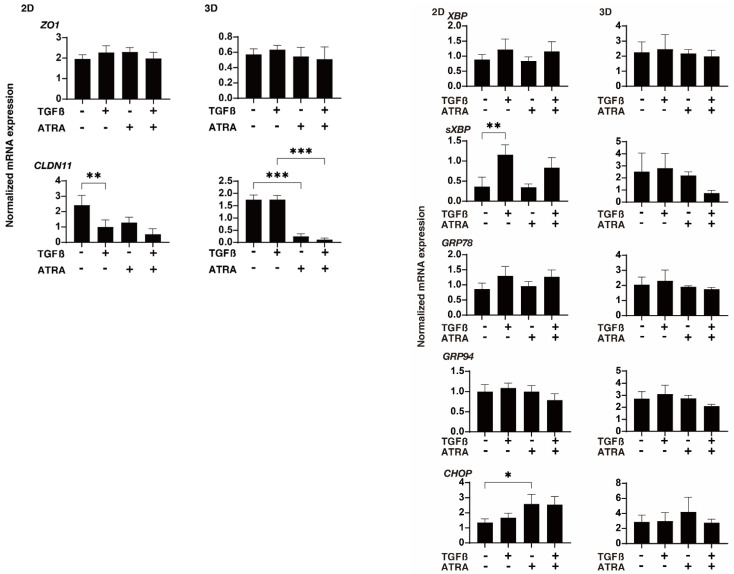
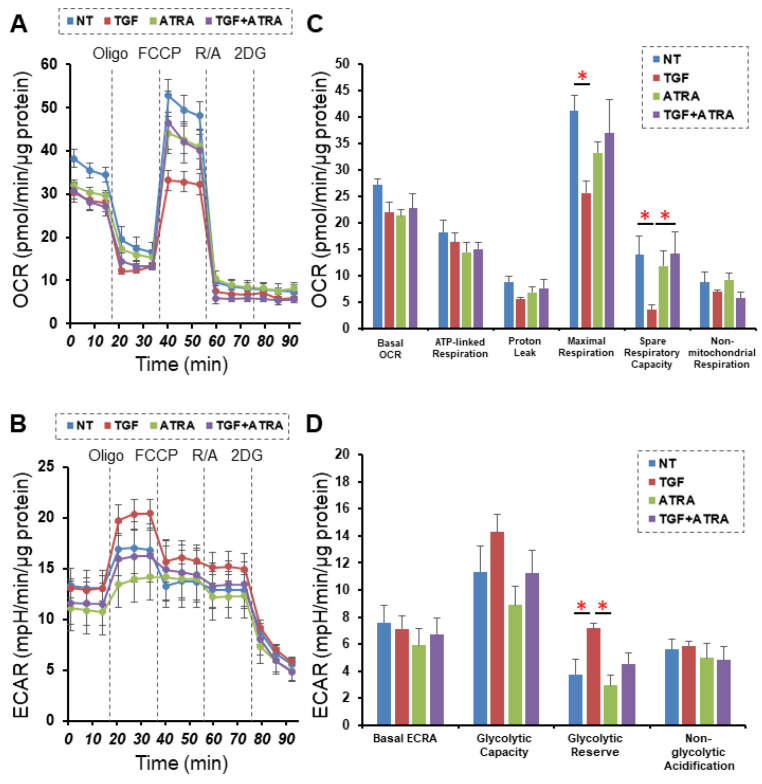
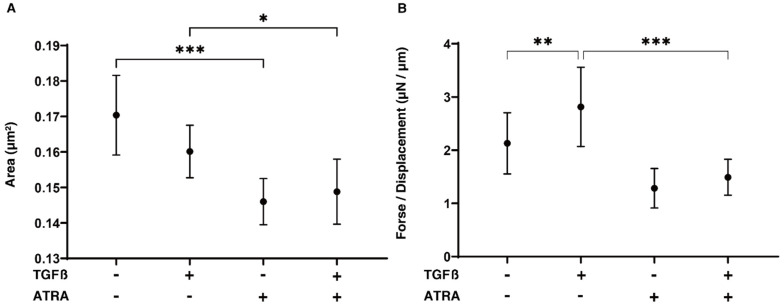
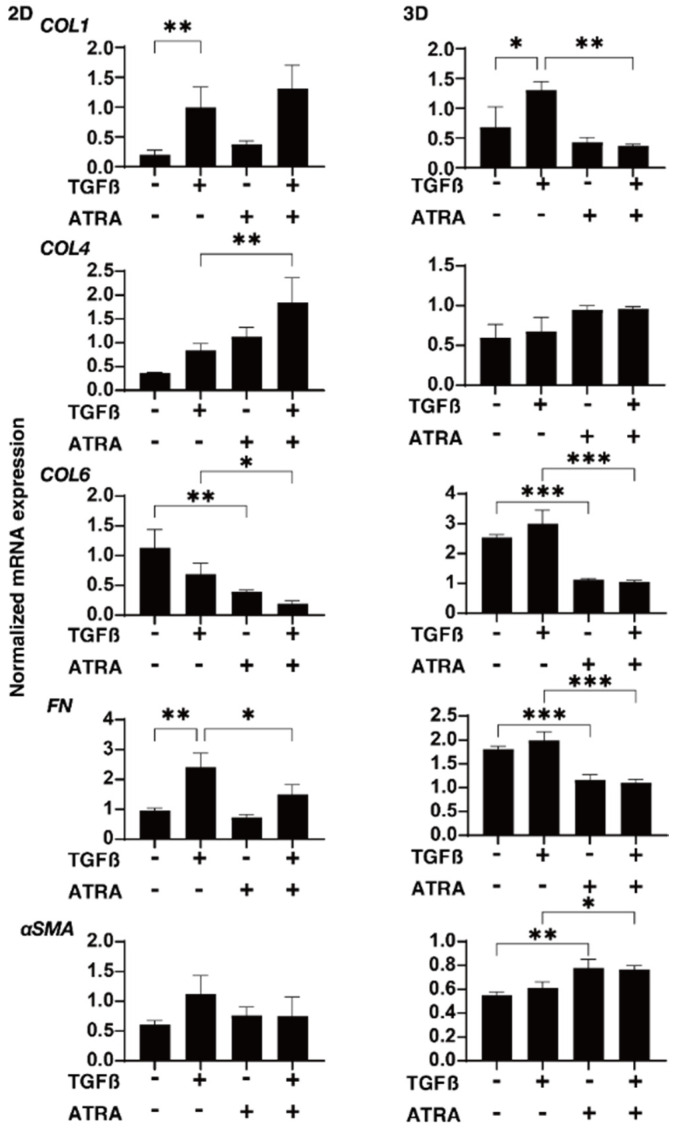
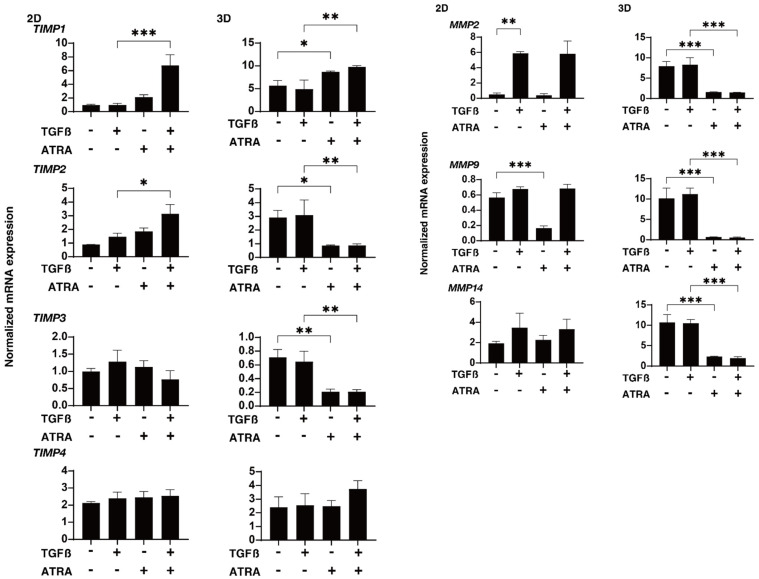
We report herein on the effects of all- retinoic acid (ATRA) on two-dimensional (2D) and three-dimensional (3D) cultures of human trabecular meshwork (HTM) cells that were treated with transforming growth factor β2 (TGF-β2). In the presence of 5 ng/mL TGF-β2, the effects of ATRA on the following were observed: (1) the barrier function of the 2D HTM monolayers, as determined by -endothelial electrical resistance (TEER) and fluorescein isothiocyanate (FITC) dextran permeability measurements; (2) a Seahorse cellular bio-metabolism analysis; (3) physical properties, including the size and stiffness, of 3D spheroids; (4) the gene expression of extracellular matrix (ECM) molecules, ECM modulators including tissue inhibitor of metalloproteinases (TIMPs), matrix metalloproteinases (MMPs), tight junction (TJ)-related molecules, and endoplasmic reticulum (ER)-stress-related factors. ATRA significantly inhibited the TGF-β2-induced increase in the TEER values and FITC dextran permeability of the 2D monolayers, while an ATRA monotreatment induced similar effects as TGF-β2. A real-time metabolic analysis revealed that ATRA significantly inhibited the TGF-β2-induced shift in metabolic reserve from mitochondrial oxidative phosphorylation to glycolysis in 2D HTM cells, whereas ATRA alone did not induce significant metabolic changes. In contrast, ATRA induced the formation of substantially downsized and softer 3D spheroids in the absence and presence of TGF-β2. The different effects induced by ATRA toward 2D and 3D HTM cells were also supported by the qPCR analysis of several proteins as above. The findings reported here indicate that ATRA may induce synergistic and beneficial effects on TGF-β2-treated 2D- and 3D-cultured HTM cells; those effects varied significantly between the 2D and 3D cultures.
我们在此报告全反式视黄酸(ATRA)对转化生长因子β2(TGF-β2)处理的人眼小梁网(HTM)细胞的二维(2D)和三维(3D)培养物的影响。在存在 5ng/mL TGF-β2 的情况下,观察到 ATRA 对以下方面的影响:(1)通过内皮细胞电阻(TEER)和荧光素异硫氰酸酯(FITC)葡聚糖通透性测量来确定 2D HTM 单层的屏障功能;(2)进行 Seahorse 细胞生物代谢分析;(3)包括大小和硬度在内的 3D 球体的物理特性;(4)细胞外基质(ECM)分子的基因表达,包括组织金属蛋白酶抑制剂(TIMPs)、基质金属蛋白酶(MMPs)、紧密连接(TJ)相关分子和内质网(ER)应激相关因子的 ECM 调节剂。ATRA 显著抑制 TGF-β2 诱导的 2D 单层 TEER 值和 FITC 葡聚糖通透性的增加,而 ATRA 单一处理诱导的效果与 TGF-β2 相似。实时代谢分析表明,ATRA 显著抑制 TGF-β2 诱导的 2D HTM 细胞中线粒体氧化磷酸化向糖酵解的代谢储备转移,而 ATRA 单独处理不会引起明显的代谢变化。相反,在不存在和存在 TGF-β2 的情况下,ATRA 诱导形成明显缩小且更柔软的 3D 球体。ATRA 对 2D 和 3D HTM 细胞的不同作用也得到了上述几种蛋白质的 qPCR 分析的支持。这里报道的发现表明,ATRA 可能对 TGF-β2 处理的 2D 和 3D 培养 HTM 细胞产生协同和有益的影响;这些影响在 2D 和 3D 培养物之间存在显著差异。