Department of Physiotherapy, University of Bydgoszcz, Unii Lubelskiej 4, 85-059 Bydgoszcz, Poland.
Department of Neurosurgery, 10th Military Research Hospital and Polyclinic, 85-681 Bydgoszcz, Poland.
Int J Environ Res Public Health. 2022 Aug 31;19(17):10871. doi: 10.3390/ijerph191710871.
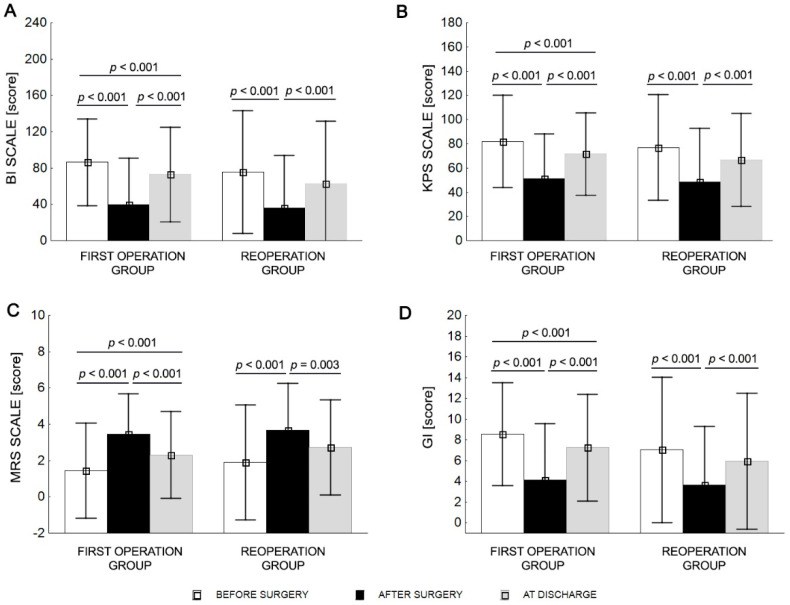
Repeat surgery is often required to treat brain tumor recurrences. Here, we compared the functional state and rehabilitation of patients undergoing initial and repeat surgery for brain tumors to establish their individual risks that might impact management. In total, 835 patients underwent operations, and 139 (16.6%) required rehabilitation during the inpatient stay. The Karnofsky performance status, Barthel index, and the modified Rankin scale were used to assess functional status, and the gait index was used to assess gait efficiency. Motor skills, postoperative complications, and length of hospital stay were recorded. Patients were classified into two groups: first surgery ( = 103) and repeat surgery ( = 30). Eighteen percent of patients required reoperations, and these patients required prolonged postoperative rehabilitation as often as those operated on for the first time. Rehabilitation was more often complicated in the repeat surgery group ( = 0.047), and the complications were more severe and persistent. Reoperated patients had significantly worse motor function and independence in activities of daily living before surgery and at discharge, but the deterioration after surgery affected patients in the first surgery group to a greater extent according to all metrics ( < 0.001). The length of hospital stay was similar in both groups. These results will be useful for tailoring postoperative rehabilitation during a hospital stay on the neurosurgical ward as well as planning discharge requirements after leaving the hospital.
重复手术常常是治疗脑肿瘤复发的必要手段。在这里,我们比较了首次和再次接受脑肿瘤手术患者的功能状态和康复情况,以确定可能影响治疗管理的个体风险。共有 835 名患者接受了手术,139 名(16.6%)在住院期间需要康复治疗。我们使用卡氏功能状态量表(Karnofsky performance status)、巴氏指数(Barthel index)和改良 Rankin 量表(modified Rankin scale)来评估功能状态,并用步态指数(gait index)来评估步态效率。记录了运动技能、术后并发症和住院时间。患者被分为两组:首次手术组(=103)和再次手术组(=30)。18%的患者需要再次手术,这些患者的术后康复时间和首次手术患者一样长。再次手术组的康复治疗更常出现并发症(=0.047),且并发症更严重、更持久。再次手术患者术前和出院时的运动功能和日常生活活动的独立性明显较差,但根据所有指标,术后恶化对首次手术组患者的影响更大(<0.001)。两组患者的住院时间相似。这些结果将有助于在神经外科病房制定住院期间的术后康复计划,并规划出院后的需求。