Kim Seon-Chil
Department of Biomedical Engineering, School of Medicine, Keimyung University, 1095 Dalgubeol-daero, Daegu 42601, Korea.
Materials (Basel). 2022 Sep 1;15(17):6075. doi: 10.3390/ma15176075.
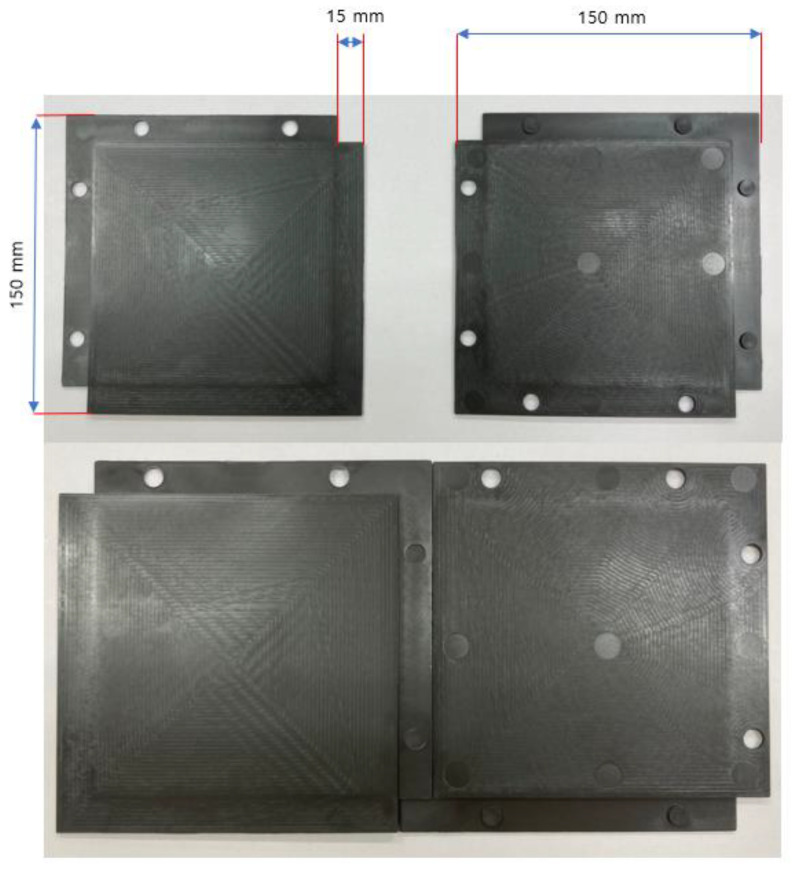
During medical diagnoses, X-ray shielding barriers are used to protect against direct and indirect X-rays. Currently, lead is used as the primary material for shielding barriers; however, the demand for eco-friendly shielding barriers has been increasing. Conventionally, shielding barriers are manufactured using a mechanically bonded combination of lead and aluminum; however, in this study, a plastic-based injection-molded product was developed using tungsten as an eco-friendly alternative to lead. A new process technology was required for mixing tungsten-which can be difficult to process-with a polymer. Consequently, the mixing conditions within the injection molding machine and the related compounding technology factors were analyzed. The process technology considered the pre-mixing method using powdery polymer, particle dispersion method, number of screw rotations, and amount of filler input. The product's shielding performance was then analyzed. The tungsten content of the 2-mm thick barrier manufactured using the proposed method was 90 wt%, and the lead equivalent was 0.321 mmPb. To increase the effectiveness of injection molding in the manufacturing process, specific hourly compounding conditions were proposed. Consequently, the process technology method developed in this study can be considered suitable for manufacturing various shielding barriers.
在医学诊断过程中,X射线屏蔽屏障用于防护直接和间接X射线。目前,铅被用作屏蔽屏障的主要材料;然而,对环保型屏蔽屏障的需求一直在增加。传统上,屏蔽屏障是通过铅和铝的机械结合制造的;然而,在本研究中,开发了一种以塑料为基础的注塑产品,使用钨作为铅的环保替代品。需要一种新工艺技术来将难以加工的钨与聚合物混合。因此,分析了注塑机内的混合条件以及相关的复合技术因素。该工艺技术考虑了使用粉末状聚合物的预混合方法、颗粒分散方法、螺杆转速和填料输入量。然后分析了产品的屏蔽性能。使用所提出的方法制造的2毫米厚屏障的钨含量为90 wt%,铅当量为0.321毫米铅。为了提高制造过程中注塑的有效性,提出了特定的每小时复合条件。因此,本研究中开发的工艺技术方法可被认为适用于制造各种屏蔽屏障。