Department of Anatomy, Histology and Embryology, School of Basic Medical Sciences, Health Science Center, Peking University, Beijing 100191, China.
Department of Basic Medical Sciences, School of Medicine, Tsinghua University, Beijing 100084, China.
Nutrients. 2022 Aug 26;14(17):3518. doi: 10.3390/nu14173518.
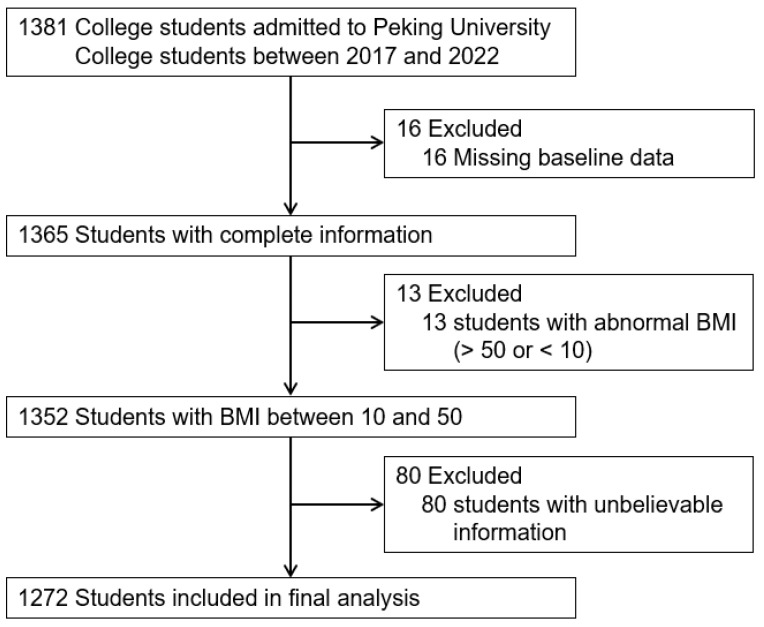
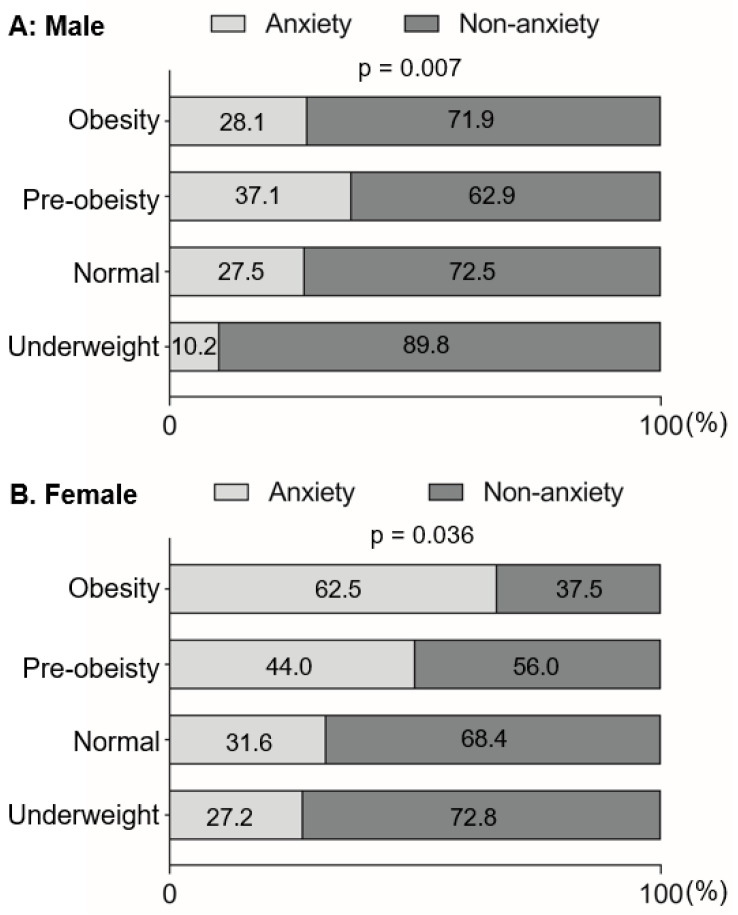
Anxiety is a common disorder among college students, especially those with obesity. Obesity contributes to metabolic disorders and disturbs the neural functions, further leading to anxiety. In this cross-sectional study, we aimed to determine the association between obesity and anxiety among college students and identified the potential factors for obesity-associated anxiety. We evaluated the intervention effects of calorie restriction on anxiety. Self-reported questionnaires were distributed to 1381 college students from January to March in 2021. Anxiety was measured by the State-Trait Anxiety Inventory (STAI). Participants were classified into anxiety and non-anxiety groups according to their STAI scores. Chi-squared test and logistic regression were used to analyze the potential factors. We found that 383 college students exhibited anxiety, accounting for 30.1% among all included college students, which was higher than the global average. The association between anxiety and obesity was observed among college students (p = 0.009), especially in males (p = 0.007). We identified that pre-obesity (p = 0.012), unhealthy calorie intake (p = 0.001), dieting (p = 0.003) and high academic year (p = 0.006) as the risk factors for anxiety and found that the long sleep duration was a protective factor for anxiety (p < 0.001). We found that more obese students showed an improvement of anxiety than the underweight students after calorie restriction (p < 0.001). Collectively, our findings suggest that obesity-associated anxiety is prevalent among the college students and could be alleviated by moderate calorie restriction. It is necessary for students to receive anxiety management in their college life. Additionally, the proper calorie restriction should be promoted to help students protect against obesity and obesity-associated anxiety.
焦虑是大学生中常见的障碍,尤其是肥胖的大学生。肥胖会导致代谢紊乱和神经功能障碍,进一步导致焦虑。在这项横断面研究中,我们旨在确定肥胖与大学生焦虑之间的关联,并确定肥胖相关焦虑的潜在因素。我们评估了热量限制对焦虑的干预效果。我们于 2021 年 1 月至 3 月向 1381 名大学生发放了自填式问卷。焦虑采用状态-特质焦虑量表(STAI)进行测量。根据 STAI 评分,将参与者分为焦虑组和非焦虑组。采用卡方检验和 logistic 回归分析潜在因素。我们发现,有 383 名大学生表现出焦虑,占所有纳入大学生的 30.1%,高于全球平均水平。我们观察到大学生的焦虑与肥胖之间存在关联(p = 0.009),尤其是男性(p = 0.007)。我们确定了肥胖前期(p = 0.012)、不健康的热量摄入(p = 0.001)、节食(p = 0.003)和高学年(p = 0.006)是焦虑的危险因素,发现长睡眠时长是焦虑的保护因素(p < 0.001)。我们发现,与消瘦的学生相比,热量限制后肥胖程度较高的学生焦虑改善更为明显(p < 0.001)。总的来说,我们的研究结果表明,肥胖相关的焦虑在大学生中很常见,可以通过适度的热量限制来缓解。在大学生活中,学生需要接受焦虑管理。此外,应提倡适当的热量限制,帮助学生预防肥胖和肥胖相关的焦虑。