
工业4.0对注塑成型零件的在线人工智能质量控制
Industry 4.0 In-Line AI Quality Control of Plastic Injection Molded Parts.
作者信息
Aminabadi Saeid Saeidi, Tabatabai Paul, Steiner Alexander, Gruber Dieter Paul, Friesenbichler Walter, Habersohn Christoph, Berger-Weber Gerald
机构信息
Department of Polymer Engineering and Science, Montanuniversitaet Leoben, Otto Gloeckel str. 2, 8700 Leoben, Austria.
Polymer Competence Center Leoben GmbH, Rosegger str. 12, 8700 Leoben, Austria.
出版信息
Polymers (Basel). 2022 Aug 29;14(17):3551. doi: 10.3390/polym14173551.
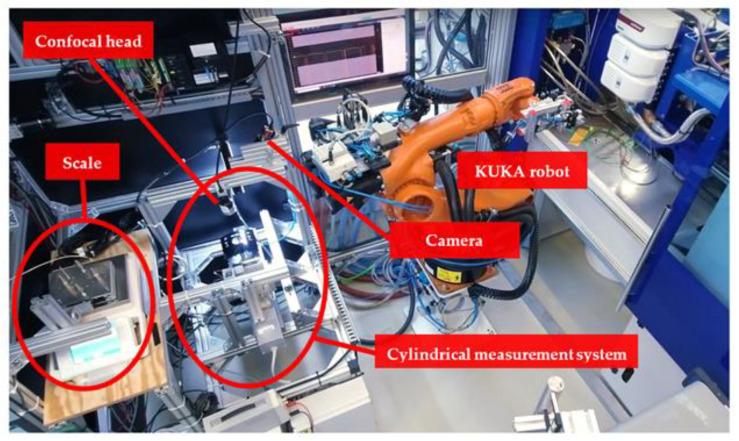
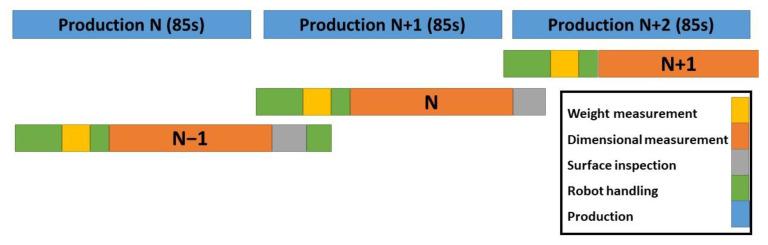
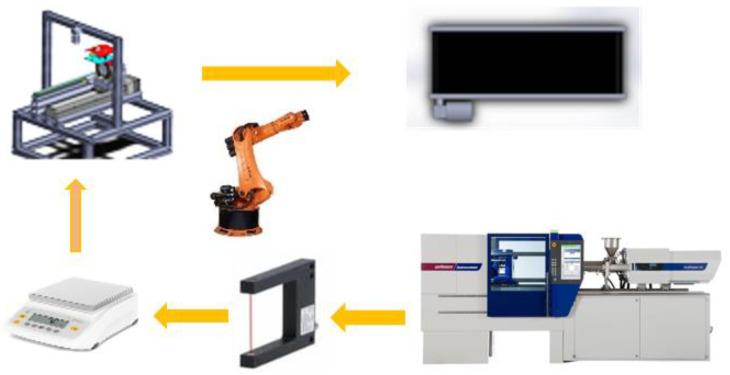
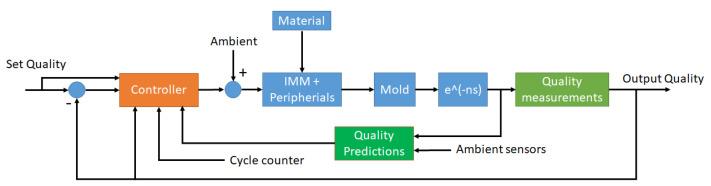
Automatic in-line process quality control plays a crucial role to enhance production efficiency in the injection molding industry. Industry 4.0 is leading the productivity and efficiency of companies to minimize scrap rates and strive for zero-defect production, especially in the injection molding industry. In this study, a fully automated closed-loop injection molding (IM) setup with a communication platform via OPC UA was built in compliance with Industry 4.0. The setup included fully automated inline measurements, in-line data analysis, and an AI control system to set the new machine parameters via the OPC UA communication protocol. The surface quality of the injection molded parts was rated using the ResNet-18 convolutional neural network, which was trained on data gathered by a heuristic approach. Further, eight different machine learning models for predicting the part quality (weight, surface quality, and dimensional properties) and for predicting sensor data were trained using data from a variety of production information sources, including in-mold sensors, injection molding machine (IMM) sensors, ambient sensors, and inline product quality measurements. These models are the backbone of the AI control system, which is a heuristic model predictive control (MPC) method. This method was applied to find new sets of machine parameters during production to control the specified part quality feature. The control system and predictive models were successfully tested for two groups of quality features: Geometry control and surface quality control. Control parameters were limited to injection speed and holding pressure. Moreover, the geometry control was repeated with mold temperature as an additional control parameter.
在线自动过程质量控制对于提高注塑行业的生产效率起着至关重要的作用。工业4.0引领着企业的生产力和效率,以最大限度地降低废品率并追求零缺陷生产,尤其是在注塑行业。在本研究中,构建了一个符合工业4.0的、通过OPC UA具有通信平台的全自动闭环注塑(IM)装置。该装置包括全自动在线测量、在线数据分析以及一个通过OPC UA通信协议设置新机器参数的人工智能控制系统。注塑部件的表面质量使用ResNet-18卷积神经网络进行评级,该网络是基于通过启发式方法收集的数据进行训练的。此外,使用来自各种生产信息源的数据,包括模内传感器、注塑机(IMM)传感器、环境传感器和在线产品质量测量数据,训练了八个不同的机器学习模型,用于预测部件质量(重量、表面质量和尺寸特性)以及预测传感器数据。这些模型是人工智能控制系统的核心,该系统是一种启发式模型预测控制(MPC)方法。该方法用于在生产过程中找到新的机器参数集,以控制指定的部件质量特征。控制系统和预测模型针对两组质量特征成功进行了测试:几何形状控制和表面质量控制。控制参数限于注射速度和保压压力。此外,以模具温度作为附加控制参数重复进行几何形状控制。









 Zotero 插件