
基于拉丁超立方抽样和约束生成逆设计网络的液态二氧化硅阵列透镜多目标优化
Multi-Objective Optimization of Liquid Silica Array Lenses Based on Latin Hypercube Sampling and Constrained Generative Inverse Design Networks.
作者信息
Chang Hanjui, Lu Shuzhou, Sun Yue, Zhang Guangyi, Rao Longshi
机构信息
Department of Mechanical Engineering, College of Engineering, Shantou University, Shantou 515063, China.
Intelligent Manufacturing Key Laboratory of Ministry of Education, Shantou University, Shantou 515063, China.
出版信息
Polymers (Basel). 2023 Jan 18;15(3):499. doi: 10.3390/polym15030499.
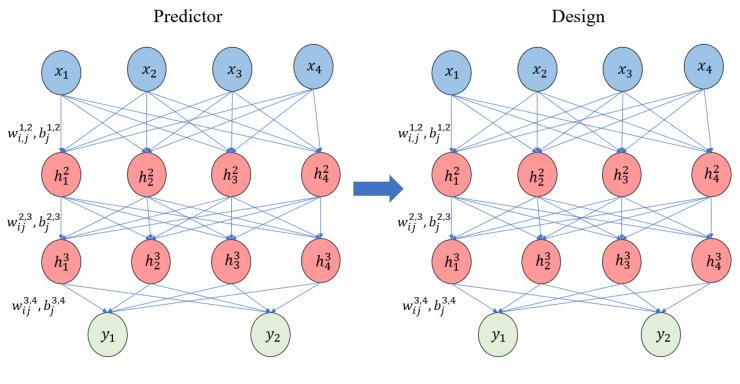
Injection molding process parameters have a great impact on plastic production quality, manufacturing cost, and molding efficiency. This study proposes to apply the method of Latin hypercube sampling, and to combine the response surface model and "Constraint Generation Inverse Design Network (CGIDN)" to achieve multi-objective optimization of the injection process, shorten the time to find the optimal process parameters, and improve the production efficiency of plastic parts. Taking the LSR lens array of automotive LED lights as the research object, the residual stress and volume shrinkage were taken as the optimization objectives, and the filling time, melt temperature, maturation time, and maturation pressure were taken as the influencing factors to obtain the optimization target values, and the response surface models between the volume shrinkage rate and the influencing factors were established. Based on the "Constraint-Generated Inverse Design Network", the optimization was independently sought within the set parameters to obtain the optimal combination of process parameters to meet the injection molding quality of plastic parts. The results showed that the optimal residual stress value and volume shrinkage rate were 11.96 MPa and 4.88%, respectively, in the data set of 20 Latin test samples obtained based on Latin hypercube sampling, and the optimal residual stress value and volume shrinkage rate were 8.47 MPa and 2.83%, respectively, after optimization by the CGIDN method. The optimal process parameters obtained by CGIDN optimization were a melt temperature of 30 °C, filling time of 2.5 s, maturation pressure of 40 MPa, and maturation time of 15 s. The optimization results were obvious and showed the feasibility of the data-driven injection molding process optimization method based on the combination of Latin hypercube sampling and CGIDN.
注塑工艺参数对塑料制品的生产质量、制造成本和成型效率有很大影响。本研究提出应用拉丁超立方抽样方法,并结合响应面模型和“约束生成逆设计网络(CGIDN)”来实现注塑工艺的多目标优化,缩短寻找最优工艺参数的时间,提高塑料零件的生产效率。以汽车LED灯的LSR透镜阵列作为研究对象,将残余应力和体积收缩率作为优化目标,将填充时间、熔体温度、熟化时间和熟化压力作为影响因素,得出优化目标值,并建立了体积收缩率与各影响因素之间的响应面模型。基于“约束生成逆设计网络”,在设定参数范围内独立寻求优化方案,以获得满足塑料零件注塑成型质量的最优工艺参数组合。结果表明,在基于拉丁超立方抽样得到的20个拉丁测试样本数据集中,最优残余应力值和体积收缩率分别为11.96MPa和4.88%,经CGIDN方法优化后,最优残余应力值和体积收缩率分别为8.47MPa和2.83%。经CGIDN优化得到的最优工艺参数为熔体温度30℃、填充时间2.5s、熟化压力40MPa、熟化时间15s。优化效果明显,表明了基于拉丁超立方抽样与CGIDN相结合的数据驱动注塑工艺优化方法的可行性。




 Zotero 插件