Rattee Josh, Sims Laura, Leswick David A, Obaid Haron
Faculty of Medicine, University of Saskatchewan, Saskatoon, SK, Canada.
Division of Orthopedic Surgery, Department of Surgery, Faculty of Medicine, University of Saskatchewan, Saskatoon, SK, Canada.
JSES Int. 2022 Jul 3;6(5):809-814. doi: 10.1016/j.jseint.2022.06.003. eCollection 2022 Sep.
The biomechanical role of the proximal long head of the biceps tendon (PLHB) in glenohumeral joint stability remains controversial. This retrospective study aims to correlate between humeral head migration and PLHB pathology in patients with and without rotator cuff tendon tears using imaging.
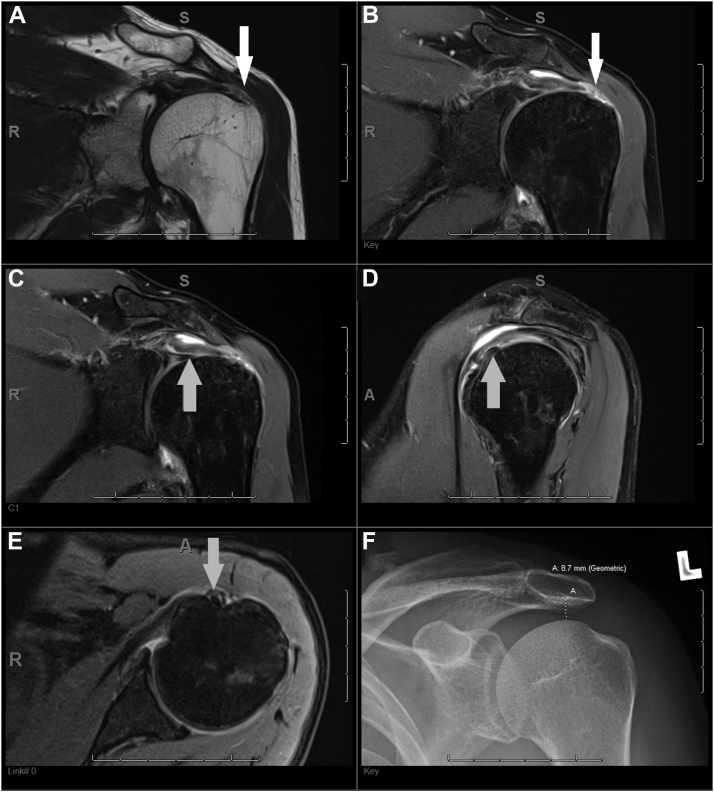
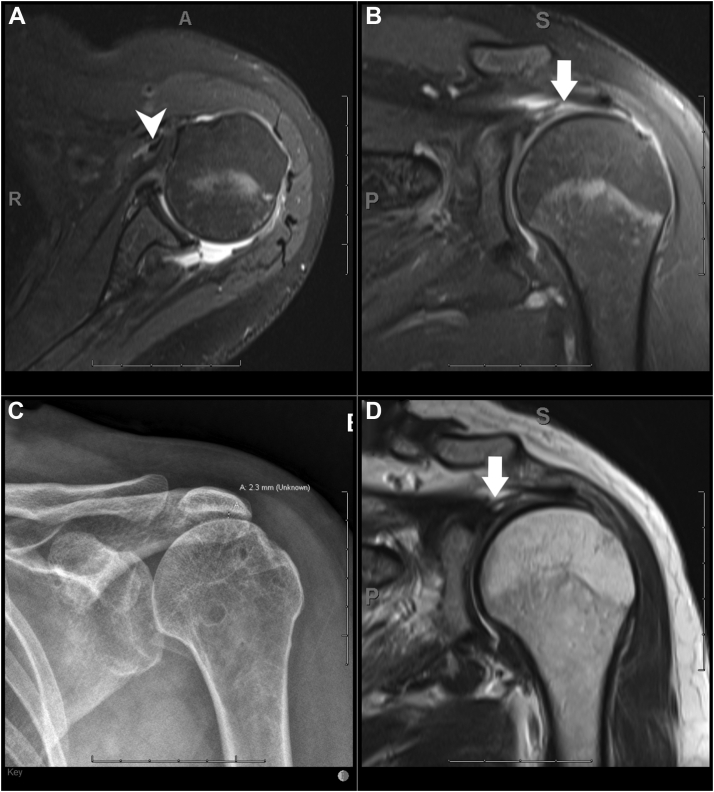
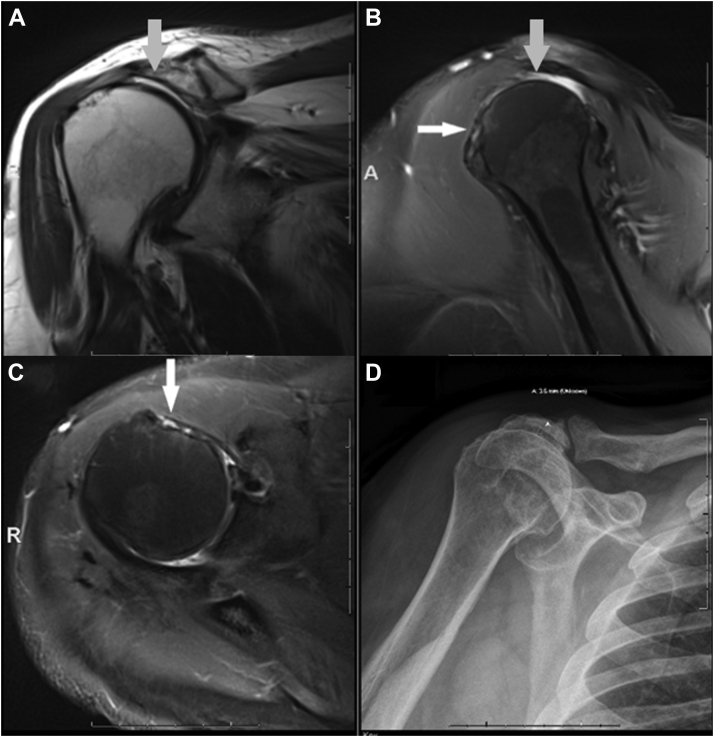
Seventy-nine patients who underwent 3T magnetic resonance imaging of the shoulder were retrospectively reviewed. Imaging findings were documented by a fellowship-trained musculoskeletal radiologist. PLHB tendon diameter change, contour irregularity, and signal intensity change were assessed. Rotator cuff status was given a binary assignment of intact vs. torn. Radiographs were used for measurement of the acromiohumeral distance and a cutoff value of 7 mm was set as a lower limit of normal.
In the cohort of 79 shoulders, 41.8% (33/79) of patients had intact PLHB tendon and rotator cuff, 26.6% (21/79) demonstrated isolated PLHB tendon pathology, 13.9% (11/79) demonstrated isolated rotator cuff tears, and 17.7% (14/79) demonstrated concomitant PLHB tendon pathology and rotator cuff tears. Acromiohumeral distance was preserved in 97.0% (32/33) of patients with intact PLHB tendon and rotator cuff, 28.6% (6/21) of patients with isolated PLHB tendon pathology, 81.8% (9/11) of patients with isolated rotator cuff tears, and 14.3% (2/14) of patients with concomitant PLHB tendon pathology and rotator cuff tears ( < .0001).
Results of this study have shown that a statistical correlation was present between superior humeral head migration and PLHB tendon pathology with or without rotator cuff tears, compared to rotator cuff pathology alone. Findings suggest that intact PLHB tendon plays an important role in glenohumeral stability.
肱二头肌长头肌腱近端(PLHB)在盂肱关节稳定性中的生物力学作用仍存在争议。本回顾性研究旨在通过影像学分析有或无肩袖肌腱撕裂患者的肱骨头移位与PLHB病变之间的相关性。
回顾性分析79例行肩部3T磁共振成像的患者。成像结果由一名经过专科培训的肌肉骨骼放射科医生记录。评估PLHB肌腱直径变化、轮廓不规则及信号强度变化。肩袖状态分为完整或撕裂两种情况。通过X线片测量肩峰下间隙,将7mm的临界值设定为正常下限。
在79例肩部病例中,41.8%(33/79)的患者PLHB肌腱和肩袖完整,26.6%(21/79)表现为孤立的PLHB肌腱病变,13.9%(11/79)表现为孤立的肩袖撕裂,17.7%(14/79)表现为PLHB肌腱病变与肩袖撕裂并存。肩峰下间隙在PLHB肌腱和肩袖完整的患者中97.0%(32/33)得以保留,孤立PLHB肌腱病变的患者中28.6%(6/21)得以保留,孤立肩袖撕裂的患者中81.8%(9/11)得以保留,PLHB肌腱病变与肩袖撕裂并存的患者中14.3%(2/14)得以保留(P<0.0001)。
本研究结果表明,与单纯肩袖病变相比,无论有无肩袖撕裂,肱骨头向上移位与PLHB肌腱病变之间均存在统计学相关性。研究结果提示,完整的PLHB肌腱在盂肱关节稳定性中起重要作用。