Ning Peng, Jiang Xiaobo, Yang Jing, Zhang Jiaxing, Yang Fan, Cao Hongyi
Department of Endocrine and Metabolism, Geriatric Diseases Institute of Chengdu/Cancer Prevention and Treatment Institute of Chengdu, Chengdu Fifth People's Hospital(The Second Clinical Medical College, Affiliated Fifth People's Hospital of Chengdu University of Traditional Chinese Medicine), Chengdu, China.
Department of Cardiovascular Medicine, Geriatric Diseases Institute of Chengdu/Cancer Prevention and Treatment Institute of Chengdu, Chengdu Fifth People's Hospital(The Second Clinical Medical College, Affiliated Fifth People's Hospital of Chengdu University of Traditional Chinese Medicine), Chengdu, China.
Front Physiol. 2022 Aug 23;13:957968. doi: 10.3389/fphys.2022.957968. eCollection 2022.
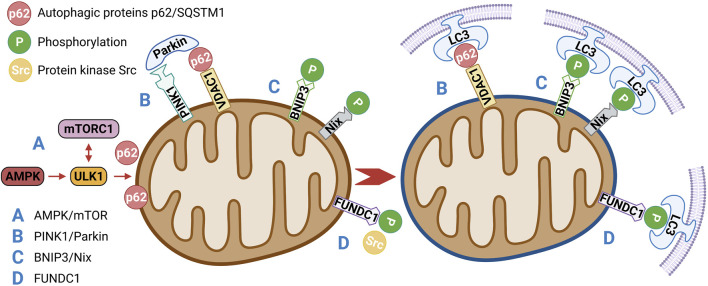
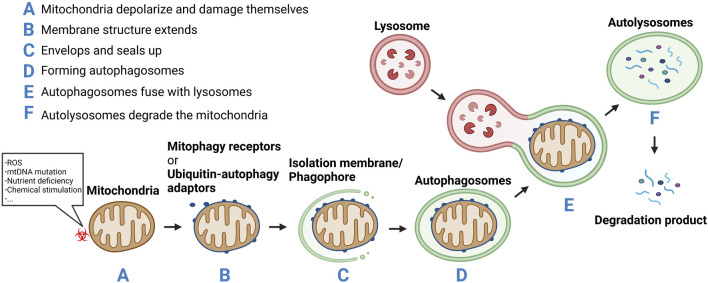
Glucose and lipid metabolism disorders caused by insulin resistance (IR) can lead to metabolic disorders such as diabetes, obesity, and the metabolic syndrome. Early and targeted intervention of IR is beneficial for the treatment of various metabolic disorders. Although significant progress has been made in the development of IR drug therapies, the state of the condition has not improved significantly. There is a critical need to identify novel therapeutic targets. Mitophagy is a type of selective autophagy quality control system that is activated to clear damaged and dysfunctional mitochondria. Mitophagy is highly regulated by various signaling pathways, such as the AMPK/mTOR pathway which is involved in the initiation of mitophagy, and the PINK1/Parkin, BNIP3/Nix, and FUNDC1 pathways, which are involved in mitophagosome formation. Mitophagy is involved in numerous human diseases such as neurological disorders, cardiovascular diseases, cancer, and aging. However, recently, there has been an increasing interest in the role of mitophagy in metabolic disorders. There is emerging evidence that normal mitophagy can improve IR. Unfortunately, few studies have investigated the relationship between mitophagy and IR. Therefore, we set out to review the role of mitophagy in IR and explore whether mitophagy may be a potential new target for IR therapy. We hope that this effort serves to stimulate further research in this area.
胰岛素抵抗(IR)引起的葡萄糖和脂质代谢紊乱可导致糖尿病、肥胖症和代谢综合征等代谢紊乱。对IR进行早期且有针对性的干预有利于治疗各种代谢紊乱。尽管IR药物治疗的研发取得了重大进展,但病情状况并未显著改善。迫切需要确定新的治疗靶点。线粒体自噬是一种选择性自噬质量控制系统,被激活以清除受损和功能失调的线粒体。线粒体自噬受到多种信号通路的高度调控,例如参与线粒体自噬起始的AMPK/mTOR通路,以及参与线粒体自噬体形成的PINK1/Parkin、BNIP3/Nix和FUNDC1通路。线粒体自噬涉及许多人类疾病,如神经疾病、心血管疾病、癌症和衰老。然而,最近,人们对线粒体自噬在代谢紊乱中的作用越来越感兴趣。有新证据表明正常的线粒体自噬可以改善IR。不幸的是,很少有研究调查线粒体自噬与IR之间的关系。因此,我们着手综述线粒体自噬在IR中的作用,并探讨线粒体自噬是否可能是IR治疗的潜在新靶点。我们希望这项工作有助于激发该领域的进一步研究。