The Ruth M. Rothstein CORE Center, Cook County Health, Chicago, Illinois, United States of America.
Rush University Medical Center, Chicago, Illinois, United States of America.
PLoS One. 2022 Sep 9;17(9):e0273323. doi: 10.1371/journal.pone.0273323. eCollection 2022.
The humoral response to SARS-CoV-2 can provide immunity and prevent reinfection. However, less is known about how the diversity, magnitude, and length of the antibody response after a primary infection is associated with symptoms, post-infection immunity, and post-vaccinated immunity.
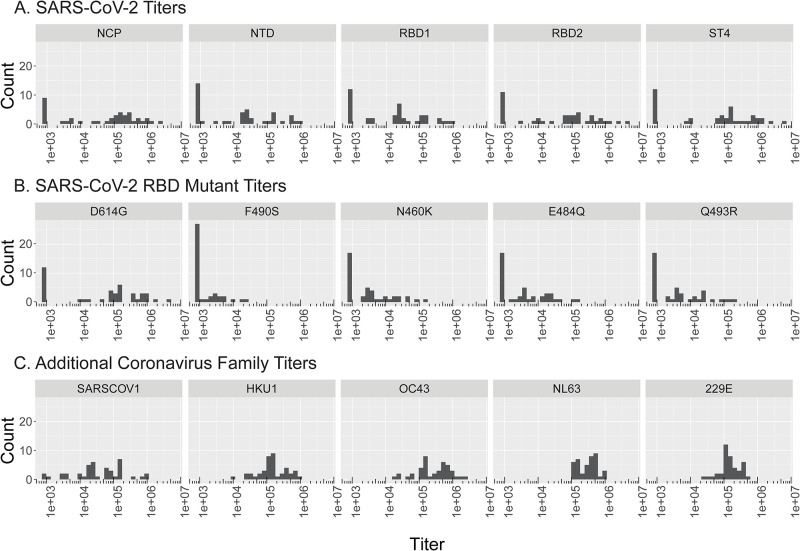
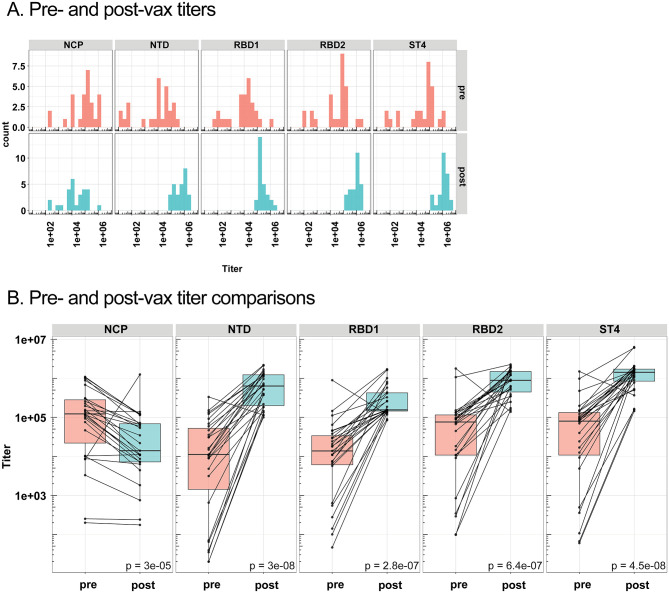
Cook County Health employees provided blood samples and completed an online survey 8-10 weeks after a PCR-confirmed positive SARS-CoV-2 test (pre-vaccinated, N = 41) and again, 1-4 weeks after completion of a 2-dose series mRNA BNT162b2 COVID-19 vaccine (post-vaccinated, N = 27). Associations were evaluated between SARS-CoV-2 antibody titers, participant demographics, and clinical characteristics. Antibody titers and angiotensin-converting enzyme 2 (ACE2) neutralization were compared before and after the mRNA BNT162b2 COVID-19 vaccine.
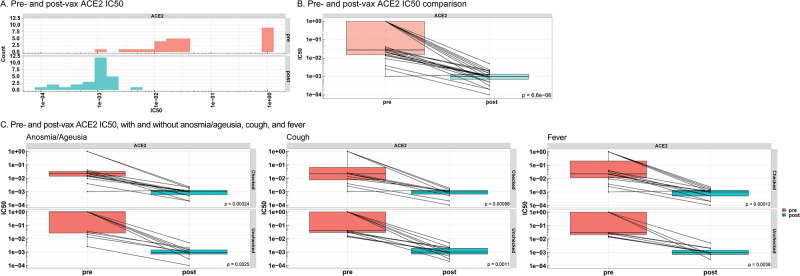
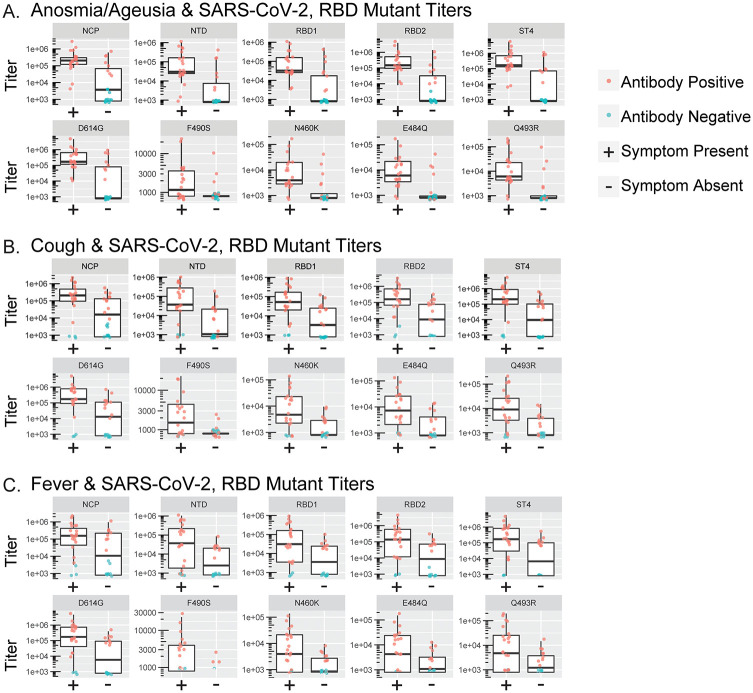
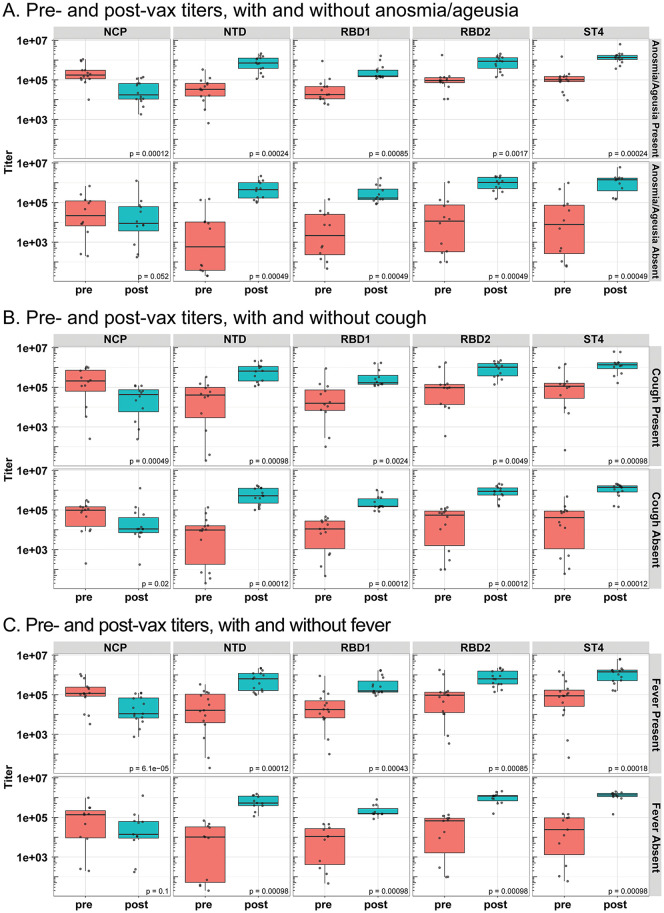
Antibody titers to the spike protein (ST4), receptor binding domain (RBD), and RBD mutant D614G were significantly associated with anosmia and ageusia, cough, and fever. Spike protein antibody titers and ACE2 neutralization were significantly higher in participants that presented with these symptoms. Antibody titers to the spike protein N-terminal domain (NTD), RBD, and ST4, and ACE2 IC50 were significantly higher in all post-vaccinated participant samples compared to pre-vaccinated participant sample, and not dependent on previously reported symptoms.
Spike protein antibody titers and ACE2 neutralization are associated with the presentation of anosmia and ageusia, cough, and fever after SARS-CoV-2 infection. Symptom response to previous SARS-CoV-2 infection did not influence the antibody response from subsequent vaccination. These results suggest a relationship between infection severity and the magnitude of the immune response and provide meaningful insights into COVID-19 immunity according to discrete symptom presentation.
针对 SARS-CoV-2 的体液免疫反应可提供免疫保护并防止再次感染。然而,人们对于初次感染后抗体反应的多样性、幅度和持续时间与症状、感染后免疫和接种疫苗后免疫之间的关联知之甚少。
库克县卫生部门的员工在 PCR 确证 SARS-CoV-2 阳性检测后 8-10 周(接种前,N=41)和完成 2 剂 mRNA BNT162b2 COVID-19 疫苗接种后 1-4 周(接种后,N=27)提供了血液样本并完成了在线调查。评估了 SARS-CoV-2 抗体滴度、参与者人口统计学特征和临床特征之间的关联。比较了 mRNA BNT162b2 COVID-19 疫苗接种前后的抗体滴度和血管紧张素转换酶 2(ACE2)中和作用。
刺突蛋白(ST4)、受体结合域(RBD)和 RBD 突变体 D614G 的抗体滴度与嗅觉丧失和味觉丧失、咳嗽和发热显著相关。出现这些症状的参与者的刺突蛋白抗体滴度和 ACE2 中和作用明显更高。与接种前的参与者样本相比,所有接种后的参与者样本中的刺突蛋白 N 端结构域(NTD)、RBD、ST4 和 ACE2 IC50 的抗体滴度均显著升高,且与先前报告的症状无关。
刺突蛋白抗体滴度和 ACE2 中和作用与 SARS-CoV-2 感染后嗅觉丧失和味觉丧失、咳嗽和发热的表现相关。先前 SARS-CoV-2 感染的症状反应并未影响随后接种疫苗的抗体反应。这些结果表明感染严重程度与免疫反应的幅度之间存在关系,并根据不同的症状表现为 COVID-19 免疫提供了有意义的见解。