Department of Ophthalmology, Saitama Medical Center, Dokkyo Medical University, 2-1-50 Minamikoshigaya, Koshigaya, Saitama, 343-0845, Japan.
Lively Eye Clinic, Soka, Saitama, Japan.
BMC Ophthalmol. 2022 Sep 10;22(1):366. doi: 10.1186/s12886-022-02590-w.
Acute acquired comitant esotropia induced by excessive digital device usage, especially smartphones (SAACE), has been increasing over the past few years. One suggested mechanism is convergence spasm induced by excessive near work, with refraining from digital device use considered to be an effective method for decreasing the degree of esodeviation. However, if symptoms persist and are untreated over time, recovery becomes more difficult. The present study evaluated the effects of topical cycloplegics on persistent SAACE untreated for over 1 year.
Patients with sustained SAACE that was untreated for over 1 year were evaluated. Digital device usage was discouraged and a topical cycloplegic, 0.4% tropicamide, was prescribed at bedtime. After obtaining informed consent, the 14 out of 23 enrolled patients who agreed to eye drop administration were defined as the study group, with the others serving as the controls. After a 3-month follow-up, patients who elected to undergo surgery were analyzed as the surgery group. Changes in esotropia angles, stereoacuity and diplopia complaints were evaluated after a 3-month follow-up.
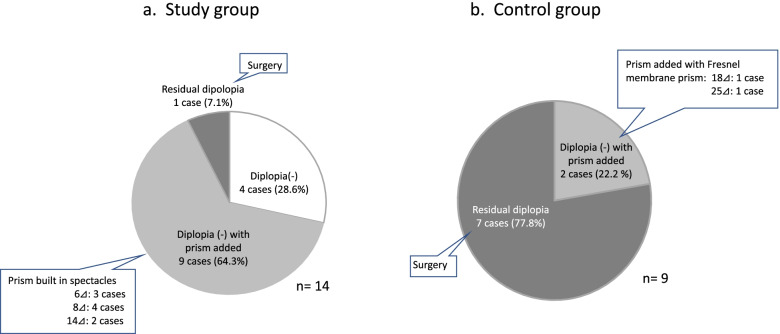
Esotropia angles decreased and stereoacuity improved after a 3-month treatment in the study group (P < 0.01). Diplopia disappeared in 13 patients (92.9%, totally disappeared or disappeared when using glasses with built-in prisms). Among 11 patients with untreated esotropia ranging from 1-3 years, decreases in esotropia angles were correlated to untreated esotropia duration (near: R = -0.6; distance: R = 0.7; both P < 0.05). Esotropia angles in the control group exhibited a tendency to increase while stereoacuity tended to deteriorate after the 3-month follow-up. As diplopia did not disappear in any patients, 7 elected to undergo surgery and were enrolled as the surgery group. While esotropia angles decreased in the study group, they were lower than the surgery group (P < 0.01), but higher than the control group (P < 0.01). Stereoacuity was worse in the control versus the study and surgery groups (both P < 0.05).
Results suggest short-acting topical cycloplegics are effective in SAACE patients with long untreated periods. Decreases in esotropia angles were negatively correlated to untreated esotropia duration, which suggests the necessity of early treatment.
近年来,由于过度使用数字设备(尤其是智能手机)而导致的急性获得性共同性内斜视(SAACE)不断增加。一种推测的机制是由过度近距离工作引起的集合痉挛,而避免使用数字设备被认为是减少斜视程度的有效方法。然而,如果症状持续存在且未得到及时治疗,恢复将变得更加困难。本研究评估了局部睫状肌麻痹剂对未经治疗持续超过 1 年的持续性 SAACE 的影响。
评估未经治疗持续超过 1 年的持续性 SAACE 患者。不鼓励使用数字设备,并在睡前开具 0.4%托品酰胺局部睫状肌麻痹剂。在获得知情同意后,同意滴眼的 23 名患者中的 14 名被定义为研究组,其余患者为对照组。经过 3 个月的随访,选择手术的患者被分析为手术组。在 3 个月的随访后,评估斜视角度、立体视锐度和复视主诉的变化。
研究组在 3 个月的治疗后斜视角度减小,立体视锐度提高(P<0.01)。复视在 13 名患者中消失(92.9%,完全消失或使用内置棱镜眼镜时消失)。在 11 名未经治疗的斜视角度为 1-3 年的患者中,斜视角度的减小与未经治疗的斜视持续时间呈负相关(近距离:R=-0.6;远距离:R=0.7;均 P<0.05)。对照组在 3 个月的随访后斜视角度有增加的趋势,立体视锐度有恶化的趋势。由于任何患者的复视都没有消失,7 名患者选择手术,并被纳入手术组。研究组的斜视角度虽然减小,但低于手术组(P<0.01),但高于对照组(P<0.01)。对照组的立体视锐度低于研究组和手术组(均 P<0.05)。
结果表明,短效局部睫状肌麻痹剂对未经治疗时间较长的 SAACE 患者有效。斜视角度的减小与未经治疗的斜视持续时间呈负相关,这表明需要早期治疗。