Kannan Abhishek S, Hartwell Matthew J, Grace Trevor, Hammond Eric, Soriano Kylen K J, Souza Richard B, Zhang Alan L
Department of Orthopaedic Surgery, University of California, San Francisco, San Francisco, California, USA.
Musculoskeletal and Quantitative Imaging Research Group, Department of Radiology and Biomedical Imaging, University of California, San Francisco, San Francisco, California, USA.
Orthop J Sports Med. 2022 Sep 5;10(9):23259671221121352. doi: 10.1177/23259671221121352. eCollection 2022 Sep.
Postoperative biomechanics after hip arthroscopy for femoroacetabular impingement syndrome (FAIS) are an outcome of interest, but correlation with patient-reported outcomes (PROs) remains unclear.
PURPOSE/HYPOTHESIS: The purpose of this study was to assess the correlation between changes in hip biomechanics in FAIS patients after hip arthroscopy and changes in PRO scores. We hypothesized that gait analysis would demonstrate significant correlations between pre- and postoperative changes in biomechanics and changes in PRO scores.
Descriptive laboratory study.
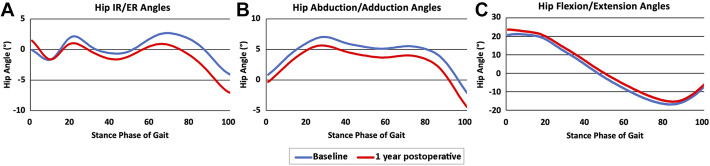
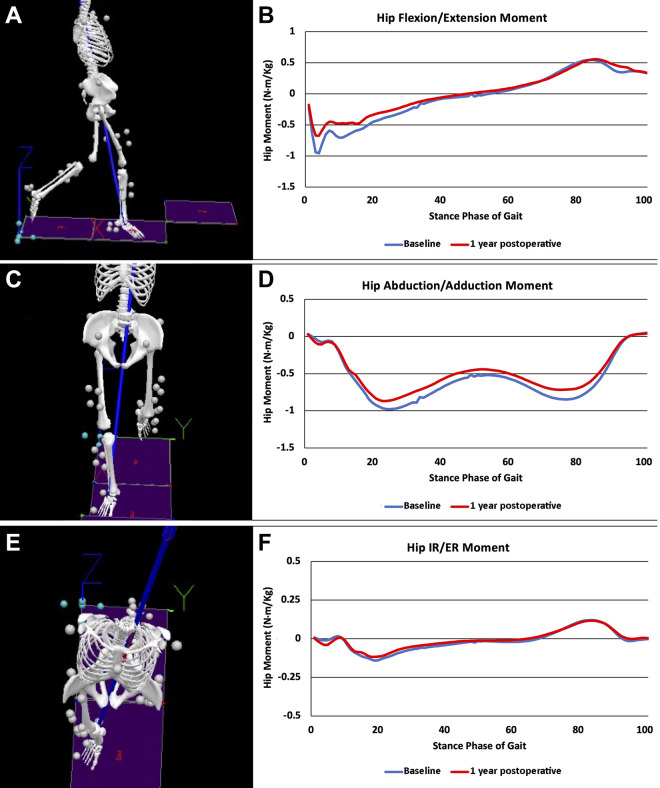
FAIS patients without dysplasia or arthritis who underwent primary hip arthroscopy for labral repair and femoroplasty underwent preoperative and 1-year postoperative 3-dimensional motion tracking and biomechanical testing during normal gait. Joint kinematics calculated included flexion/extension (sagittal plane), abduction/adduction (frontal plane), and internal/external rotation (transverse plane). Peak hip angles and moments were compared between baseline and 1-year postoperative measures. At baseline, 1-year, and 2-year postoperatively, patients completed the following PRO surveys: 12-Item Short Form Health Survey (SF-12), modified Harris Hip Score (mHHS), and Hip disability and Osteoarthritis Outcome Score (HOOS). Joint kinematics that significantly improved 1 year after surgery were assessed for correlations with PRO scores.
A total of 10 patients (12 hips) were enrolled prospectively. PROs significantly improved at 1 and 2 years postoperatively compared with baseline values for HOOS, mHHS, and SF-12 Physical Component Score, with all patients achieving the minimal clinically important difference (MCID) on the HOOS Sport/Recreation and Quality of Life subscales. From preoperatively to 1-year postoperatively, significant improvements were seen in peak hip abduction angle (from -2.3° ± 1.8° to -4.6° ± 1.8°; = .0058) and peak hip extension moment (from -1.03 ± 0.19 to -0.85 ± 0.20 N·m/kg; = .014); however, there were no significant correlations between these changes and the pre- to postoperative changes on any PRO scores.
Gait analysis of FAIS patients after hip arthroscopy demonstrated small, albeit significant, changes in postoperative hip kinetics and kinematics; however, these changes did not correlate with the large, clinically significant improvements in PROs at 1 year after surgery.
The results of this study suggest that the degree of improvement in short-term PROs after hip arthroscopy for FAIS may not be related to small changes in biomechanics postoperatively.
髋关节镜治疗股骨髋臼撞击综合征(FAIS)后的术后生物力学是一个值得关注的结果,但与患者报告结局(PROs)的相关性仍不明确。
目的/假设:本研究的目的是评估FAIS患者髋关节镜检查后髋关节生物力学变化与PRO评分变化之间的相关性。我们假设步态分析将显示生物力学术前和术后变化与PRO评分变化之间存在显著相关性。
描述性实验室研究。
对无发育异常或关节炎且接受初次髋关节镜下盂唇修复和股骨成形术的FAIS患者,在正常步态期间进行术前和术后1年的三维运动跟踪和生物力学测试。计算的关节运动学包括屈伸(矢状面)、外展/内收(额状面)和内/外旋转(横断面)。比较基线和术后1年测量的髋关节峰值角度和力矩。在基线、术后1年和2年,患者完成以下PRO调查:12项简明健康调查(SF-12)、改良Harris髋关节评分(mHHS)和髋关节残疾与骨关节炎转归评分(HOOS)。评估术后1年显著改善的关节运动学与PRO评分之间的相关性。
共前瞻性纳入10例患者(12髋)。与HOOS、mHHS和SF-12身体成分评分的基线值相比,PROs在术后1年和2年显著改善,所有患者在HOOS运动/娱乐和生活质量子量表上均达到最小临床重要差异(MCID)。从术前到术后1年,髋关节峰值外展角度(从-2.3°±1.8°至-4.6°±1.8°;P = .0058)和髋关节峰值伸展力矩(从-1.03±0.19至-0.85±0.20 N·m/kg;P = .014)有显著改善;然而,这些变化与任何PRO评分的术前至术后变化之间均无显著相关性。
FAIS患者髋关节镜检查后的步态分析显示术后髋关节动力学和运动学有微小但显著的变化;然而,这些变化与术后1年PROs的大幅临床显著改善无关。
本研究结果表明,FAIS髋关节镜检查后短期PROs的改善程度可能与术后生物力学的微小变化无关。