Department of Gastroenterology, The First Affiliated Hospital of Sun Yat-sen University, Guangzhou, China.
Department of Radiology, The First Affiliated Hospital of Sun Yat-sen University, Guangzhou, China.
Front Immunol. 2022 Aug 25;13:935275. doi: 10.3389/fimmu.2022.935275. eCollection 2022.
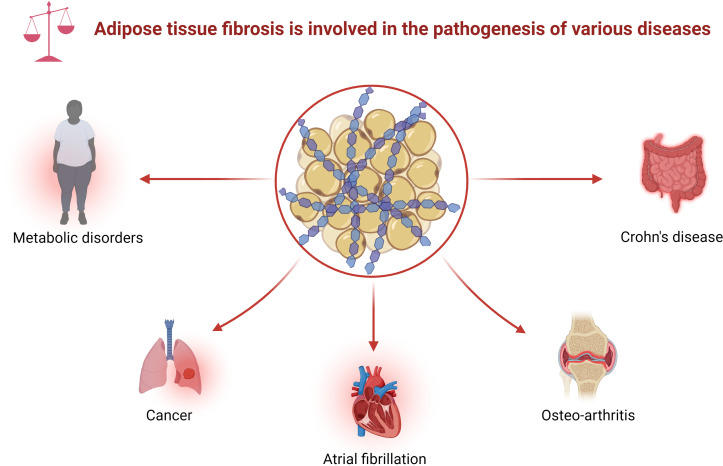
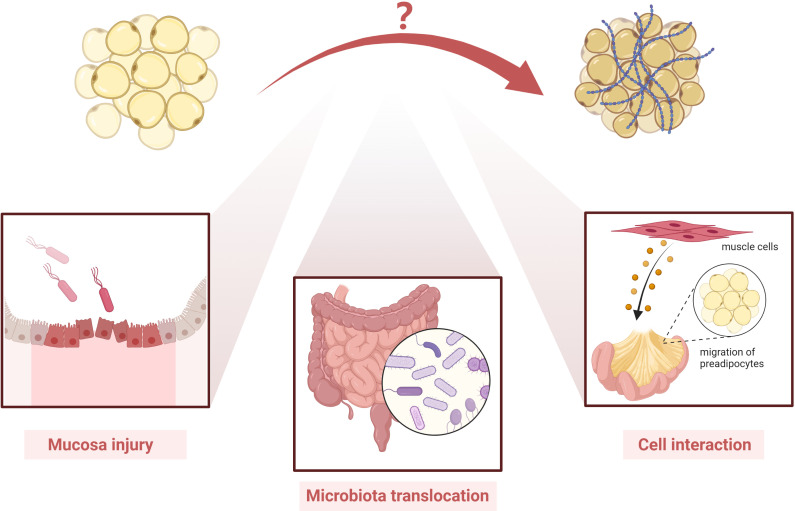
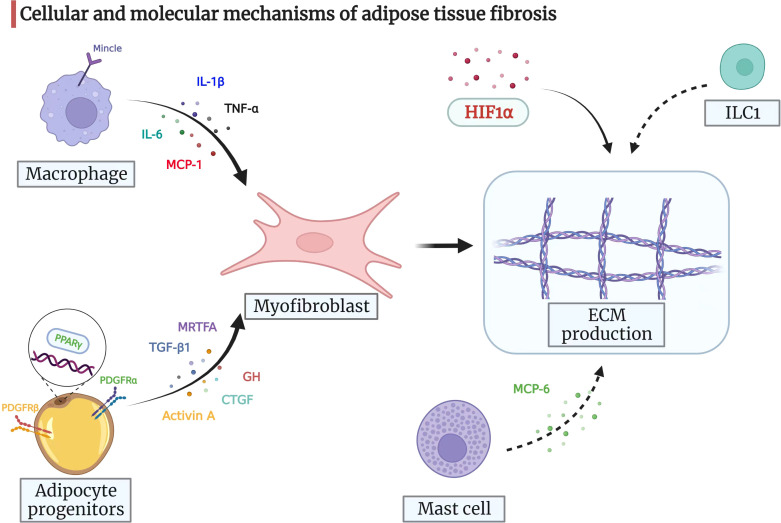
Creeping fat is a specific feature of Crohn's disease (CD) and is characterized by mesenteric fat wrapping around the intestine. It highly correlates with intestinal transmural inflammation, muscular hypertrophy, fibrosis, and stricture formation. However, the pathogenesis of creeping fat remains unclear. Molecular crosstalk exists between mesenteric fat and the intestine. Indeed, creeping fat contains different types of cells, including adipocytes and immune cells. These cell types can produce various cytokines, fatty acids, and growth factors, which affect the mesenteric fat function and modulate intestinal inflammation and immunity. Moreover, adipocyte progenitors can produce extracellular matrix to adapt to fat expansion. Previous studies have shown that fat fibrosis is an important feature of adipose tissue malfunction and exists in other diseases, including metabolic disorders, cancer, atrial fibrillation, and osteoarthritis. Furthermore, histological sections of CD showed fibrosis in the creeping fat. However, the role of fibrosis in the mesenteric fat of CD is not well understood. In this review, we summarized the possible mechanisms of fat fibrosis and its impact on other diseases. More specifically, we illustrated the role of various cells (adipocyte progenitors, macrophages, mast cells, and group 1 innate lymphoid cells) and molecules (including hypoxia-inducible factor 1-alpha, transforming growth factor-beta, platelet-derived growth factor, and peroxisome proliferator-activated receptor-gamma) in the pathogenesis of fat fibrosis in other diseases to understand the role of creeping fat fibrosis in CD pathogenesis. Future research will provide key information to decipher the role of fat fibrosis in creeping fat formation and intestinal damage, thereby helping us identify novel targets for the diagnosis and treatment of CD.
creeping fat 是克罗恩病(CD)的一个特有特征,其特征为肠系膜脂肪包裹在肠周围。它与肠壁黏膜炎症、肌肉肥大、纤维化和狭窄形成高度相关。然而,creeping fat 的发病机制尚不清楚。肠系膜脂肪与肠道之间存在分子串扰。事实上,creeping fat 包含不同类型的细胞,包括脂肪细胞和免疫细胞。这些细胞类型可以产生各种细胞因子、脂肪酸和生长因子,影响肠系膜脂肪的功能,并调节肠道炎症和免疫。此外,脂肪前体细胞可以产生细胞外基质以适应脂肪扩张。先前的研究表明,脂肪纤维化是脂肪组织功能障碍的一个重要特征,存在于其他疾病中,包括代谢紊乱、癌症、心房颤动和骨关节炎。此外,CD 的组织学切片显示 creeping fat 中有纤维化。然而,纤维化在 CD 的肠系膜脂肪中的作用尚不清楚。在这篇综述中,我们总结了脂肪纤维化的可能机制及其对其他疾病的影响。更具体地说,我们说明了各种细胞(脂肪前体细胞、巨噬细胞、肥大细胞和 1 型固有淋巴细胞)和分子(包括缺氧诱导因子 1-α、转化生长因子-β、血小板衍生生长因子和过氧化物酶体增殖物激活受体-γ)在其他疾病中脂肪纤维化发病机制中的作用,以了解 creeping fat 纤维化在 CD 发病机制中的作用。未来的研究将提供关键信息,以阐明脂肪纤维化在 creeping fat 形成和肠道损伤中的作用,从而帮助我们确定 CD 的诊断和治疗的新靶点。