Liang Long, Liu Zixuan, Wang Changhui, Xie Shuanshuan
Department of Respiratory Medicine, Shanghai Tenth People's Hospital, Tongji University School of Medicine, Shanghai, China.
Tongji University School of Medicine, Shanghai, China.
Front Oncol. 2022 Aug 25;12:940839. doi: 10.3389/fonc.2022.940839. eCollection 2022.
This study aimed to investigate the impact of adjuvant chemotherapy on overall survival (OS) for pulmonary sarcomatoid carcinoma (PSC) and non-small-cell lung cancer (NSCLC) cohorts and to identify its potential risk factors.
A retrospective analysis was performed by querying the Surveillance, Epidemiology, and End Results (SEER) database for patients diagnosed as having PSC (n=460) and NSCLC (n=140,467) from 2004 to 2015. The demographics, tumor characteristics, treatment modes, and survival were included in the scope of statistical analysis. Confounding factors were controlled by propensity score matching (PSM) analysis. Kaplan-Meier survival curves were performed to compare the effects of adjuvant chemotherapy on OS of the patients in the two cohorts (PSC . NSCLC). A multivariable Cox regression model was constructed, and Kaplan-Meier analysis on each variate was applied to predict risk factors associated with OS.
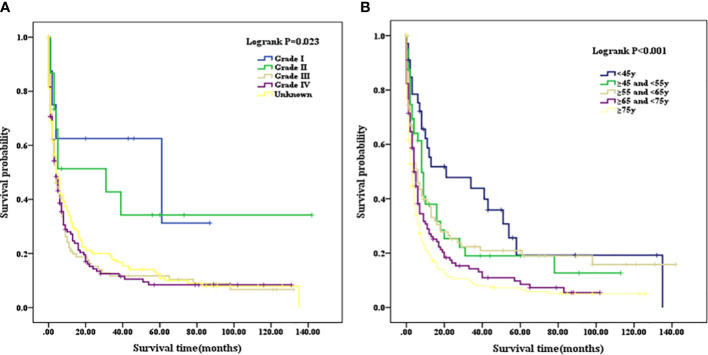
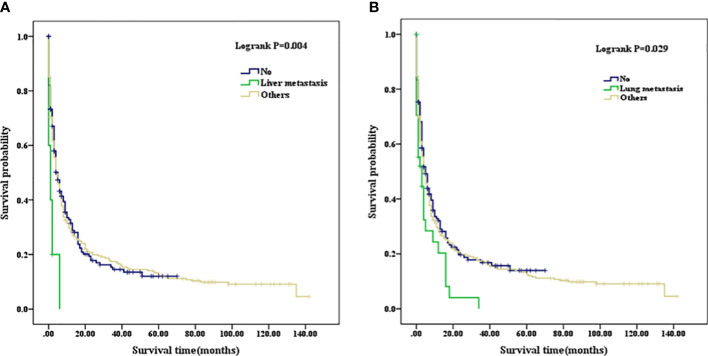
When adjuvant chemotherapy approach was applied in the treatment of patients with PSC or adjusted NSCLC, respectively, an improved OS could be observed in the NSCLC cohort (p=0.017). For the entire PSC cohort, 1-, 3-, and 5-year OS were 25.43%, 13.04%, and 6.96%, respectively, compared with 41.96%, 17.39%, and 10.00%, respectively, for the new adjusted NSCLC cohort after PSM, which were statistically significant difference (p<0.001). Multivariable Cox regression analysis was performed on OS covering prognostic factors such as primary site (p=0.036), first malignant indicator (p<0.001), age at diagnosis (p<0.001), marital status at diagnosis (p=0.039), and high school education (p=0.045). Additionally, patients with the following parameters had the worse impact on OS: a poorly differentiated pathology (Grade III/IV, p=0.023), older age (p<0.001), liver or lung metastasis (p=0.004, p=0.029), and the number of lymph nodes removed <4 (p<0.001).
Adjuvant chemotherapy did not play a decisive role in improving the OS of PSC, while it was associated with improved OS of NSCLC.
本研究旨在调查辅助化疗对肺肉瘤样癌(PSC)和非小细胞肺癌(NSCLC)患者总生存期(OS)的影响,并确定其潜在危险因素。
通过查询监测、流行病学和最终结果(SEER)数据库,对2004年至2015年期间诊断为PSC(n = 460)和NSCLC(n = 140,467)的患者进行回顾性分析。人口统计学、肿瘤特征、治疗方式和生存情况纳入统计分析范围。通过倾向评分匹配(PSM)分析控制混杂因素。采用Kaplan-Meier生存曲线比较辅助化疗对两组患者(PSC和NSCLC)OS的影响。构建多变量Cox回归模型,并对每个变量进行Kaplan-Meier分析以预测与OS相关的危险因素。
当分别对PSC患者或调整后的NSCLC患者应用辅助化疗方法时,NSCLC队列的OS有所改善(p = 0.017)。对于整个PSC队列,1年、3年和5年OS分别为25.43%、13.04%和6.96%,而PSM后新调整的NSCLC队列分别为41.96%、17.39%和10.00%,差异具有统计学意义(p < 0.001)。对OS进行多变量Cox回归分析,涵盖预后因素,如原发部位(p = 0.036)、首个恶性指标(p < 0.001)、诊断时年龄(p < 0.001)、诊断时婚姻状况(p = 0.039)和高中教育程度(p = 0.045)。此外,具有以下参数的患者对OS的影响更差:病理分化差(III/IV级,p = 0.023)、年龄较大(p < 0.001)、肝或肺转移(p = 0.004,p = 0.029)以及切除淋巴结数量<4(p < 0.001)。
辅助化疗在改善PSC患者的OS方面未起决定性作用,而与NSCLC患者OS的改善相关。