Mohammadkhani Reihaneh, Ghahremani Reza, Salehi Iraj, Safari Samaneh, Karimi Seyed Asaad, Zarei Mohammad
Neurophysiology Research Center, Hamadan University of Medical Sciences, Hamadan 65178/518, Iran.
Department of Exercise Physiology, Faculty of Sport Sciences, University of Birjand, Birjand 9717434765, Iran.
Brain Commun. 2022 Sep 5;4(5):fcac221. doi: 10.1093/braincomms/fcac221. eCollection 2022.
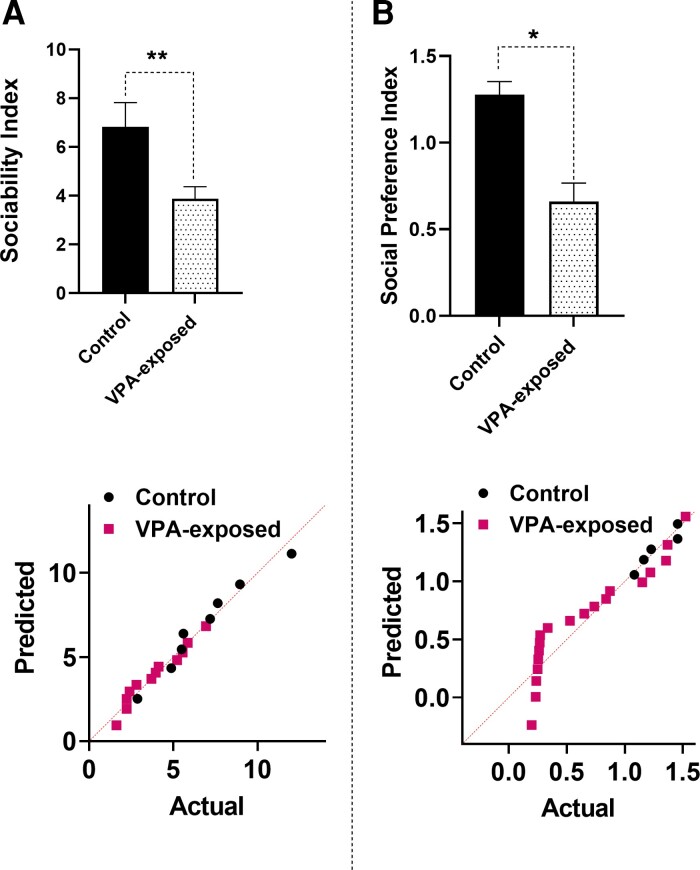
It is well established that prenatal valproic acid exposure in rats leads to autism-like behaviours and social deficits. Long-term potentiation changes in the brain have been proposed as a potential mechanism in the development of autistic behaviour. However, there are controversies regarding the effect of valproic acid exposure on long-term potentiation. This study examined the social interaction and long-term potentiation induction in perforant pathway-dentate gyrus synapses in male offspring of a rat model of autism induced by prenatal exposure to valproic acid. On Embryonic Day 12.5, the pregnant dams received an injection of 500 mg/kg valproic acid (intraperitoneal) to produce the autism model. The sociability test was performed between Postnatal Days 37 and 40. The offsprings were urethane-anaesthetized and placed into a stereotaxic apparatus for surgery, electrode implantation and field potential recording on Postnatal Days 45-55. In the dentate gyrus region, excitatory postsynaptic potential slope and population spike amplitude were measured. Valproic acid-exposed offspring showed significantly impaired social interaction. The birth weight in valproic acid-exposed rats was significantly lower than in control rats. The ability of dentate gyrus synapses to induce long-term potentiation was hampered by valproic acid exposure. The decreasing excitatory postsynaptic potential slope and population spike amplitude of long-term potentiation provide evidence in favour of this notion. It is widely supposed that the hippocampus plays a central role in the process of learning and memory as well as social interaction and social memory. Therefore, deficiencies in hippocampal synaptic plasticity may be responsible, at least in part, for the social interaction deficits in valproic acid-exposed rats.
众所周知,大鼠孕期暴露于丙戊酸会导致自闭症样行为和社交缺陷。大脑中的长时程增强变化被认为是自闭症行为发展的一种潜在机制。然而,关于丙戊酸暴露对长时程增强的影响存在争议。本研究检测了产前暴露于丙戊酸所致自闭症大鼠模型雄性后代的穿通通路-齿状回突触中的社交互动和长时程增强诱导情况。在胚胎第12.5天,给怀孕的母鼠腹腔注射500 mg/kg丙戊酸以建立自闭症模型。在出生后第37至40天进行社交能力测试。在出生后第45 - 55天,将后代用乌拉坦麻醉后置于立体定位仪中进行手术、电极植入和场电位记录。在齿状回区域,测量兴奋性突触后电位斜率和群体峰电位幅度。暴露于丙戊酸的后代表现出明显受损的社交互动。暴露于丙戊酸的大鼠出生体重显著低于对照大鼠。丙戊酸暴露阻碍了齿状回突触诱导长时程增强的能力。长时程增强中兴奋性突触后电位斜率和群体峰电位幅度的降低为这一观点提供了证据。人们普遍认为海马体在学习和记忆过程以及社交互动和社会记忆中起核心作用。因此,海马体突触可塑性的缺陷可能至少部分地导致了暴露于丙戊酸的大鼠的社交互动缺陷。