Zhang Lening, Yates Bridget, Murphy Ryan, Liu Su, Xie Lin, Handyside Britta, Sihn Choong-Ryoul, Bouwman Taren, Galicia Nicole, Tan Danielle, Fonck Carlos, Arens Jeremy, Clark Annie, Zhang Weiming, Chandra Sundeep, Srimani Jaydeep, Holcomb Jennifer, Van Tuyl Andrea, Henshaw Joshua, Vettermann Christian, Siso Silvia, Su Cheng, Bullens Sherry, Bunting Stuart, O'Neill Charles, Fong Sylvia
Biology Research, BioMarin Pharmaceutical Inc., Novato, CA 94949, USA.
Pharmacological Sciences, BioMarin Pharmaceutical Inc., Novato, CA 94949, USA.
Mol Ther Methods Clin Dev. 2022 Aug 13;26:519-531. doi: 10.1016/j.omtm.2022.08.002. eCollection 2022 Sep 8.
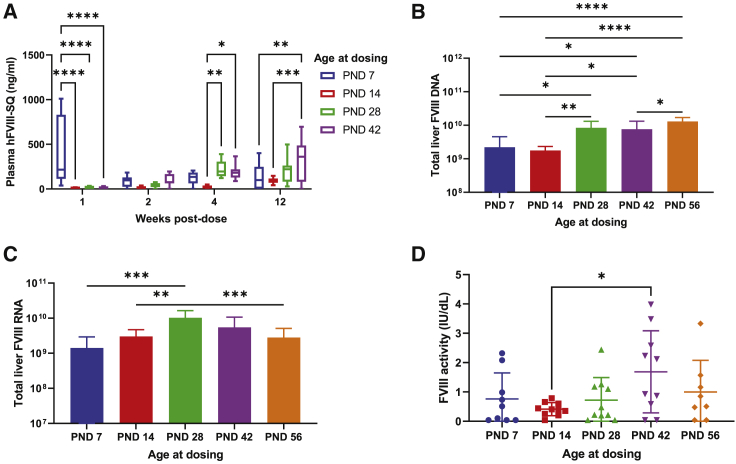
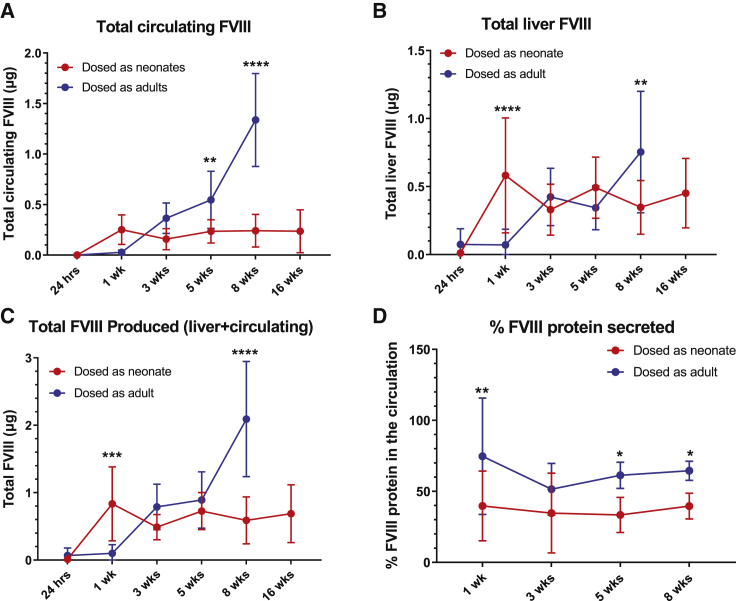
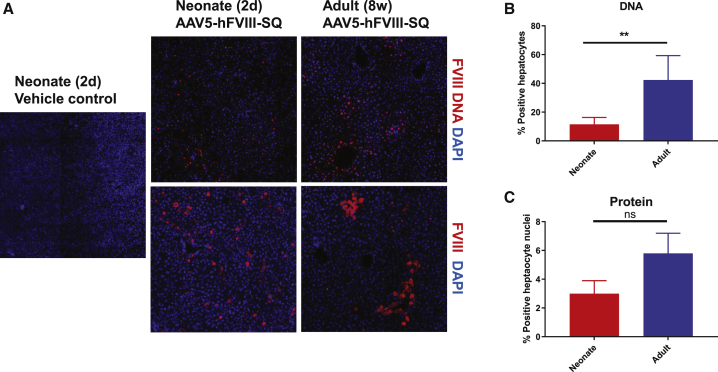
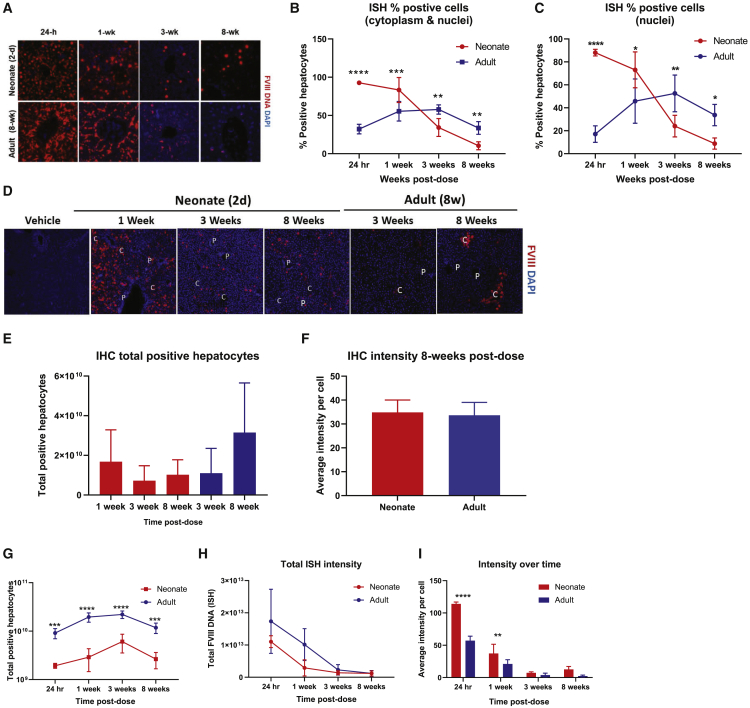
Valoctocogene roxaparvovec (AAV5-hFVIII-SQ) gene transfer provided reduced bleeding for adult clinical trial participants with severe hemophilia A. However, pediatric outcomes are unknown. Using a mouse model of hemophilia A, we investigated the effect of vector dose and age at treatment on transgene production and persistence. We dosed AAV5-hFVIII-SQ to neonatal and adult mice based on body weight or at a fixed dose and assessed human factor VIII-SQ variant (hFVIII-SQ) expression through 16 weeks. AAV5-hFVIII-SQ dosed per body weight in neonatal mice did not result in meaningful plasma hFVIII-SQ protein levels in adulthood. When treated with the same total vector genomes per mouse as adult mice, neonates maintained hFVIII-SQ expression into adulthood, although plasma levels were 3- to 4-fold lower versus mice dosed as adults. Mice <1 week old initially exhibited high hFVIII-SQ plasma levels and maintained meaningful levels into adulthood, despite a partial decline potentially due to age-related body mass and blood volume increases. Spatial transduction patterns differed between mice dosed as neonates versus adults. No features of hepatotoxicity or endoplasmic reticulum stress were observed with dosing at any age. These data suggest that young mice require the same total vector genomes as adult mice to sustain hFVIII-SQ plasma levels.
Valoctocogene roxaparvovec(AAV5-hFVIII-SQ)基因转移使重度A型血友病成年临床试验参与者的出血情况减少。然而,儿科治疗结果尚不清楚。我们使用A型血友病小鼠模型,研究了载体剂量和治疗时的年龄对转基因产生和持久性的影响。我们根据体重或固定剂量给新生小鼠和成年小鼠注射AAV5-hFVIII-SQ,并在16周内评估人凝血因子VIII-SQ变体(hFVIII-SQ)的表达。按体重给新生小鼠注射AAV5-hFVIII-SQ在成年后并未产生有意义的血浆hFVIII-SQ蛋白水平。当每只新生小鼠接受与成年小鼠相同总量的载体基因组治疗时,尽管血浆水平比成年时给药的小鼠低3至4倍,但新生小鼠在成年后仍维持hFVIII-SQ表达。小于1周龄的小鼠最初表现出较高的hFVIII-SQ血浆水平,并在成年后维持有意义的水平,尽管可能由于与年龄相关的体重和血容量增加而出现部分下降。新生小鼠和成年小鼠给药后的空间转导模式有所不同。在任何年龄给药均未观察到肝毒性或内质网应激的特征。这些数据表明,幼鼠需要与成年小鼠相同总量的载体基因组来维持hFVIII-SQ血浆水平。