Zheng Weixian, Liu Xinyu, Li Qianwen, Shu Zuju, Li Zhongbo, Zhang Lijun
College of Light-Textile Engineering and Art, Anhui Agriculture University Hefei 230009 China
RSC Adv. 2022 Aug 23;12(37):23801-23807. doi: 10.1039/d2ra03690h. eCollection 2022 Aug 22.
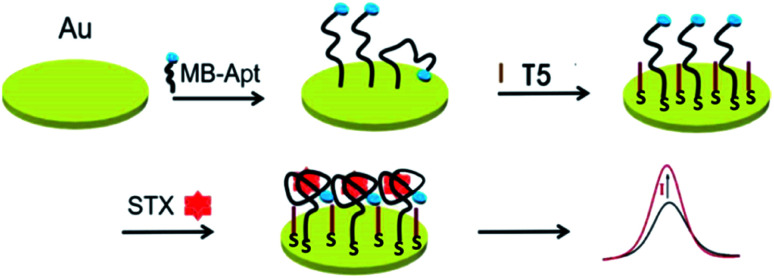
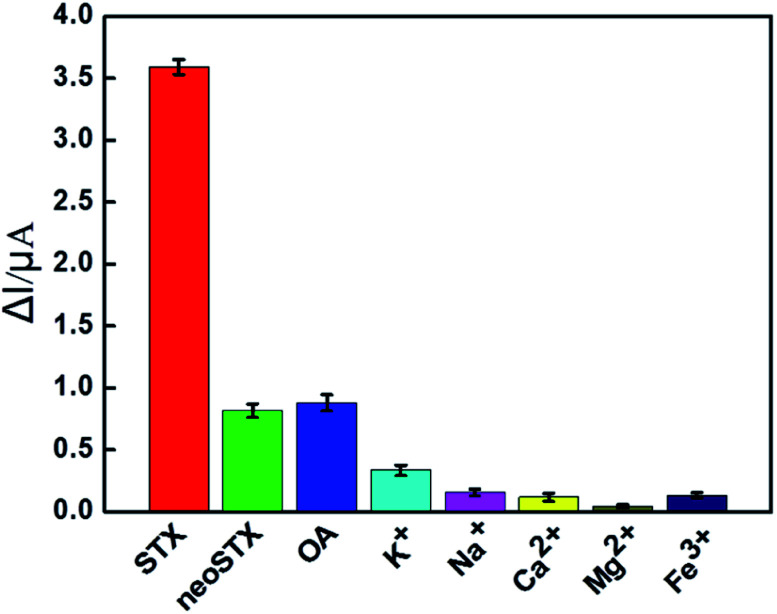
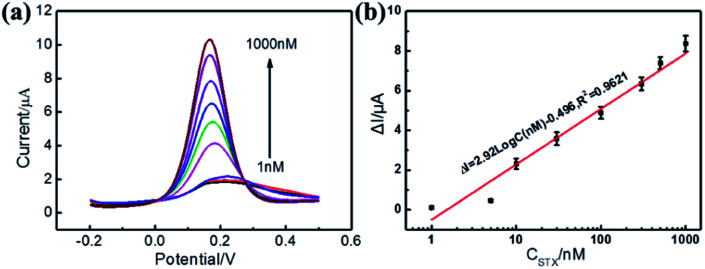
In this study, a simple electrochemical aptasensor for saxitoxin (STX) detection was developed based on a short anti-STX aptamer with a methylene blue (MB) incorporated at the 3'-end. The aptamer was immobilized on the surface of gold electrode and served as the recognition element. The aptasensor was successfully used as a highly selective and sensitive biosensor for STX detection because of the selection of aptamer along with the excellent electrocatalytical properties of MB. With the increase of the dynamic concentration of STX from 1 nM to 1 μM, the aptasensor exhibited a sensitivity with a peak current change of 2.92 μA per decade and a low detection limit of 1 nM. In addition, the aptasensor demonstrated excellent selectivity to STX, which prevented the interferences from neo-STX, okadaic acid and common metal ions. Using the proposed principle, several other aptasensors with improved performance can be constructed the modification of the electrochemical sensor with appropriate aptamers.
在本研究中,基于一种3'-末端掺入亚甲基蓝(MB)的短抗石房蛤毒素(STX)适配体,开发了一种用于检测石房蛤毒素的简单电化学适配体传感器。该适配体固定在金电极表面,作为识别元件。由于适配体的选择以及MB优异的电催化性能,该适配体传感器成功用作检测STX的高选择性和灵敏的生物传感器。随着STX动态浓度从1 nM增加到1 μM,该适配体传感器表现出灵敏度,每十年峰值电流变化为2.92 μA,检测限低至1 nM。此外,该适配体传感器对STX表现出优异的选择性,可防止新石房蛤毒素、冈田酸和常见金属离子的干扰。利用所提出的原理,通过用合适的适配体修饰电化学传感器,可以构建其他几种性能得到改善的适配体传感器。