Department of Physiology & Biophysics, Boston University School of Medicine, Boston, Massachusetts, United States of America.
PLoS One. 2022 Sep 12;17(9):e0268664. doi: 10.1371/journal.pone.0268664. eCollection 2022.
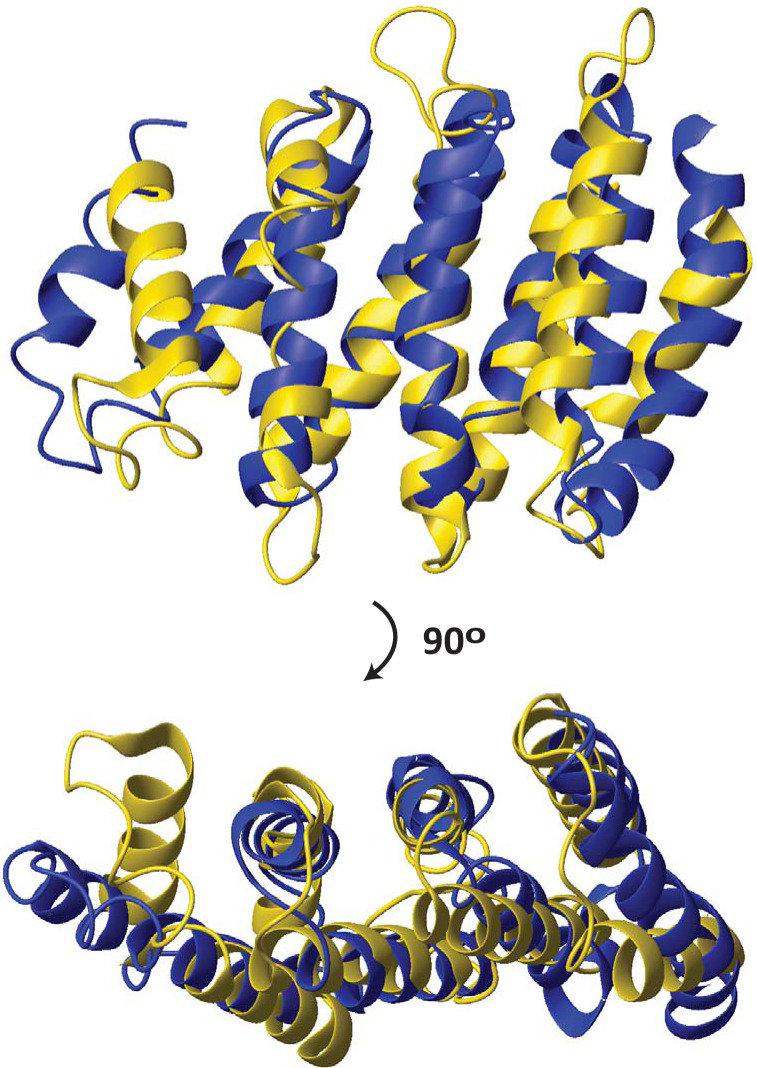
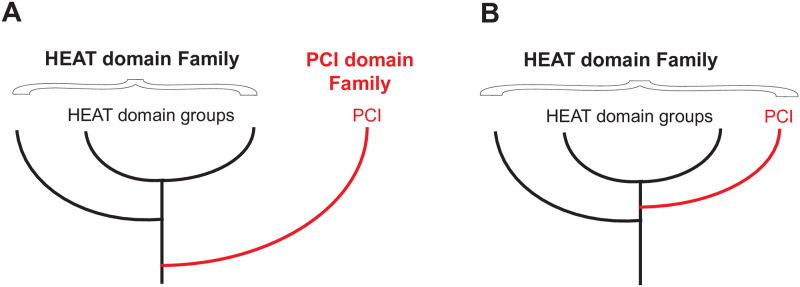
The HEAT domains are a family of helical hairpin repeat domains, composed of four or more hairpins. HEAT is derived from the names of four family members: huntingtin, eukaryotic translation elongation factor 3 (eEF3), protein phosphatase 2 regulatory A subunit (PP2A), and mechanistic target of rapamycin (mTOR). HEAT domain-containing proteins play roles in a wide range of cellular processes, such as protein synthesis, nuclear transport and metabolism, and cell signaling. The PCI domains are a related group of helical hairpin domains, with a "winged-helix" (WH) subdomain at their C-terminus, which is responsible for multi-subunit complex formation with other PCI domains. The name is derived from the complexes, where these domains are found: the 26S Proteasome "lid" regulatory subcomplex, the COP9 signalosome (CSN), and eukaryotic translation initiation factor 3 (eIF3). We noted that in structure similarity searches using HEAT domains, sometimes PCI domains appeared in the search results ahead of other HEAT domains, which indicated that the PCI domains could be members of the HEAT domain family, and not a related but separate group, as currently thought. Here, we report extensive structure similarity analysis of HEAT and PCI domains, both within and between the two groups of proteins. We present evidence that the PCI domains as a group have greater structural similarity with individual groups of HEAT domains than some of the HEAT domain groups have among each other. Therefore, our results indicate that the PCI domains have evolved from a HEAT domain that acquired a WH subdomain. The WH subdomain in turn mediated self-association into a multi-subunit complex, which eventually evolved into the common ancestor of the Proteasome lid/CSN/eIF3.
HEAT 结构域是一类由四个或更多发夹组成的螺旋发夹重复结构域。HEAT 这个名称来源于四个家族成员的名字:亨廷顿蛋白、真核翻译延伸因子 3(eEF3)、蛋白磷酸酶 2 调节 A 亚基(PP2A)和雷帕霉素靶蛋白(mTOR)。HEAT 结构域蛋白在多种细胞过程中发挥作用,如蛋白质合成、核转运和代谢以及细胞信号转导。PCI 结构域是一类相关的螺旋发夹结构域,其 C 端具有“翼螺旋”(WH)亚结构域,负责与其他 PCI 结构域形成多亚基复合物。这个名称来源于包含这些结构域的复合物:26S 蛋白酶体“盖”调节亚复合物、COP9 信号体(CSN)和真核翻译起始因子 3(eIF3)。我们注意到,在使用 HEAT 结构域进行结构相似性搜索时,有时 PCI 结构域会先于其他 HEAT 结构域出现在搜索结果中,这表明 PCI 结构域可能是 HEAT 结构域家族的成员,而不是目前认为的相关但独立的群体。在这里,我们报告了对 HEAT 和 PCI 结构域的广泛结构相似性分析,包括在这两组蛋白质内部和之间。我们提供的证据表明,作为一个整体,PCI 结构域与某些 HEAT 结构域组之间的结构相似性大于某些 HEAT 结构域组之间的结构相似性。因此,我们的结果表明,PCI 结构域是从获得 WH 亚结构域的 HEAT 结构域进化而来的。WH 亚结构域反过来介导自身缔合成多亚基复合物,最终进化为蛋白酶体盖/CSN/eIF3 的共同祖先。