Department of Human-Centred Computing, Faculty of Information Technology, Monash University, Melbourne, Australia.
Office of Research and Ethics, Eastern Health, Melbourne, Australia.
PLoS One. 2022 Sep 12;17(9):e0274493. doi: 10.1371/journal.pone.0274493. eCollection 2022.
Patient flow describes the progression of patients along a pathway of care such as the journey from hospital inpatient admission to discharge. Poor patient flow has detrimental effects on health outcomes, patient satisfaction and hospital revenue. There has been an increasing adoption of health information systems (HISs) in various healthcare settings to address patient flow issues, yet there remains limited evidence of their overall impacts.
To systematically review evidence on the impacts of HISs on patient flow management including what HISs have been used, their application scope, features, and what aspects of patient flow are affected by the HIS adoption.
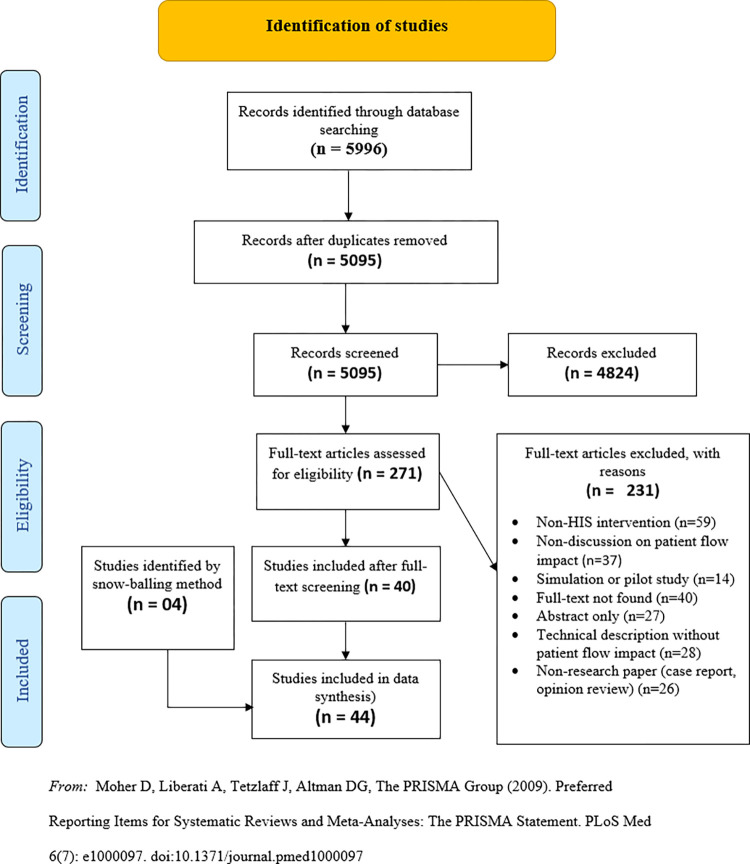
A systematic search for English-language, peer-review literature indexed in MEDLINE and EMBASE, CINAHL, INSPEC, and ACM Digital Library from the earliest date available to February 2022 was conducted. Two authors independently scanned the search results for eligible publications, and reporting followed the PRISMA guidelines. Eligibility criteria included studies that reported impacts of HIS on patient flow outcomes. Information on the study design, type of HIS, key features and impacts was extracted and analysed using an analytical framework which was based on domain-expert opinions and literature review.
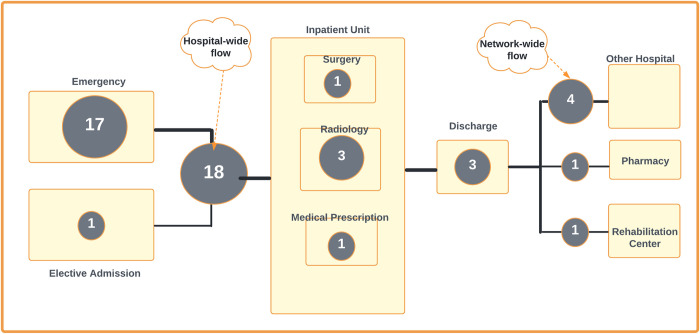
Overall, 5996 titles were identified, with 44 eligible studies, across 17 types of HIS. 22 studies (50%) focused on patient flow in the department level such as emergency department while 18 studies (41%) focused on hospital-wide level and four studies (9%) investigated network-wide HIS. Process outcomes with time-related measures such as 'length of stay' and 'waiting time' were investigated in most of the studies. In addition, HISs were found to address flow problems by identifying blockages, streamlining care processes and improving care coordination.
HIS affected various aspects of patient flow at different levels of care; however, how and why they delivered the impacts require further research.
患者流程描述了患者沿着医疗路径的进展情况,例如从医院住院入院到出院的过程。患者流程不畅会对健康结果、患者满意度和医院收入产生不利影响。在各种医疗保健环境中,越来越多地采用健康信息系统 (HIS) 来解决患者流程问题,但仍缺乏对其总体影响的证据。
系统回顾关于 HIS 对患者流程管理影响的证据,包括使用了哪些 HIS、其应用范围、功能以及患者流程的哪些方面受到 HIS 采用的影响。
从最早可获得的日期到 2022 年 2 月,对 MEDLINE 和 EMBASE、CINAHL、INSPEC 和 ACM Digital Library 中收录的英文同行评审文献进行了系统搜索。两名作者独立扫描搜索结果以确定符合条件的出版物,报告遵循 PRISMA 指南。纳入标准包括报告 HIS 对患者流程结果影响的研究。使用基于领域专家意见和文献综述的分析框架提取并分析了研究设计、HIS 类型、关键特征和影响的信息。
总体而言,共确定了 5996 个标题,其中有 44 项符合条件的研究,涉及 17 种类型的 HIS。22 项研究(50%)侧重于急诊科等部门级别的患者流程,18 项研究(41%)侧重于全院级别的患者流程,4 项研究(9%)调查了网络范围的 HIS。大多数研究都调查了与时间相关的指标,如“住院时间”和“等待时间”等流程结果。此外,HIS 通过识别阻塞、简化护理流程和改善护理协调来解决流程问题。
HIS 影响了不同护理级别的患者流程的各个方面;然而,它们如何以及为什么产生影响需要进一步研究。