Department of Nephrology, Amsterdam UMC, Amsterdam, The Netherlands.
Division of Nephrology, Department of Internal Medicine, University Medical Center Groningen, University of Groningen, Groningen, The Netherlands.
Trials. 2022 Sep 12;23(1):769. doi: 10.1186/s13063-022-06562-9.
Arterial stiffness and calcification propensity are associated with high cardiovascular risk and increased mortality in chronic kidney disease (CKD). Both magnesium and phosphate are recognized as modulators of vascular calcification and chronic inflammation, both features of CKD that contribute to arterial stiffness. In this paper, we outline the rationale and design of a randomized controlled trial (RCT) investigating whether 24 weeks of oral magnesium supplementation with or without additional phosphate-binding therapy can improve arterial stiffness and calcification propensity in patients with stage 3-4 CKD.
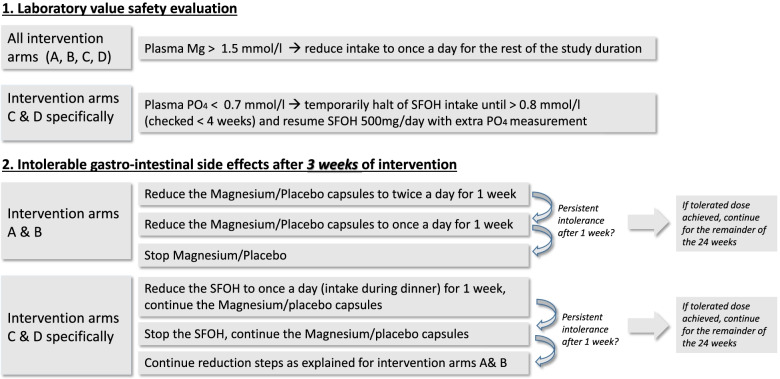
In this multi-center, placebo-controlled RCT, a total of 180 participants with an estimated glomerular filtration rate of 15 to 50 ml/min/1.73 m without phosphate binder therapy will be recruited. During the 24 weeks intervention, participants will be randomized to one of four intervention groups to receive either magnesium citrate (350 mg elemental magnesium/day) or placebo, with or without the addition of the phosphate binder sucroferric oxyhydroxide (1000 mg/day). Primary outcome of the study is the change of arterial stiffness measured by the carotid-femoral pulse wave velocity over 24 weeks. Secondary outcomes include markers of calcification and inflammation, among others calcification propensity (T) and high-sensitivity C-reactive protein. As explorative endpoints, repeated F-FDG and F-NaF PET-scans will be performed in a subset of participants (n = 40). Measurements of primary and secondary endpoints are performed at baseline, 12 and 24 weeks.
The combined intervention of magnesium citrate supplementation and phosphate-lowering therapy with sucroferric oxyhydroxide, in stage 3-4 CKD patients without overt hyperphosphatemia, aims to modulate the complex and deregulated mineral metabolism leading to vascular calcification and arterial stiffness and to establish to what extent this is mediated by T changes. The results of this combined intervention may contribute to future early interventions for CKD patients to reduce the risk of CVD and mortality.
Netherlands Trial Register, NL8252 (registered December 2019), EU clinical Trial Register 2019-001306-23 (registered November 2019).
动脉僵硬度和钙化倾向与慢性肾脏病(CKD)患者的心血管风险增加和死亡率升高有关。镁和磷酸盐都被认为是血管钙化和慢性炎症的调节剂,这两个特征都是 CKD 的特征,会导致动脉僵硬度增加。在本文中,我们概述了一项随机对照试验(RCT)的基本原理和设计,该试验旨在研究 24 周口服镁补充剂联合或不联合额外的磷酸盐结合治疗是否可以改善 3-4 期 CKD 患者的动脉僵硬度和钙化倾向。
在这项多中心、安慰剂对照 RCT 中,将招募 180 名估计肾小球滤过率为 15-50ml/min/1.73m、未接受磷酸盐结合剂治疗的患者。在 24 周的干预期间,参与者将被随机分配到四个干预组中的一个,分别接受柠檬酸镁(350mg 元素镁/天)或安慰剂,同时或不添加磷酸盐结合剂苏糖酸铁羟化物(1000mg/天)。研究的主要终点是 24 周时通过颈股脉搏波速度测量的动脉僵硬度变化。次要终点包括钙化和炎症标志物等,其中包括钙化倾向(T)和高敏 C 反应蛋白。作为探索性终点,将在一部分参与者(n=40)中进行重复的 F-FDG 和 F-NaF PET 扫描。主要和次要终点的测量在基线、12 周和 24 周进行。
柠檬酸镁补充剂联合苏糖酸铁羟化物降磷治疗,适用于 3-4 期 CKD 患者,且无明显高磷血症,旨在调节导致血管钙化和动脉僵硬度的复杂和失调的矿物质代谢,并确定 T 变化在多大程度上介导了这种变化。这种联合干预的结果可能有助于未来对 CKD 患者进行早期干预,以降低 CVD 和死亡率的风险。
荷兰试验注册中心,NL8252(2019 年 12 月注册),欧盟临床试验注册中心 2019-001306-23(2019 年 11 月注册)。