Zhejiang Provincial Key Laboratory of Horticultural Plant Integrative Biology, Zhejiang University, Zijingang Campus, Hangzhou 310058, China; State Agriculture Ministry Laboratory of Horticultural Plant Growth, Development and Quality Improvement, Zhejiang University, Zijingang Campus, Hangzhou 310058, China.
Key Laboratory of Environment Remediation and Ecological Health, Ministry of Education, College of Environmental & Resource Science, Zhejiang University, Hangzhou 310058, China.
J Adv Res. 2022 Sep;40:59-68. doi: 10.1016/j.jare.2021.11.019. Epub 2021 Dec 4.
Cell wall degradation and remodeling is the key factor causing fruit softening during ripening.
To explore the mechanism underlying postharvest cell wall metabolism, a transcriptome analysis method for more precious prediction on functional genes was needed.
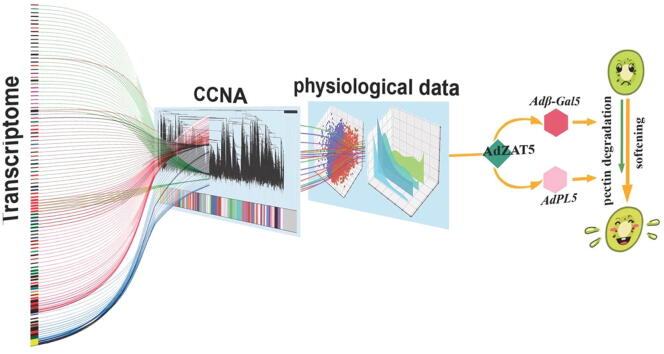
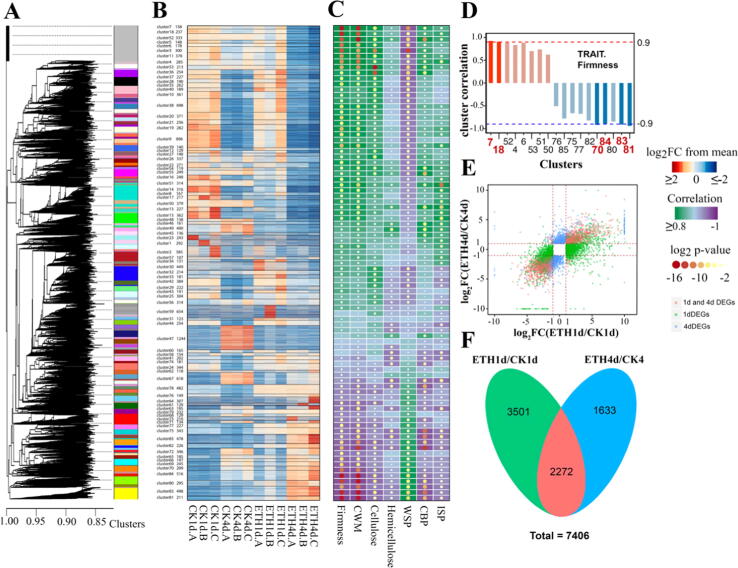
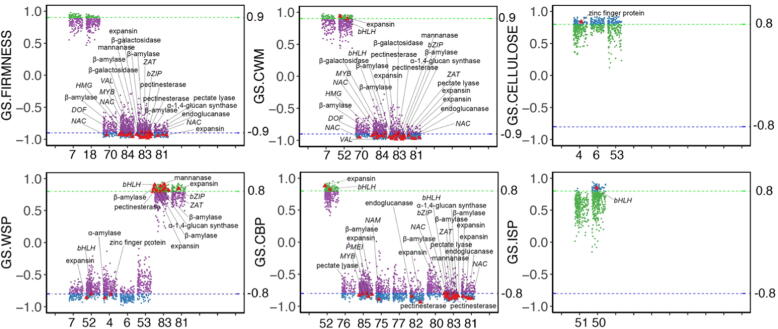
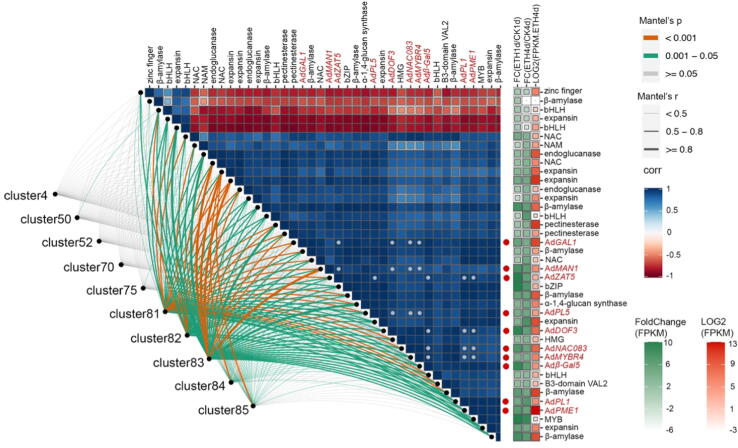
Kiwifruits treated by ethylene (a conventional and effective phytohormone to accelerate climacteric fruit ripening and softening as kiwifruits) or air were taken as materials. Here, Consensus Coexpression Network Analysis (CCNA), a procedure evolved from Weighted Gene Co-expression Network Analysis (WGCNA) package in R, was applied and generated 85 consensus clusters from twelve transcriptome libraries. Advanced and comprehensive modifications were achieved by combination of CCNA and WGCNA with introduction of physiological traits, including firmness, cell wall materials, cellulose, hemicellulose, water soluble pectin, covalent binding pectin and ionic soluble pectin.
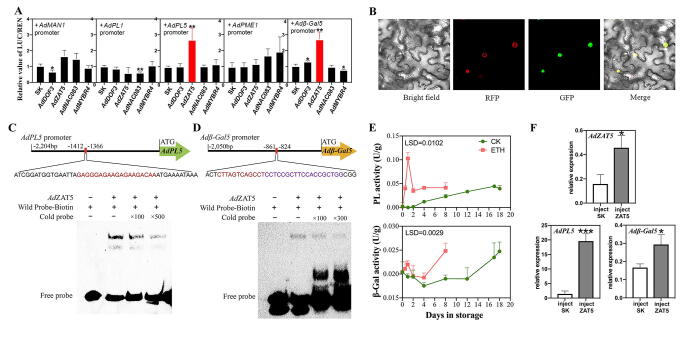
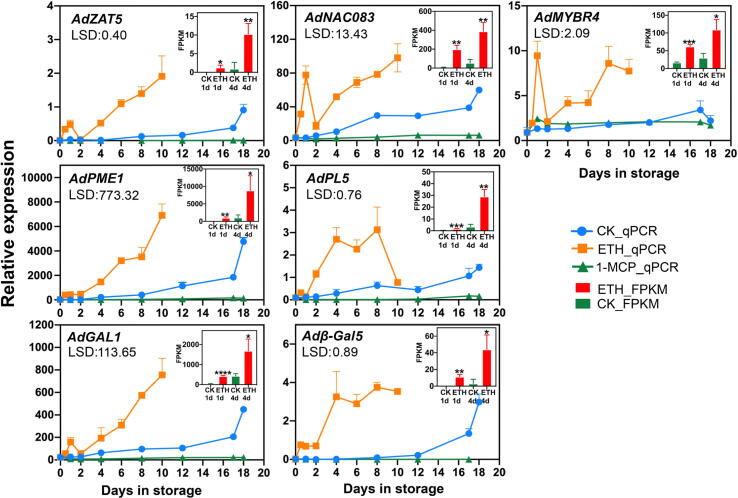
As a result, six cell wall metabolisms related structural genes AdGAL1, AdMAN1, AdPL1, AdPL5, Adβ-Gal5, AdPME1 and four transcription factors AdZAT5, AdDOF3, AdNAC083, AdMYBR4 were identified as hub candidate genes for pectin degradation. Dual-luciferase system and electrophoretic mobility shift assays validated that promoters of AdPL5 and Adβ-Gal5 were recognized and trans-activated by transcription factor AdZAT5. The relatively higher enzyme activities of PL and β-Gal were observed in ethylene treated kiwifruit, further emphasized the critical roles of these two pectin related genes for fruit softening. Moreover, stable transient overexpression AdZAT5 in kiwifruit significantly enhanced AdPL5 and Adβ-Gal5 expression, which confirmed the in vivo regulations between transcription factor and pectin related genes.
Thus, modification and application of CCNA would be powerful for the precious phishing the unknown regulators. It revealed that AdZAT5 is a key factor for pectin degradation by binding and regulating effector genes AdPL5 and Adβ-Gal5.
细胞壁的降解和重塑是果实成熟过程中软化的关键因素。
为了探索采后细胞壁代谢的机制,需要一种转录组分析方法来更准确地预测功能基因。
以乙烯(一种传统而有效的植物激素,可加速呼吸跃变型果实的成熟和软化,如猕猴桃)或空气处理的猕猴桃为材料。在这里,共识共表达网络分析(CCNA),一种从 R 中的加权基因共表达网络分析(WGCNA)包中发展而来的程序,被应用于从 12 个转录组文库中生成 85 个共识簇。通过将 CCNA 和 WGCNA 与生理特性(包括硬度、细胞壁物质、纤维素、半纤维素、水溶性果胶、共价结合果胶和离子可溶性果胶)相结合,实现了先进和全面的改进。
结果,确定了六个与细胞壁代谢相关的结构基因 AdGAL1、AdMAN1、AdPL1、AdPL5、Adβ-Gal5、AdPME1 和四个转录因子 AdZAT5、AdDOF3、AdNAC083、AdMYBR4 作为果胶降解的枢纽候选基因。双荧光素酶系统和电泳迁移率变动分析验证了转录因子 AdZAT5 识别和反式激活了 AdPL5 和 Adβ-Gal5 的启动子。乙烯处理的猕猴桃中 PL 和β-Gal 的相对较高的酶活性进一步强调了这两个果胶相关基因对果实软化的关键作用。此外,在猕猴桃中稳定瞬时过表达 AdZAT5 显著增强了 AdPL5 和 Adβ-Gal5 的表达,证实了转录因子与果胶相关基因之间的体内调控关系。
因此,CCNA 的改进和应用将为珍贵的未知调控因子的研究提供强大的工具。结果表明,AdZAT5 通过结合和调节效应基因 AdPL5 和 Adβ-Gal5 成为果胶降解的关键因素。