Orsini Erica M, Sacha Gretchen L, Han Xiaozhen, Wang Xiaofeng, Duggal Abhijit, Rajendram Prabalini
Department of Critical Care, Cleveland Clinic, Cleveland, OH, USA.
Department of Pharmacy, Cleveland Clinic, Cleveland, OH, USA.
Acute Crit Care. 2022 Aug;37(3):312-321. doi: 10.4266/acc.2022.00136. Epub 2022 Aug 29.
At outset of the coronavirus disease 2019 (COVID-19) pandemic, the significance of bacterial and fungal coinfections in individuals with COVID-19 was unknown. Initial reports indicated that the prevalence of coinfection in the general population was low, but there was uncertainty regarding the risk of coinfection in critically ill patients.
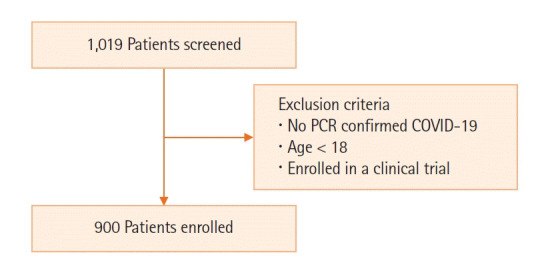
Nine hundred critically ill adult patients with COVID-19 infection were enrolled in this observational case-control study. Patients with a coinfection (case) and patients without a coinfection (control) were compared using univariate and multivariable analyses. A subgroup analysis was performed on patients with coinfection, dividing them into early (infection within 7 days) and late (infection after 7 days) infection groups.
Two hundred and thirty-three patients (25.9%) had a bacterial or fungal coinfection. Vasopressor use (P<0.001) and severity of illness (higher Acute Physiology and Chronic Health Evaluation III score, P=0.009) were risk factors for the development of a coinfection. Patients with coinfection had higher mortality and length of stay. Vasopressor and corticosteroid use and central line and foley catheter placement were risk factors for late infection (>7 days). There were high rates of drug-resistant infections.
Critically ill patients with COVID-19 are at risk for both community-acquired and hospital-acquired infections throughout their hospitalization for COVID-19. It is important to consider the development of a coinfection in clinically worsening critically ill patients with COVID-19 and consider the likelihood of drug-resistance when choosing an empiric regimen.
在2019冠状病毒病(COVID-19)大流行初期,COVID-19患者中细菌和真菌合并感染的意义尚不清楚。初步报告表明,普通人群中合并感染的患病率较低,但重症患者合并感染的风险存在不确定性。
900例成年COVID-19重症感染患者纳入了这项观察性病例对照研究。使用单因素和多因素分析比较合并感染患者(病例组)和未合并感染患者(对照组)。对合并感染患者进行亚组分析,将他们分为早期(7天内感染)和晚期(7天后感染)感染组。
233例患者(25.9%)发生细菌或真菌合并感染。使用血管活性药物(P<0.001)和疾病严重程度(急性生理与慢性健康状况评分III更高,P=0.009)是发生合并感染的危险因素。合并感染患者的死亡率和住院时间更长。使用血管活性药物和皮质类固醇以及放置中心静脉导管和导尿管是晚期感染(>7天)的危险因素。耐药感染率很高。
COVID-19重症患者在整个COVID-19住院期间有社区获得性和医院获得性感染的风险。对于临床病情恶化的COVID-19重症患者,考虑合并感染的发生并在选择经验性治疗方案时考虑耐药的可能性很重要。