Tao Qiushan, Akhter-Khan Samia C, Ang Ting Fang Alvin, DeCarli Charles, Alosco Michael L, Mez Jesse, Killiany Ronald, Devine Sherral, Rokach Ami, Itchapurapu Indira Swetha, Zhang Xiaoling, Lunetta Kathryn L, Steffens David C, Farrer Lindsay A, Greve Douglas N, Au Rhoda, Qiu Wei Qiao
Department of Pharmacology & Experimental Therapeutics, Boston University School of Medicine, Boston, MA, USA.
Framingham Heart Study, Boston University School of Medicine, USA.
EClinicalMedicine. 2022 Sep 6;53:101643. doi: 10.1016/j.eclinm.2022.101643. eCollection 2022 Nov.
It remains unclear whether persistent loneliness is related to brain structures that are associated with cognitive decline and development of Alzheimer's disease (AD). This study aimed to investigate the relationships between different loneliness types, cognitive functioning, and regional brain volumes.
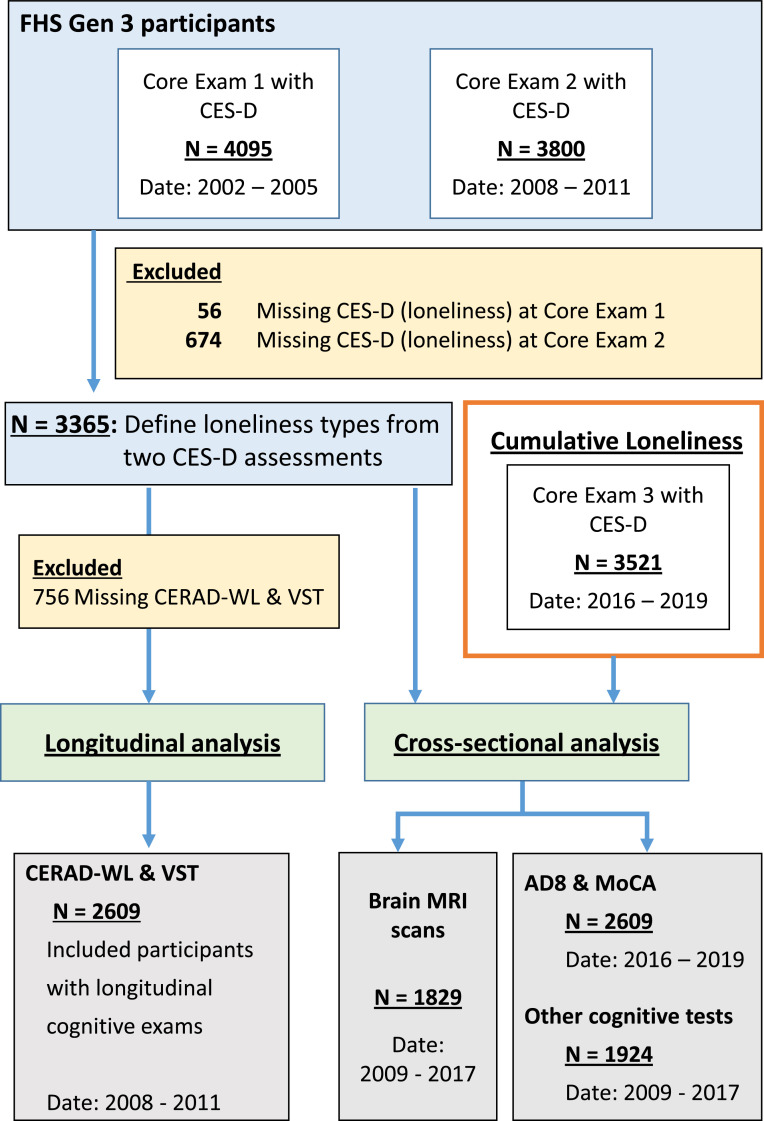
Loneliness was measured longitudinally, using the item from the Center for Epidemiologic Studies Depression Scale in the Framingham Heart Study, Generation 3, with participants' average age of 46·3 ± 8·6 years. Robust regression models tested the association between different loneliness types with longitudinal neuropsychological performance ( 2,609) and regional magnetic resonance imaging brain data ( 1,829) (2002-2019). Results were stratified for sex, depression, and Apolipoprotein E4 (4).
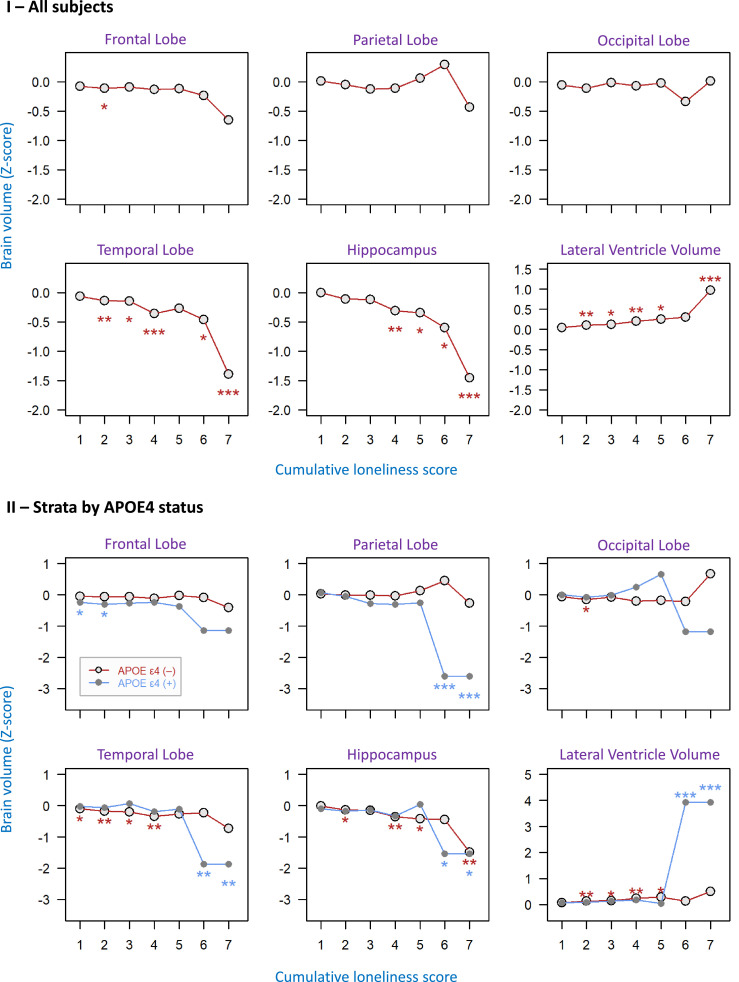
Persistent loneliness, but not transient loneliness, was strongly associated with cognitive decline, especially memory and executive function. Persistent loneliness was negatively associated with temporal lobe volume ( = -0.18, 95%CI [-0.32, -0.04], = 0·01). Among women, persistent loneliness was associated with smaller frontal lobe ( = -0.19, 95%CI [-0.38, -0.01], = 0·04), temporal lobe ( = -0.20, 95%CI [-0.37, -0.03], = 0·02), and hippocampus volumes ( = -0.23, 95%CI [-0.40, -0.06], = 0·007), and larger lateral ventricle volume ( = 0.15, 95%CI [0.02, 0.28], = 0·03). The higher cumulative loneliness scores across three exams, the smaller parietal, temporal, and hippocampus volumes and larger lateral ventricle were evident, especially in the presence of 4.
Persistent loneliness in midlife was associated with atrophy in brain regions responsible for memory and executive dysfunction. Interventions to reduce the chronicity of loneliness may mitigate the risk of age-related cognitive decline and AD.
US National Institute on Aging.
持续性孤独是否与认知能力下降及阿尔茨海默病(AD)发展相关的脑结构有关仍不清楚。本研究旨在调查不同类型孤独、认知功能和脑区体积之间的关系。
在弗雷明汉心脏研究第三代中,使用流行病学研究中心抑郁量表中的项目对孤独进行纵向测量,参与者平均年龄为46.3±8.6岁。稳健回归模型测试了不同类型孤独与纵向神经心理学表现(2609例)和区域磁共振成像脑数据(1829例)(2002 - 2019年)之间的关联。结果按性别、抑郁和载脂蛋白E4(ApoE4)进行分层。
持续性孤独而非短暂性孤独与认知能力下降密切相关,尤其是记忆和执行功能。持续性孤独与颞叶体积呈负相关(β = -0.18,95%CI[-0.32, -0.04],p = 0.01)。在女性中,持续性孤独与额叶体积较小(β = -0.19,95%CI[-0.38, -0.01],p = 0.04)、颞叶体积较小(β = -0.20,95%CI[-0.37, -0.03],p = 0.02)、海马体体积较小(β = -0.23,95%CI[-0.40, -0.06],p = 0.007)以及侧脑室体积较大(β = 0.15,95%CI[0.02, 0.28],p = 0.03)相关。在三次检查中累积孤独得分越高,顶叶、颞叶和海马体体积越小,侧脑室越大,尤其是在携带ApoE4的情况下。
中年时期的持续性孤独与负责记忆和执行功能障碍的脑区萎缩有关。减少孤独慢性化的干预措施可能会降低与年龄相关的认知能力下降和AD的风险。
美国国立衰老研究所。