Department of Biological Sciences, University of Toronto Scarborough, Toronto, Canada; Department of Cell and Systems Biology, University of Toronto, Toronto, Canada.
Department of Biological Sciences, University of Toronto Scarborough, Toronto, Canada.
J Biol Chem. 2022 Oct;298(10):102496. doi: 10.1016/j.jbc.2022.102496. Epub 2022 Sep 15.
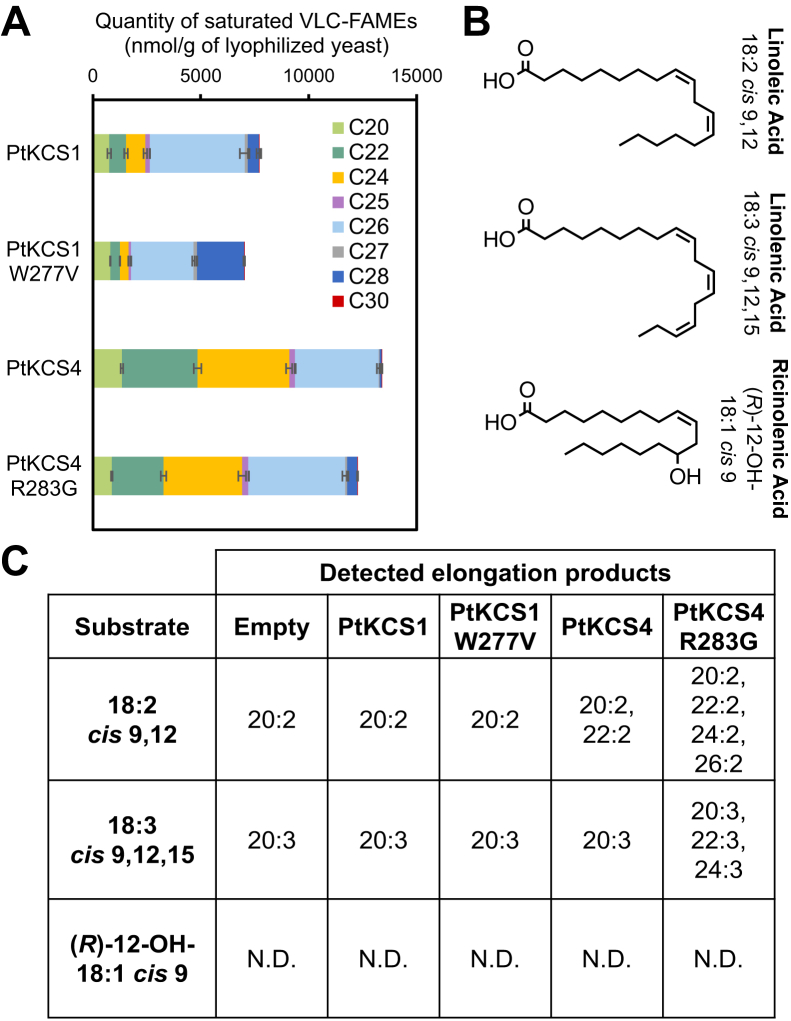
Very long chain fatty acids (VLCFAs) are precursors to sphingolipids, glycerophospholipids, and plant cuticular waxes. In plants, members of a large 3-ketoacyl-CoA synthase (KCS) gene family catalyze the substrate-specific elongation of VLCFAs. Although it is well understood that KCSs have evolved to use diverse substrates, the underlying molecular determinants of their specificity are still unclear. In this study, we exploited the sequence similarity of a KCS gene cluster from Populus trichocarpa to examine the evolution and molecular determinants of KCS substrate specificity. Functional characterization of five members (PtKCS1, 2, 4, 8, 9) in yeast showed divergent product profiles based on VLCFA length, saturation, and position of the double bond. In addition, homology models, rationally designed chimeras, and site-directed mutants were used to identify two key regions (helix-4 and position 277) as being major determinants of substrate specificity. These results were corroborated with chimeras involving a more distantly related KCS, PtCER6 (the poplar ortholog of the Arabidopsis CER6), and used to show that helix-4 is necessary for the modulatory effect of PtCER2-like5 on KCS substrate specificity. The role of position 277 in limiting product length was further tested by substitution with smaller amino acids, which shifted specificity toward longer products. Finally, treatment with KCS inhibitors (K3 herbicides) showed varying inhibitor sensitivities between the duplicated paralogs despite their sequence similarity. Together, this work sheds light on the molecular mechanisms driving substrate diversification in the KCS family and lays the groundwork for tailoring the production of specific VLCFAs.
非常长链脂肪酸(VLCFAs)是鞘脂、甘油磷脂和植物角质层蜡的前体。在植物中,一个大型 3-酮酰基辅酶 A 合酶(KCS)基因家族的成员催化 VLCFA 的底物特异性伸长。尽管人们已经很好地理解了 KCS 已经进化到使用各种底物,但它们特异性的潜在分子决定因素仍然不清楚。在这项研究中,我们利用杨属毛果杨的一个 KCS 基因簇的序列相似性来研究 KCS 底物特异性的进化和分子决定因素。在酵母中对五个成员(PtKCS1、2、4、8、9)的功能特征进行了研究,结果表明根据 VLCFA 长度、饱和度和双键位置的不同,产物谱存在明显差异。此外,同源建模、合理设计的嵌合体和定点突变体被用于鉴定两个关键区域(螺旋-4 和位置 277)作为底物特异性的主要决定因素。这些结果与涉及更远缘 KCS(PtCER6(拟南芥 CER6 的杨属同源物)的嵌合体得到了验证,并表明螺旋-4 是 PtCER2-like5 对 KCS 底物特异性的调节作用所必需的。通过用较小的氨基酸取代位置 277 进一步测试了其对产物长度的限制作用,这使得特异性向更长的产物转移。最后,用 KCS 抑制剂(K3 除草剂)处理表明,尽管重复的旁系同源物具有序列相似性,但它们对抑制剂的敏感性不同。总之,这项工作阐明了推动 KCS 家族底物多样化的分子机制,并为定制特定 VLCFA 的生产奠定了基础。