Junghans Maya, John Felix, Cihankaya Hilal, Schliebs Daniel, Winklhofer Konstanze F, Bader Verian, Matschke Johann, Theiss Carsten, Matschke Veronika
Department of Cytology, Institute of Anatomy, Ruhr University Bochum, Bochum, Germany.
Department of Molecular Cell Biology, Institute of Biochemistry and Pathobiochemistry, Ruhr University Bochum, Bochum, Germany.
Front Cell Neurosci. 2022 Aug 31;16:963169. doi: 10.3389/fncel.2022.963169. eCollection 2022.
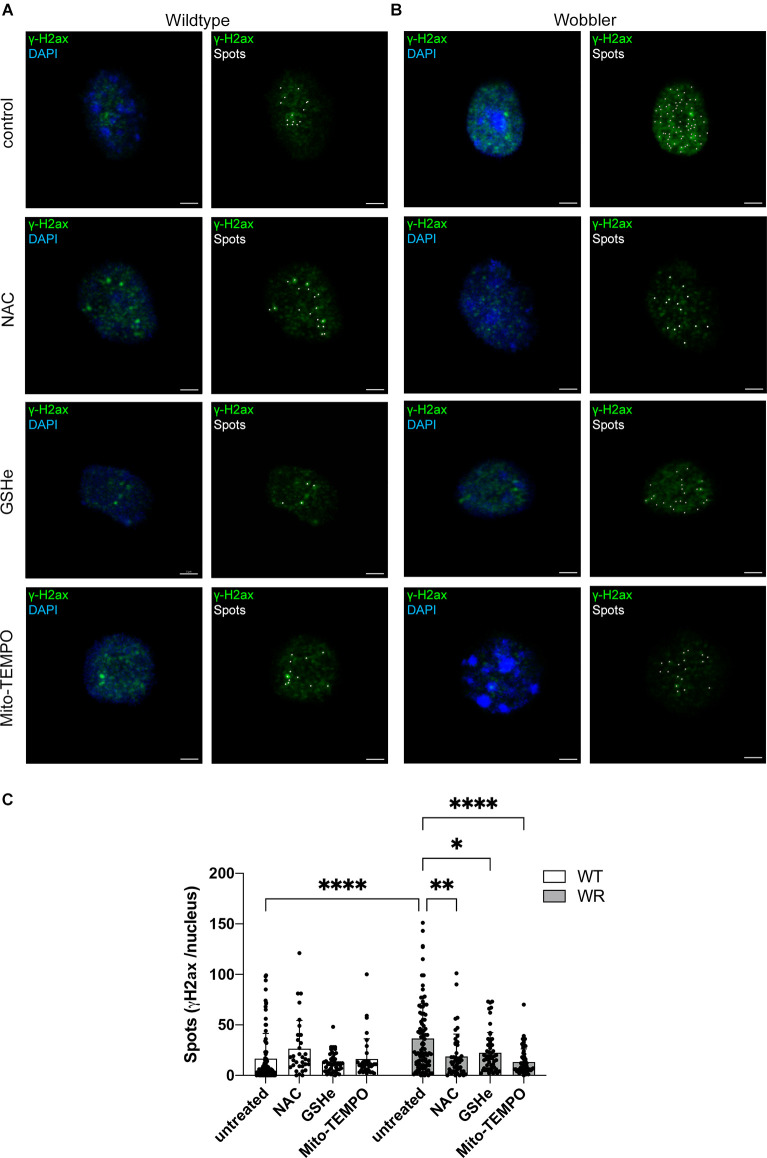
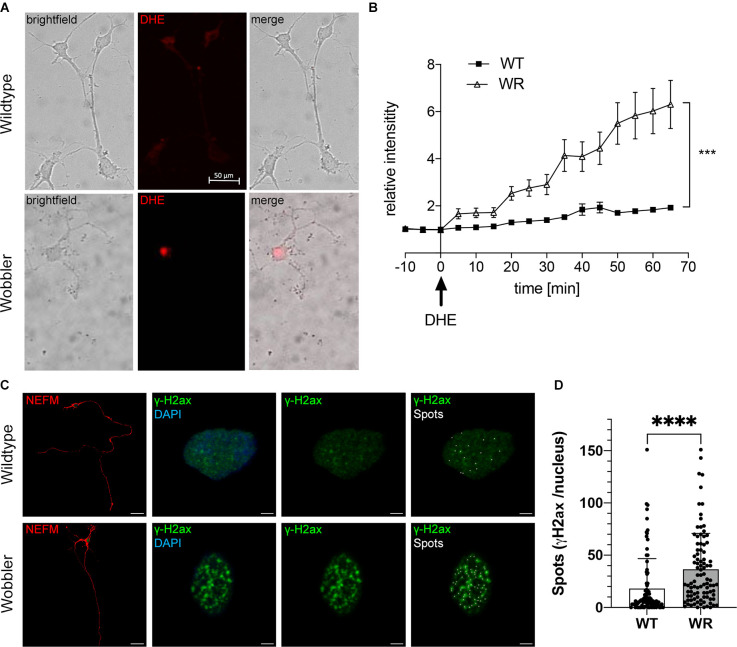
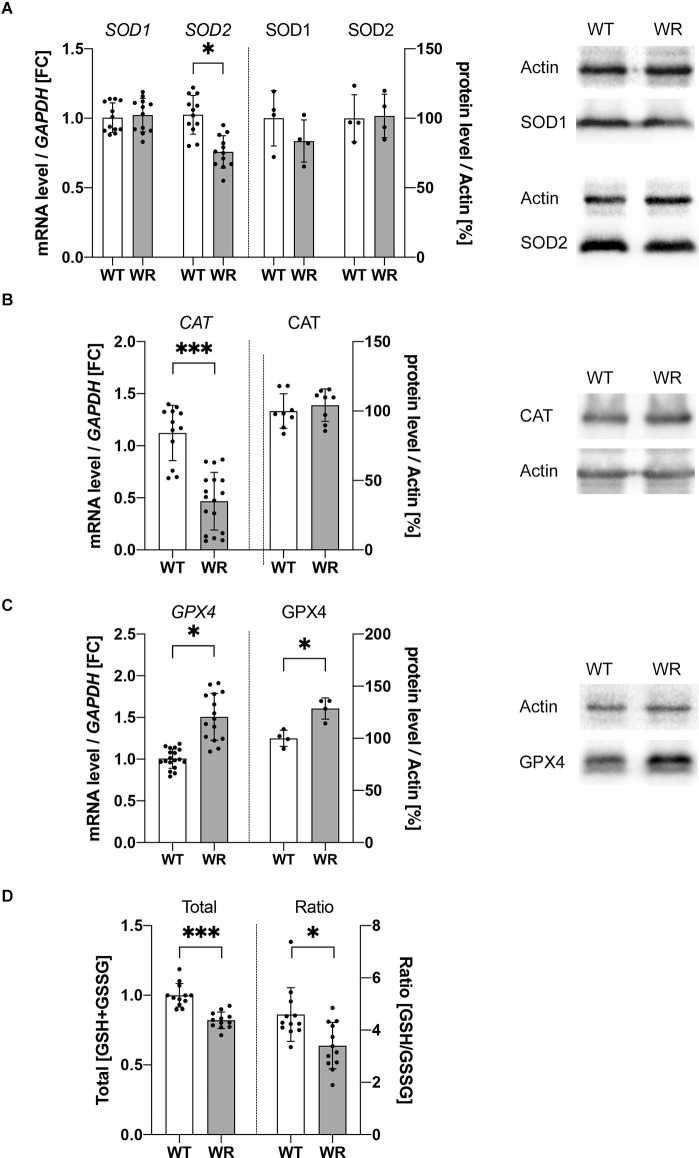
Amyotrophic lateral sclerosis (ALS) is an incurable neurodegenerative disease characterized by the loss of motor neurons in cerebral cortex, brainstem and spinal cord. Numerous studies have demonstrated signs of oxidative stress in postmortem neuronal tissue, cerebrospinal fluid, plasma and urine of ALS patients, without focusing on the specific processes within motor neurons. Thus, we aimed to investigate the relevance of reactive oxygen species (ROS) detoxification mechanisms and its consequences on the formation of toxic/lethal DNA double strand breaks (DSBs) in the ALS model of the Wobbler mouse. Live cell imaging in dissociated motor neuronal cultures was used to investigate the production of ROS using Dihydroethidium (DHE). The expression levels of ROS detoxifying molecules were investigated by qPCR as well as Western blots. Furthermore, the expression levels of DNA damage response proteins p53bp1 and H2ax were investigated using qPCR and immunofluorescence staining. Proof-of-principle experiments using ROS scavengers were performed to decipher the influence of ROS on the formation of DNA double strand breaks quantifying the γH2ax spots formation. Here, we verified an elevated ROS-level in spinal motor neurons of symptomatic Wobbler mice . As a result, an increased number of DNA damage response proteins p53bp1 and γH2ax in dissociated motor neurons of the spinal cord of Wobbler mice was observed. Furthermore, we found a significantly altered expression of several antioxidant molecules in the spinal cord of Wobbler mice, suggesting a deficit in ROS detoxification mechanisms. This hypothesis could be verified by using ROS scavenger molecules to reduce the number of γH2ax foci in dissociated motor neurons and thus counteract the harmful effects of ROS. Our data indicate that maintenance of redox homeostasis may play a key role in the therapy of the neurodegenerative disease ALS. Our results underline a necessity for multimodal treatment approaches to prolong the average lifespan of motor neurons and thus slow down the progression of the disease, since a focused intervention in one pathomechanism seems to be insufficient in ALS therapy.
肌萎缩侧索硬化症(ALS)是一种无法治愈的神经退行性疾病,其特征是大脑皮层、脑干和脊髓中的运动神经元丧失。众多研究已在ALS患者的死后神经元组织、脑脊液、血浆和尿液中证实了氧化应激迹象,但未聚焦于运动神经元内的具体过程。因此,我们旨在研究活性氧(ROS)解毒机制的相关性及其对Wobbler小鼠ALS模型中有毒/致死性DNA双链断裂(DSB)形成的影响。在解离的运动神经元培养物中进行活细胞成像,使用二氢乙锭(DHE)来研究ROS的产生。通过qPCR以及蛋白质免疫印迹法研究ROS解毒分子的表达水平。此外,使用qPCR和免疫荧光染色研究DNA损伤反应蛋白p53bp1和H2ax的表达水平。进行了使用ROS清除剂的原理验证实验,以解读ROS对DNA双链断裂形成的影响,量化γH2ax斑点的形成。在此,我们证实了有症状的Wobbler小鼠脊髓运动神经元中ROS水平升高。结果,在Wobbler小鼠脊髓解离的运动神经元中观察到DNA损伤反应蛋白p53bp1和γH2ax的数量增加。此外,我们发现Wobbler小鼠脊髓中几种抗氧化分子的表达有显著改变,表明ROS解毒机制存在缺陷。通过使用ROS清除剂分子减少解离的运动神经元中γH2ax病灶的数量,从而抵消ROS的有害影响,这一假设得到了验证。我们的数据表明,维持氧化还原稳态可能在神经退行性疾病ALS的治疗中起关键作用。我们的结果强调了采取多模式治疗方法以延长运动神经元的平均寿命从而减缓疾病进展的必要性,因为在ALS治疗中仅针对一种病理机制进行干预似乎是不够的。