Huang Zhipeng, Kayanattil Meghanad, Hayes Stuart A, Miller R J Dwayne
Max Planck Institute for the Structure and Dynamics of Matter, Luruper Chaussee 149, 22761 Hamburg, Germany.
Departments of Chemistry and Physics, University of Toronto, 80 St. George Street, Toronto, Ontario M5S 1H6, Canada.
Struct Dyn. 2022 Sep 16;9(5):054301. doi: 10.1063/4.0000159. eCollection 2022 Sep.
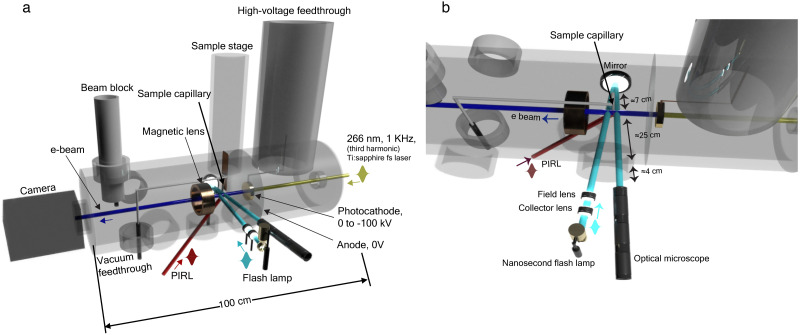
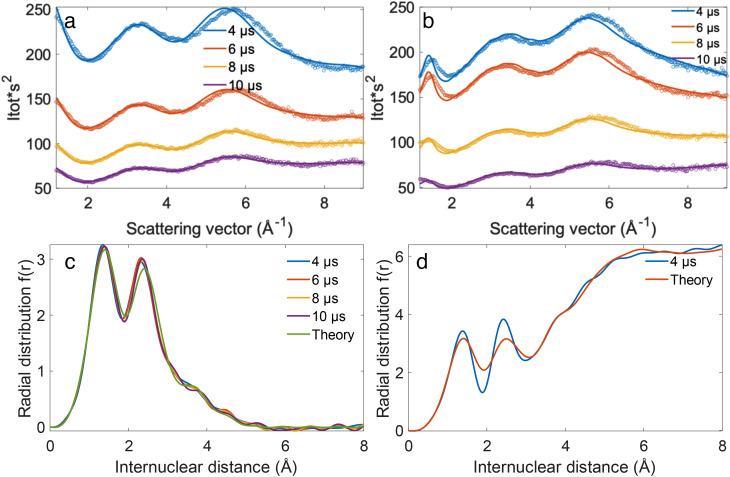
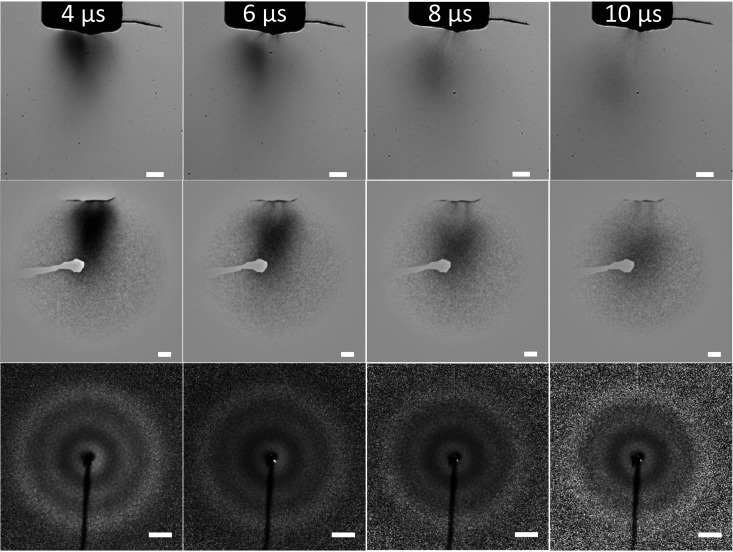
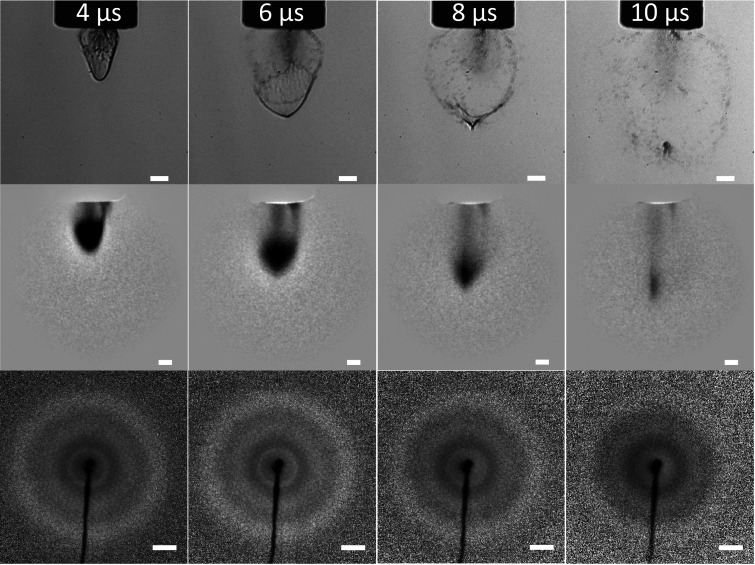
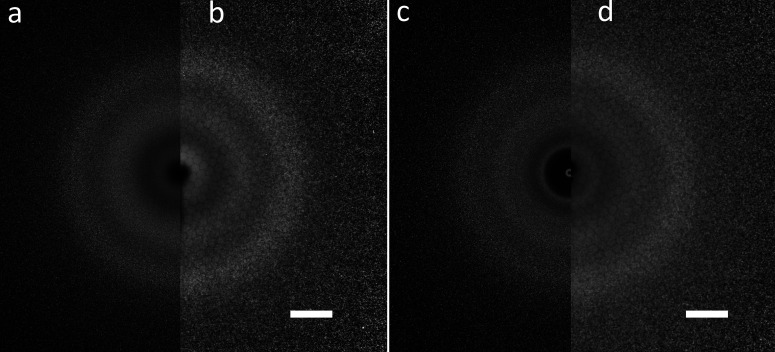
Here, we report on a new approach based on laser driven molecular beams that provides simultaneously nanoscale liquid droplets and gas-phase sample delivery for femtosecond electron diffraction studies. The method relies on Picosecond InfraRed Laser (PIRL) excitation of vibrational modes to strongly drive phase transitions under energy confinement by a mechanism referred to as Desorption by Impulsive Vibrational Excitation (DIVE). This approach is demonstrated using glycerol as the medium with selective excitation of the OH stretch region for energy deposition. The resulting plume was imaged with both an ultrafast electron gun and a pulsed bright-field optical microscope to characterize the sample source simultaneously under the same conditions with time synchronization equivalent to sub-micrometer spatial resolution in imaging the plume dynamics. The ablation front gives the expected isolated gas phase, whereas the trailing edge of the plume is found to consist of nanoscale liquid droplets to thin films depending on the excitation conditions. Thus, it is possible by adjusting the timing to go continuously from probing gas phase to solution phase dynamics in a single experiment with 100% hit rates and very low sample consumption (<100 nl per diffraction image). This approach will be particularly interesting for biomolecules that are susceptible to denaturation in turbulent flow, whereas PIRL-DIVE has been shown to inject molecules as large as proteins into the gas phase fully intact. This method opens the door as a general approach to atomically resolving solution phase chemistry as well as conformational dynamics of large molecular systems and allow separation of the solvent coordinate on the dynamics of interest.
在此,我们报告一种基于激光驱动分子束的新方法,该方法为飞秒电子衍射研究同时提供纳米级液滴和气相样品输送。该方法依赖于皮秒红外激光(PIRL)对振动模式的激发,通过一种称为脉冲振动激发解吸(DIVE)的机制在能量限制下强烈驱动相变。以甘油为介质,通过选择性激发OH伸缩区域进行能量沉积来演示这种方法。用超快电子枪和脉冲明场光学显微镜对产生的羽流进行成像,以便在相同条件下同时表征样品源,时间同步相当于在成像羽流动力学时具有亚微米空间分辨率。烧蚀前沿产生预期的孤立气相,而羽流的后缘根据激发条件被发现由纳米级液滴到薄膜组成。因此,通过调整时间,可以在单次实验中以100%的命中率和极低的样品消耗量(每个衍射图像<100 nl)从探测气相连续过渡到溶液相动力学。这种方法对于在湍流中易变性的生物分子将特别有意义;而PIRL-DIVE已被证明能将大至蛋白质的分子完整地注入气相。该方法作为一种通用方法打开了原子分辨溶液相化学以及大分子系统构象动力学的大门,并允许在感兴趣的动力学上分离溶剂坐标。