Department of Clinical Sciences, Liverpool School of Tropical Medicine, Pembroke Place, Liverpool, L3 5QA, UK.
Behaviour and Health Group, Malawi Liverpool Wellcome Trust- Clinical Research Programme, PO Box 30096, Chichiri, Blantyre 3, Malawi.
BMC Health Serv Res. 2022 Sep 22;22(1):1191. doi: 10.1186/s12913-022-08578-y.
Over one million babies are stillborn or die within the first 28 days of life each year due to preventable causes and poor-quality care in resource-constrained countries. Death audit may be a valuable tool for improving quality of care and decreasing mortality. However, challenges in implementing audit and their subsequent action plans have been reported, with few successfully implemented and sustained. This study aimed to identify factors that affect stillbirth and neonatal death audit at the facility level in the southern region of Malawi.
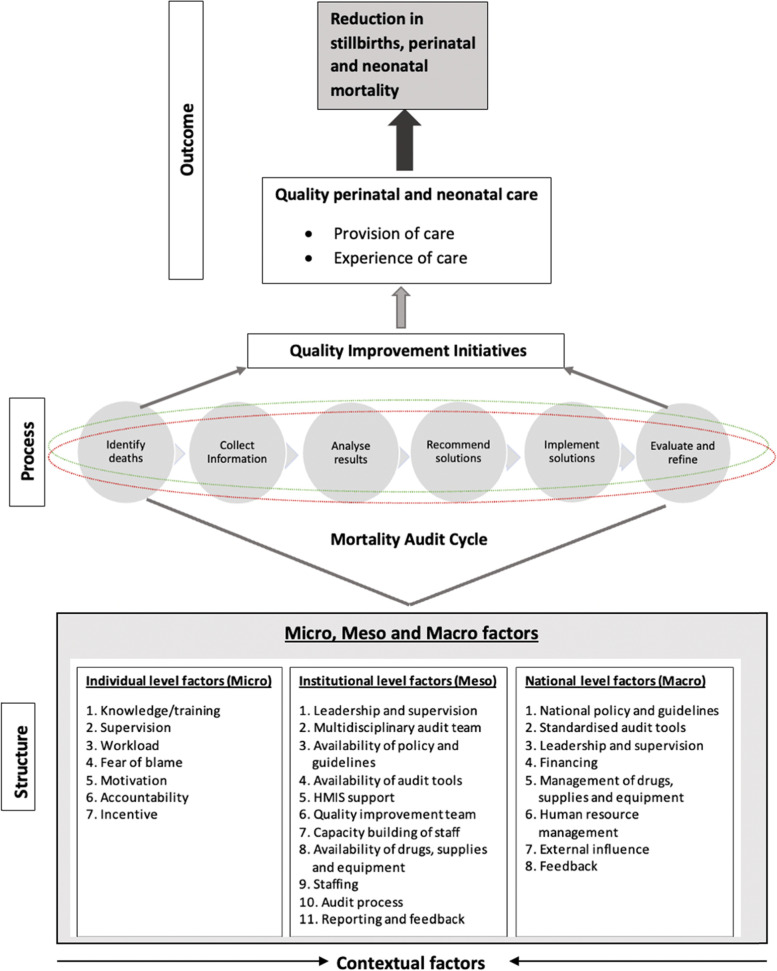
Thirty-eight semi-structured interviews and seven focus group discussions with death audit committee members were conducted. Thematic analysis was guided by a conceptual framework applied deductively, combined with inductive line-by-line coding to identify additional emerging themes.
The factors that affected audit at individual, facility and national level were related to training, staff motivation, power dynamics and autonomy, audit organisation and data support. We found that factors were linked because they informed each other. Inadequate staff training was caused by a lack of financial allocation at the facility level and donor-driven approaches to training at the national level, with training taking place only with support from funders. Staff motivation was affected by the institutional norms of reliance on monetary incentives during meetings, gazetted at the national level so that audits happened only if such incentives were available. This overshadowed other benefits and non-monetary incentives which were not promoted at the facility level. Inadequate resources to support audit were informed by limited facility-level autonomy and decision-making powers which remained controlled at the national level despite decentralisation. Action plan implementation challenges after audit meetings resulted from inadequate support at the facility level and inadequate audit policy and guidelines at the national level. Poor documentation affected audit processes informed by inadequate supervision and promotion of data usage at both facility and national levels.
Given that the factors that facilitate or inhibit audits are interconnected, implementers, policymakers and managers need to be aware that addressing barriers is likely to require a whole health systems approach targeting all system levels. This will require behavioural and complex intervention approaches.
每年仍有超过 100 万婴儿因资源匮乏国家可预防的原因和护理质量差而在生命的头 28 天内仍未出生或死亡。死亡审核可能是提高护理质量和降低死亡率的有用工具。但是,据报道,在实施审核及其后续行动计划方面存在挑战,很少有成功实施和持续的。本研究旨在确定影响马拉维南部地区医疗机构中死产和新生儿死亡审核的因素。
对死亡审核委员会成员进行了 38 次半结构式访谈和 7 次焦点小组讨论。主题分析受应用演绎法指导,结合逐行归纳编码以确定新出现的主题。
影响个体、机构和国家层面审核的因素与培训、员工激励、权力动态和自主权、审核组织和数据支持有关。我们发现,这些因素是相互关联的,因为它们相互影响。机构层面培训资源不足是由于缺乏资金分配,国家层面的培训是由捐助者驱动的,只有在资助者的支持下才能进行培训。工作人员的激励机制受到会议上依赖金钱激励的机构规范的影响,这些规范是在国家层面上规定的,因此只有在有激励措施的情况下才会进行审核。这掩盖了其他在机构层面上没有得到推广的利益和非金钱激励。支持审核的资源不足是由于机构层面的自主权和决策权有限,尽管已经进行了权力下放,但决策权仍由国家层面控制。审核会议后的行动计划实施挑战是由于机构层面的支持不足以及国家层面的审核政策和准则不足造成的。审核过程受到不良影响是由于机构和国家层面的监督和数据使用推广不足。
鉴于促进或阻碍审核的因素是相互关联的,实施者、政策制定者和管理人员需要意识到,解决障碍可能需要针对所有系统级别的整个卫生系统方法。这将需要行为和复杂干预措施。