Gámez-Chiachio Manuel, Sarrió David, Moreno-Bueno Gema
Biochemistry Department, Medicine Faculty, Universidad Autónoma Madrid-CSIC, IdiPaz, 28029 Madrid, Spain.
Centro de Investigación Biomédica en Red-Oncología (CIBERONC), 28029 Madrid, Spain.
Cancers (Basel). 2022 Sep 19;14(18):4543. doi: 10.3390/cancers14184543.
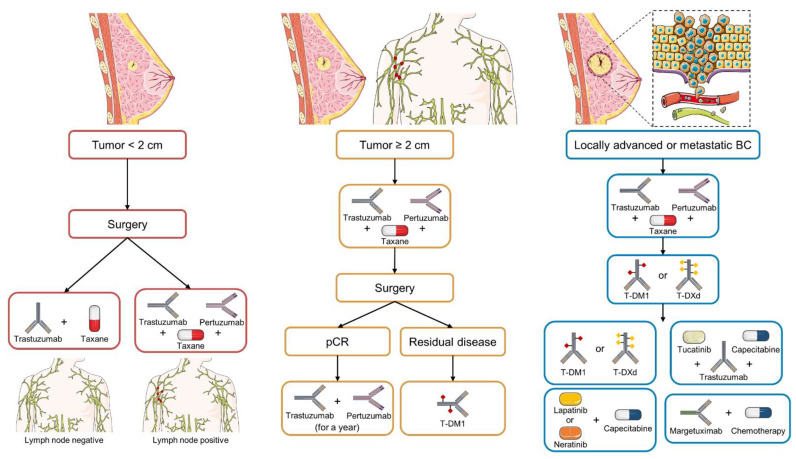
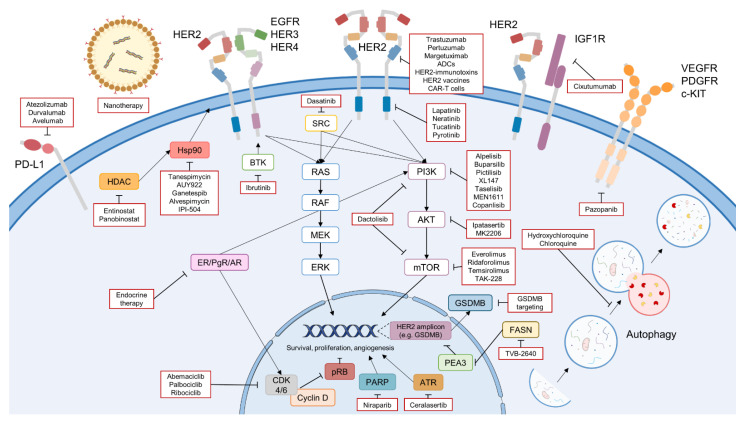
The prognosis and quality of life of HER2 breast cancer patients have significantly improved due to the crucial clinical benefit of various anti-HER2 targeted therapies. However, HER2 tumors can possess or develop several resistance mechanisms to these treatments, thus leaving patients with a limited set of additional therapeutic options. Fortunately, to overcome this problem, in recent years, multiple different and complementary approaches have been developed (such as antibody-drug conjugates (ADCs)) that are in clinical or preclinical stages. In this review, we focus on emerging strategies other than on ADCs that are either aimed at directly target the HER2 receptor (i.e., novel tyrosine kinase inhibitors) or subsequent intracellular signaling (e.g., PI3K/AKT/mTOR, CDK4/6 inhibitors, etc.), as well as on innovative approaches designed to attack other potential tumor weaknesses (such as immunotherapy, autophagy blockade, or targeting of other genes within the HER2 amplicon). Moreover, relevant technical advances such as anti-HER2 nanotherapies and immunotoxins are also discussed. In brief, this review summarizes the impact of novel therapeutic approaches on current and future clinical management of aggressive HER2 breast tumors.
由于各种抗HER2靶向治疗具有关键的临床益处,HER2乳腺癌患者的预后和生活质量有了显著改善。然而,HER2肿瘤可能具有或产生对这些治疗的多种耐药机制,从而使患者的额外治疗选择有限。幸运的是,为克服这一问题,近年来已开发出多种不同且互补的方法(如抗体药物偶联物(ADC)),这些方法正处于临床或临床前阶段。在本综述中,我们关注除ADC之外的新兴策略,这些策略要么旨在直接靶向HER2受体(即新型酪氨酸激酶抑制剂),要么针对后续的细胞内信号传导(如PI3K/AKT/mTOR、CDK4/6抑制剂等),以及旨在攻击其他潜在肿瘤弱点的创新方法(如免疫疗法、自噬阻断或靶向HER2扩增子内的其他基因)。此外,还讨论了抗HER2纳米疗法和免疫毒素等相关技术进展。简而言之,本综述总结了新型治疗方法对侵袭性HER2乳腺肿瘤当前和未来临床管理的影响。