Liu Yuh-Ying, Lin Chih-Lang, Weng Cheng-Hao, Chang Pei-Hung, Chien Cheng-Hung, Huang Kuang-Chen, Hua Man-Chin, Hu Ching-Chih
Liver Research Unit, Department of Gastroenterology and Hepatology, Chang Gung Memorial Hospital, Keelung 20401, Taiwan.
College of Medicine, Chang Gung University, Taoyuan 33302, Taiwan.
Diagnostics (Basel). 2022 Aug 28;12(9):2085. doi: 10.3390/diagnostics12092085.
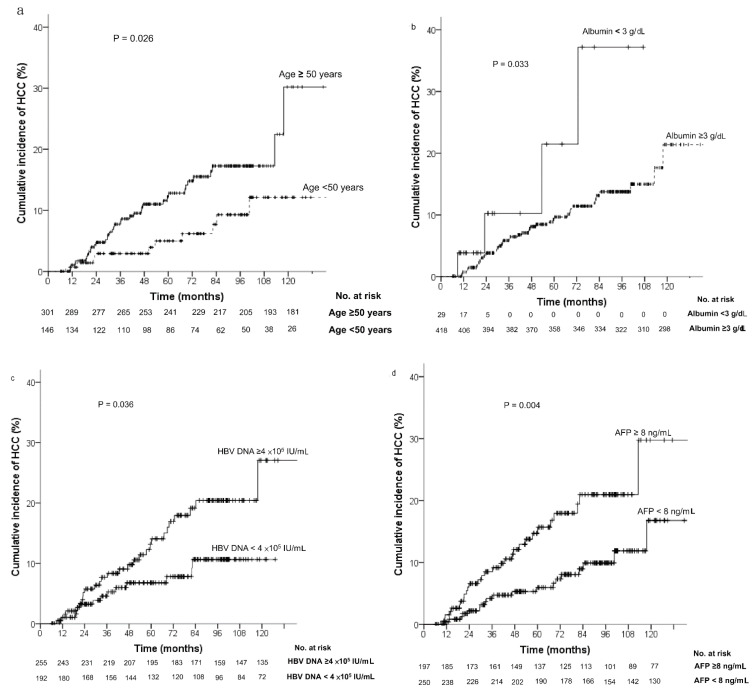
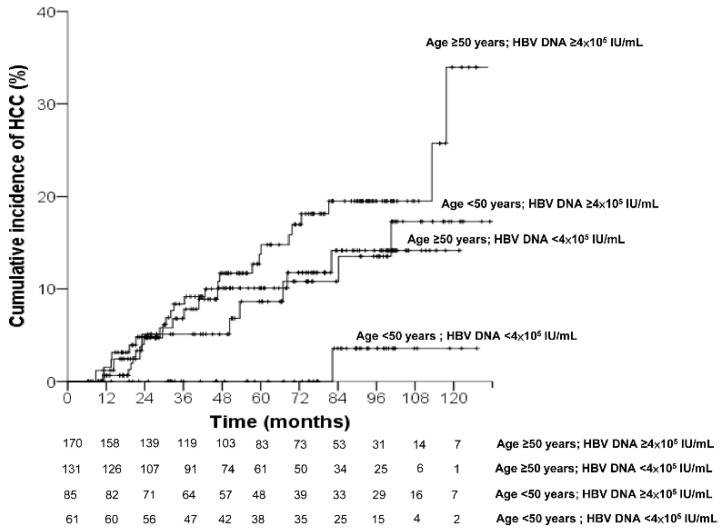
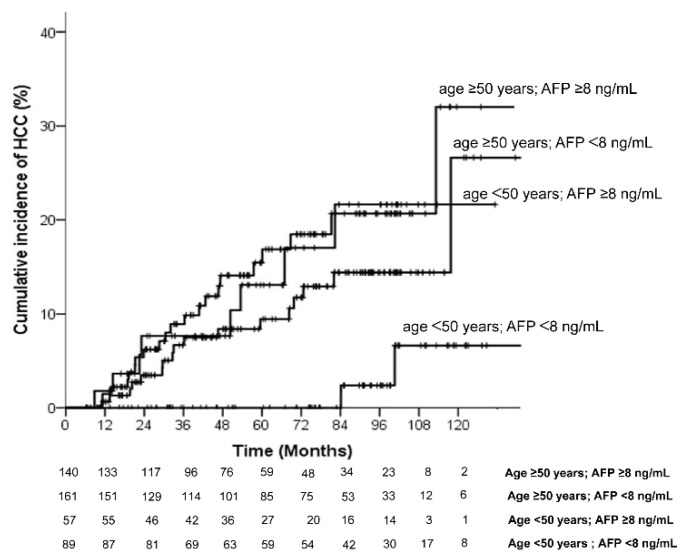
Background: Nucleos(t)ide analogues (NUCs) were proved to reduce hepatocellular carcinoma (HCC) development in chronic hepatitis B (CHB) patients, but data were limited on their efficacy in cirrhotic CHB patients. Methods: A total of 447 cirrhotic CHB patients treated with tenofovir/entecavir were retrospectively analyzed and divided into HCC (n = 48) and non-HCC (n = 399) groups. The median follow-up period was 62.1 months. Results: A total of 48 patients (10.7%) developed HCC during surveillance. The annual incidence rate of HCC was 2.04 per 100 person-years. The cumulative incidence of HCC was 0.9%, 9.8%, and 22.1% at 1, 5, and 10 years, respectively. Significant predictors for HCC identified using a multiple Cox regression analysis were age ≥50 years (hazard ratio (HR): 2.34) and α-fetoprotein (AFP) ≥8 ng/mL (HR: 2.05). The incidence rate of HCC was 8.67-fold higher in patients with age ≥50 years and AFP ≥8 ng/mL (3.14 per 100 person-years) than those with age <50 years and AFP <8 ng/mL (0.36 per 100 person-years). Conclusions: Cirrhotic CHB patients with age <50 years and AFP <8 ng/mL had the lowest annual incidence of HCC. However, those with age ≥50 years or/and AFP ≥8 ng/mL had a significantly higher risk for HCC development and warrant a careful surveillance schedule.
核苷(酸)类似物(NUCs)已被证明可降低慢性乙型肝炎(CHB)患者肝细胞癌(HCC)的发生风险,但关于其在CHB肝硬化患者中的疗效数据有限。方法:对447例接受替诺福韦/恩替卡韦治疗的CHB肝硬化患者进行回顾性分析,并分为HCC组(n = 48)和非HCC组(n = 399)。中位随访期为62.1个月。结果:共有48例患者(10.7%)在监测期间发生HCC。HCC的年发病率为每100人年2.04例。HCC的累积发病率在1年、5年和10年时分别为0.9%、9.8%和22.1%。采用多因素Cox回归分析确定的HCC显著预测因素为年龄≥50岁(风险比(HR):2.34)和甲胎蛋白(AFP)≥8 ng/mL(HR:2.05)。年龄≥50岁且AFP≥8 ng/mL的患者(每100人年3.14例)发生HCC的发病率比年龄<50岁且AFP<8 ng/mL的患者(每100人年0.36例)高8.67倍。结论:年龄<50岁且AFP<8 ng/mL的CHB肝硬化患者HCC年发病率最低。然而,年龄≥50岁或/和AFP≥8 ng/mL的患者发生HCC的风险显著更高,需要制定仔细的监测计划。