Bell Peter A, Scheuermann Sophia, Renner Florian, Pan Christina L, Lu Henry Y, Turvey Stuart E, Bornancin Frédéric, Régnier Catherine H, Overall Christopher M
Centre for Blood Research, Life Sciences Centre, University of British Columbia, Vancouver, BC V6T 1Z3, Canada.
Department of Oral Biological and Medical Sciences, Faculty of Dentistry, University of British Columbia, Vancouver, BC V6T 1Z3, Canada.
Comput Struct Biotechnol J. 2022 Aug 19;20:4717-4732. doi: 10.1016/j.csbj.2022.08.021. eCollection 2022.
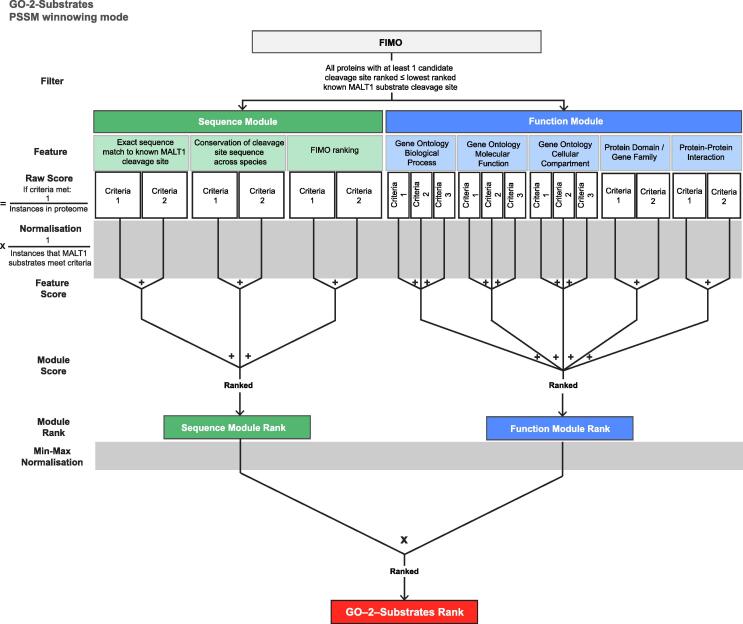
We developed a bioinformatics-led substrate discovery workflow to expand the known substrate repertoire of MALT1. Our approach, termed GO-2-Substrates, integrates protein function information, including GO terms from known substrates, with protein sequences to rank substrate candidates by similarity. We applied GO-2-Substrates to MALT1, a paracaspase and master regulator of NF-κB signalling in adaptive immune responses. With only 12 known substrates, the evolutionarily conserved paracaspase functions and phenotypes of mice strongly implicate the existence of undiscovered substrates. We tested the ranked predictions from GO-2-Substrates of new MALT1 human substrates by co-expression of candidates transfected with the oncogenic constitutively active cIAP2-MALT1 fusion protein or CARD11/BCL10/MALT1 active signalosome. We identified seven new MALT1 substrates by the co-transfection screen: TANK, TAB3, CASP10, ZC3H12D, ZC3H12B, CILK1 and ILDR2. Using catalytically inactive cIAP2-MALT1 (Cys464Ala), a MALT1 inhibitor, MLT-748, and noncleavable P1-Arg to Ala mutant versions of each substrate in dual transfections, we validated the seven new substrates in vitro. We confirmed the cleavage of endogenous TANK and the RNase ZC3H12D in B cells by Western blotting and mining TAILS -terminomics datasets, where we also uncovered evidence for these and 12 other candidate substrates by endogenous MALT1. Thus, protein function information improves substrate predictions. The new substrates and other high-ranked MALT1 candidate substrates should open new biological frontiers for further validation and exploration of the function of MALT1 within and beyond NF-κB regulation.
我们开发了一种以生物信息学为主导的底物发现工作流程,以拓展已知的MALT1底物库。我们的方法称为GO-2-Substrates,它将蛋白质功能信息(包括来自已知底物的基因本体论术语)与蛋白质序列整合起来,通过相似性对底物候选物进行排序。我们将GO-2-Substrates应用于MALT1,它是一种类半胱天冬酶,也是适应性免疫反应中NF-κB信号通路的主要调节因子。尽管已知的底物只有12种,但这种进化上保守的类半胱天冬酶的功能以及小鼠的表型强烈暗示存在未被发现的底物。我们通过共表达转染了致癌性组成型活性cIAP2-MALT1融合蛋白或CARD11/BCL10/MALT1活性信号小体的候选物,来测试GO-2-Substrates对新的MALT1人类底物的排序预测。通过共转染筛选,我们鉴定出了7种新的MALT1底物:TANK、TAB3、CASP10、ZC3H12D、ZC3H12B、CILK1和ILDR2。在双重转染中,我们使用催化无活性的cIAP2-MALT1(Cys464Ala)、一种MALT1抑制剂MLT-748以及每种底物的不可切割的P1-精氨酸到丙氨酸突变体版本,在体外验证了这7种新底物。我们通过蛋白质印迹法和挖掘TAILS -末端蛋白质组学数据集,证实了B细胞中内源性TANK和RNase ZC3H12D的切割,在该数据集中我们还发现了这些底物以及其他12种候选底物被内源性MALT1切割的证据。因此,蛋白质功能信息改善了底物预测。这些新底物和其他排名靠前的MALT1候选底物应该会为进一步验证和探索MALT1在NF-κB调节内外的功能开辟新的生物学前沿领域。